
Research reports & databases
80 publications covering banking, insurance, payments, mortgage lending and asset management across Poland and Central & Eastern Europe.
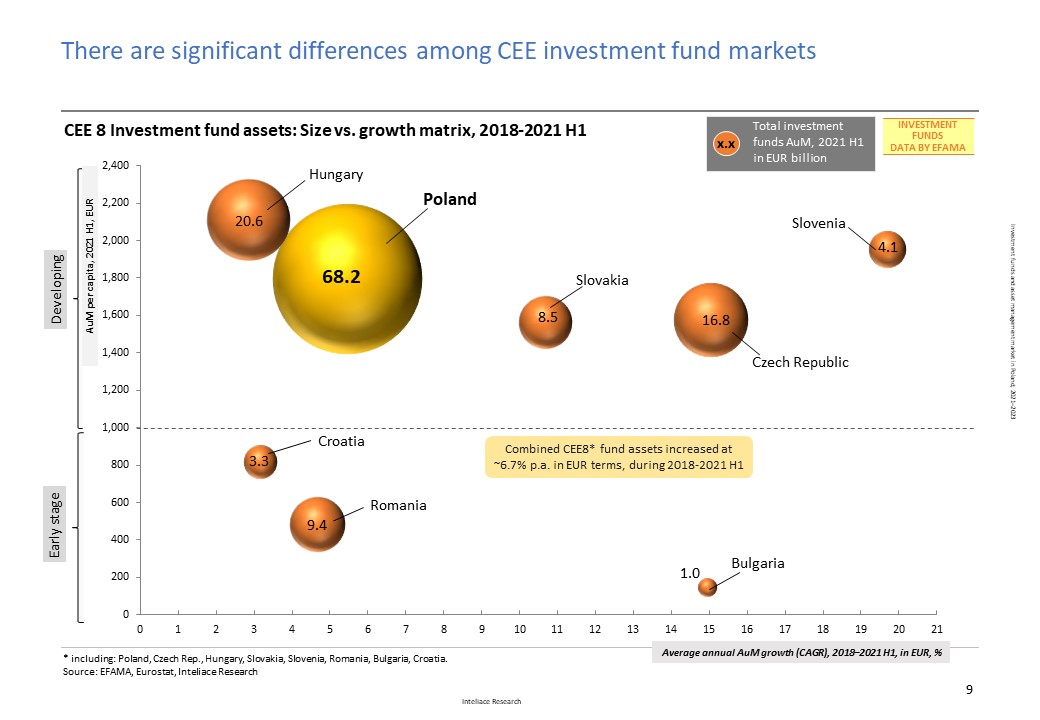
Investment funds and asset management market in Poland, 2021
After multiple years of stagnation, the asset management sector experienced solid growth in H1 2021. Total assets* increased to PLN 702 billion in H1 2021 driven by favourable performance, a few consecutive quarters of positive inflows and an extra boost provided by the launch of new 3rd pillar vehicles (PPK). The outlook Overall assets under management in Poland are expected to grow steadily in 2022 and in following years while negative real interest rates, which are likely to persist, will further benefit investments linked to capital markets relative to no interest bank deposits. Besides investment funds, which are gaining interest of retail investors, it is also the 3rd pillar pension segment which will experience significant new flows with defined contributions driving AuM over initial years of the programme. * Across key categories: Investment funds, Insurance assets, Pension assets (2nd and 3rd pillar); Excluded are bank and structured deposits, equities and bonds held directly by private individuals --------------------------------------------------------------------------------------------------------------------------------------
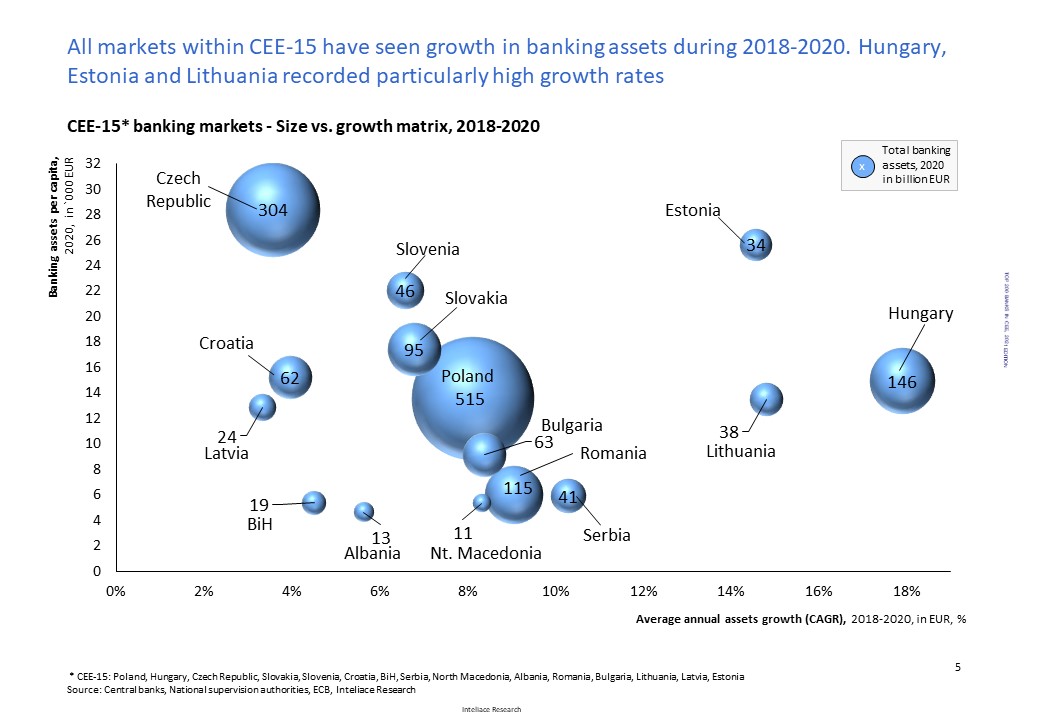
List of Top 200 banks in Central and Eastern Europe /2021 edition/
Total banking assets in CEE15* exceeded EUR 1.5 trillion in December 2020, after adding over 8% last year. Multiple banking markets in the region recorded double digit growth rates, and in a few countries, including Lithuania and Estonia the growth rate exceeded 20%. However, the growth came at the price of profits. Profitability ratios for top CEE banks plunged in 2020 with ROA and ROE falling to 0.53% and 5.0% respectively. The top banking groups in the region did not change and Erste, KBC and UniCredit remaind top banking groups. Nevertheless, the consolidation processes continued with regional players getting stronger, in particular OTP, which continued to consolidate more assets in the southern part of the region. ------------------------------------------------------------------ *CEE15 include: Poland, Czech Republic, Hungary, Slovak Republic, Romania, Bulgaria, Estonia, Latvia, Lithuania, Croatia, Slovenia, Serbia, Bosnia and Herzegovina, Albania, and North Macedonia.
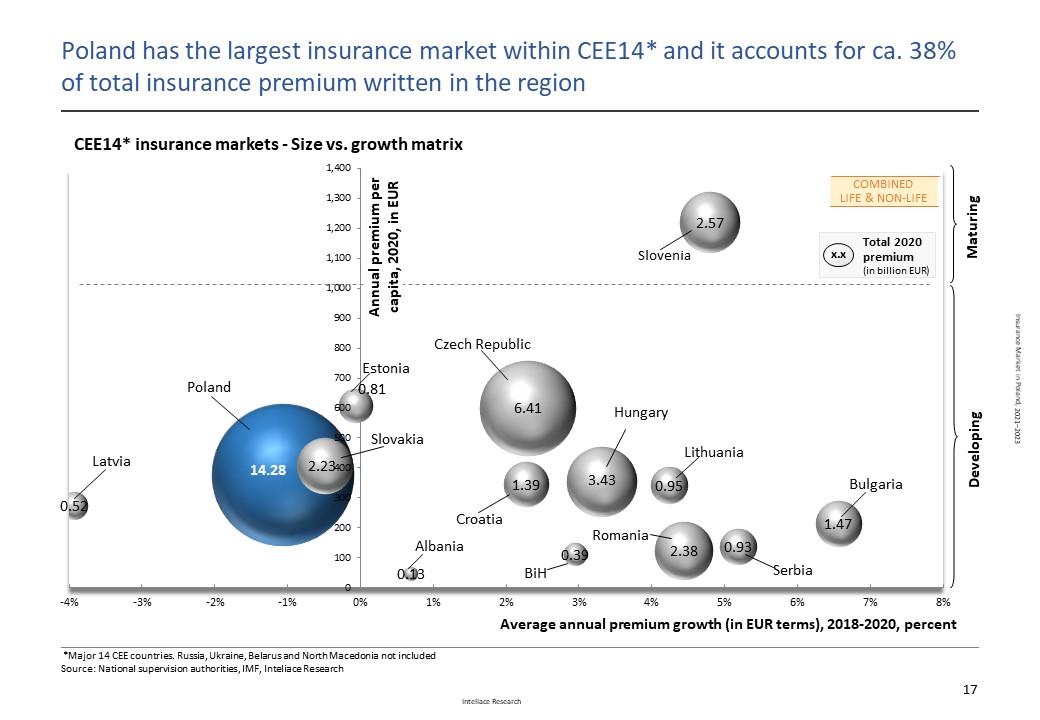
Insurance market in Poland, 2021-2023
Poland has the largest insurance sector in CEE14 (Central and Eastern Europe*) with nearly € 14.3 billion in premium written p.a. and a 38 % share in the region. In 2021, premium is expected to continue its growth, and to add at least 7% and 6% in non-life and in life segment respectively. A few last years have been challenging for insurers in Poland not only because of pandemics and lockdowns, but mostly due to record-low interest rates impacting gains on investments combined with rising operating costs and also considering unfavourable regulatory developments in life insurance segment. All those circumstances combined led to the falling profitability of insurers. In 2020, the net profit of non-life insurers went down by 15% to PLN 3.9 billion while the same benchmark for life insurers dropped 14% to PLN 2.2 billion. Market fragmentation and regulatory requirements result in ongoing market consolidation. After the withdrawal of AXA - acquired by Uniqa and Aegon - to be purchased by VIG, even larger deals were announced last year, e.g. Aviva to be taken over by Allianz and MetLife to be sold to Nationale Nederlanden. The outlook for insures operating in Poland remains positive. The life insurance segment is expected to continue the rebound after a long period of declines caused by the regulatory overhaul. The non-life segment is likely to benefit from the recent appreciation of value of properties, which is caused by accelerating inflation but also by increasing value of insured assets and overall growth in the wealth of individuals. For more information on recent developments in the Polish insurance sector, please refer to the full publication.
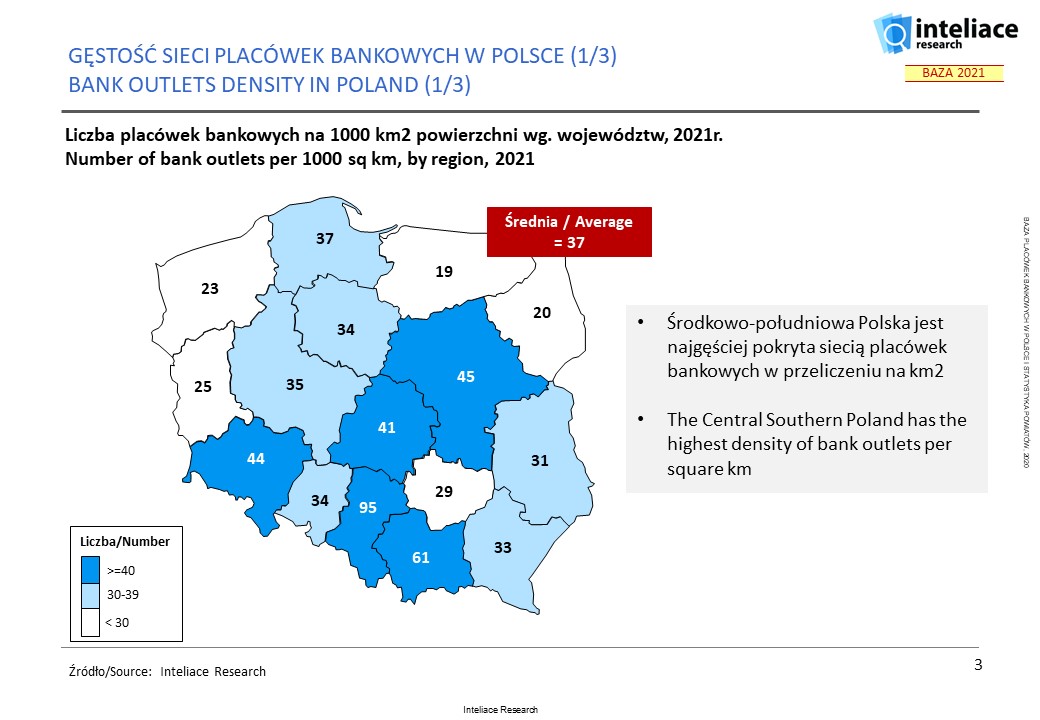
Bank outlets in Poland, 2021
The reduction in bank outlet networks in Poland accelerated in 2020 as increasing cost pressures combined with lockdowns encouraged banks to shut more branches. The total number of outlets fell by nearly 1054 outlets (8%) last year and there were 11,421 operational bank and credit union outlets countrywide as of May 2021. The closing of bank outlets in Poland is expected to persist in future and their number (manned outlets) is likely to fall to 6.5 thousand by 2026.For more information on the current structure of the bank branch network in Poland please refer to the full publication/database.
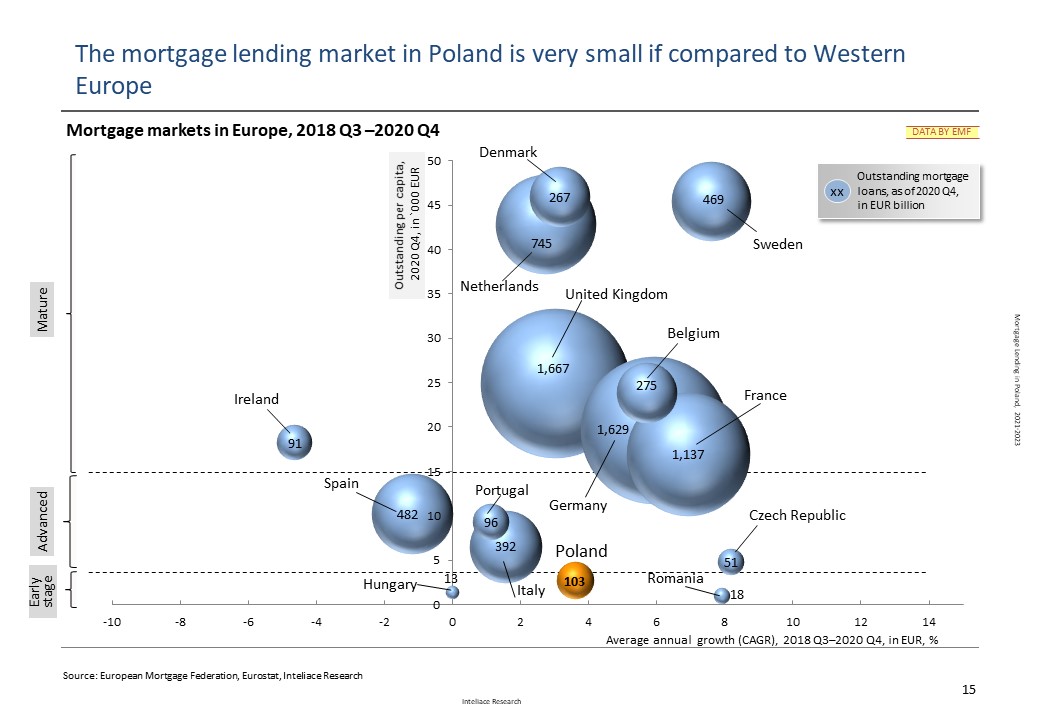
Mortgage lending in Poland, 2021-2023
The residential construction in Poland remained hot in 2020 with home completions increasing by over 7% YoY and reaching a multi-year high at 222k. Nevertheless, there have been also first signs of stabilization with permits growing just by fraction and home starts falling slightly vs. 2019. At the same time, real estate prices continued to climb very fast, fuelled by more and more negative real interest rates and by accelerating CPI, which surpassed 4% in March 2021. By contrast to real estate prices, mortgage lending cooled down slightly with new sales of mortgage loans decreasing by 10% and 3% YoY in terms of volume and value respectively in 2020. Slower sales of new mortgage on the growing real estate market could be attributed mostly to the impact of COVID-19 with lockdowns and stricter lending rules at banks. Nevertheless, mortgage lending is expected to rebound fast once the pandemics eases and it might hit new records already in 2021. For more information on recent developments in the Polish banking sector, please refer to the full publication.