
Raporty i bazy danych
Ponad 82 publikacji obejmujących bankowość, ubezpieczenia, płatności, kredyty hipoteczne i zarządzanie aktywami w Polsce i Europie Środkowo-Wschodniej.
Zdecydowana większość naszych raportów jest dostępna wyłącznie w języku angielskim. Tytuły, opisy i spisy treści poniżej pozostają w oryginale.
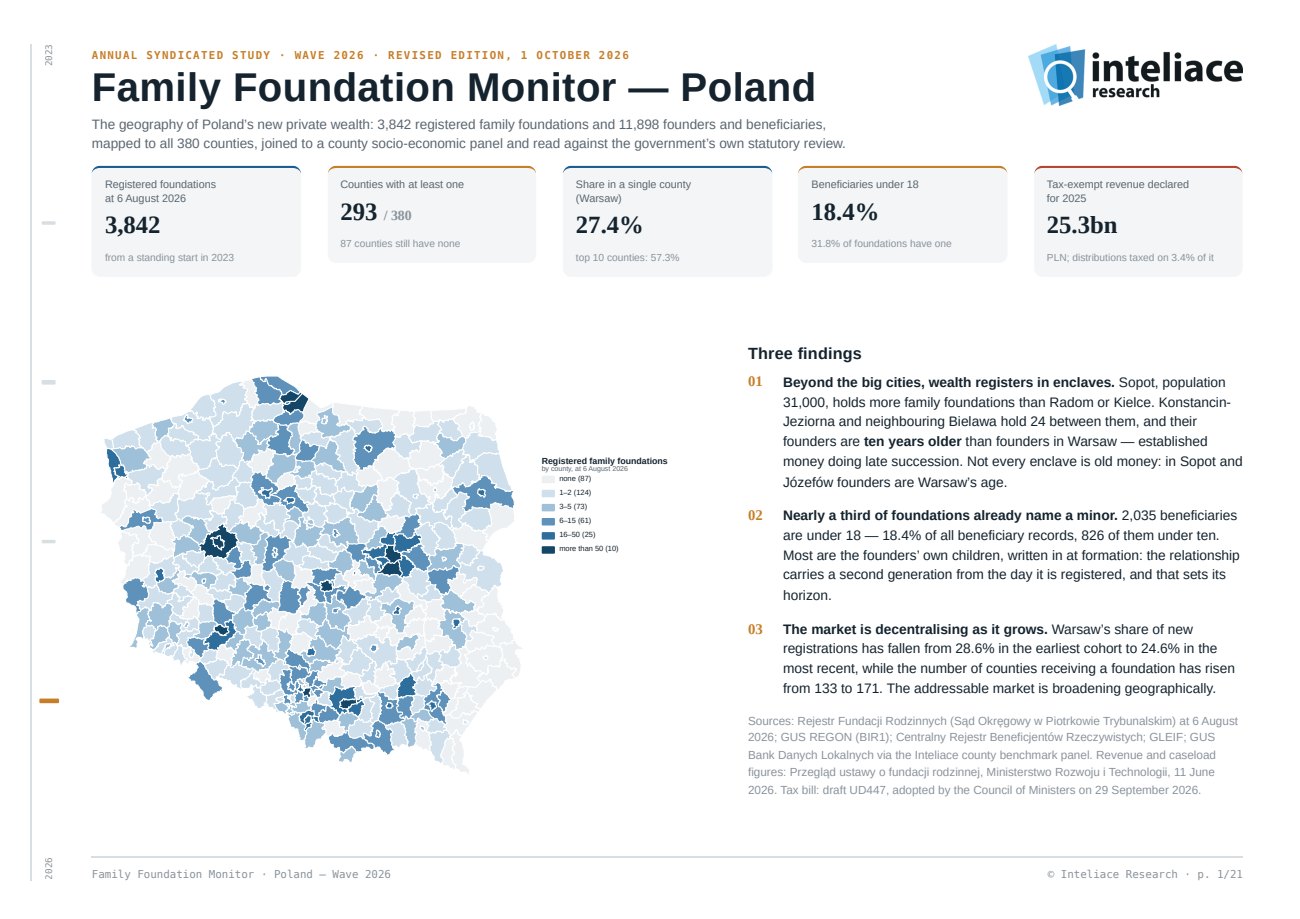
Family Foundation Monitor — Poland 2026
Three years after the family foundation became available in Polish law, 3,842 of them are registered — from a standing start in May 2023. This monitor is a census of the entire register at 6 August 2026: every foundation coded to one of Poland's 380 counties and 844 localities, its founders and beneficiaries drawn from the beneficial-ownership register, and the result joined to a 41-variable county socio-economic panel. It replaces the voivodship-level view of earlier published work with county and locality resolution.
Project Orzeł: Strategic Assessment of a Potential Combination of PKO Bank Polski and Bank Pekao
A combination of PKO Bank Polski and Bank Pekao would create a bank of approximately PLN 976 billion in assets and EUR 217 billion of CEE-controlled banking assets — second only to Erste Group across the entire CEE-16 region, and ahead of UniCredit even after its pending acquisition of Commerzbank brings mBank under its ownership. The case for it is scale: Erste has just acquired a top-five Polish bank worth more than Pekao, and UniCredit's return to the market via mBank restores a Polish franchise of real substance to a second pan-European group. PKO and Pekao, meanwhile, compete against each other in 355 of the 727 localities where either operates — a structural gift to both foreign consolidators.
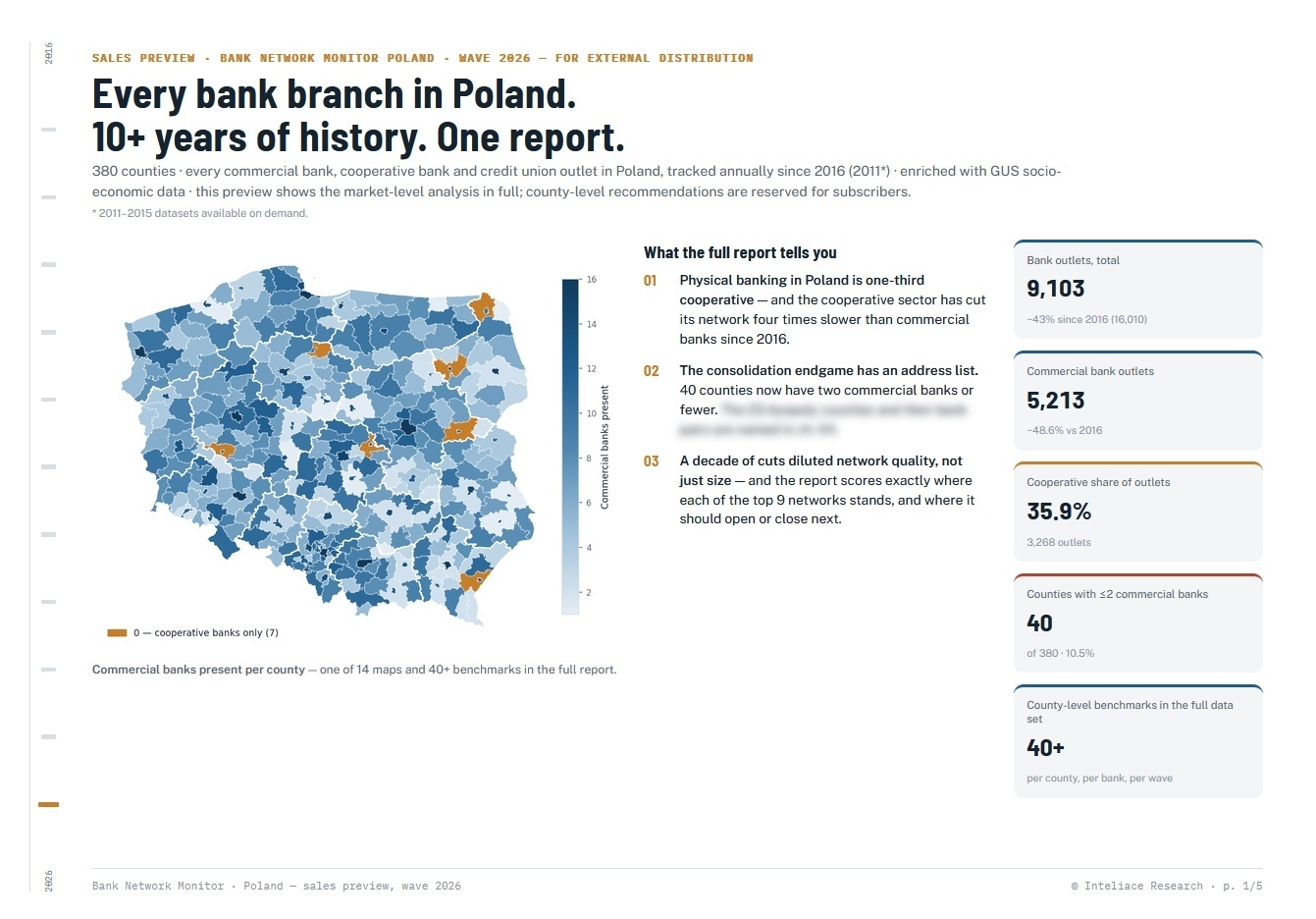
Bank Outlets Monitor, Poland 2026
As of April 2026, Poland had 9,103 bank branches, down 43% from 16,010 in 2016 — but the pace of contraction is slowing. The outlet count fell just 2.0% over the past year, the smallest annual decline on record and the fourth consecutive year of deceleration, down from -10.1% at the 2021 peak. Only 184 branches closed in the past year, compared with more than 1,150 in 2022 alone.
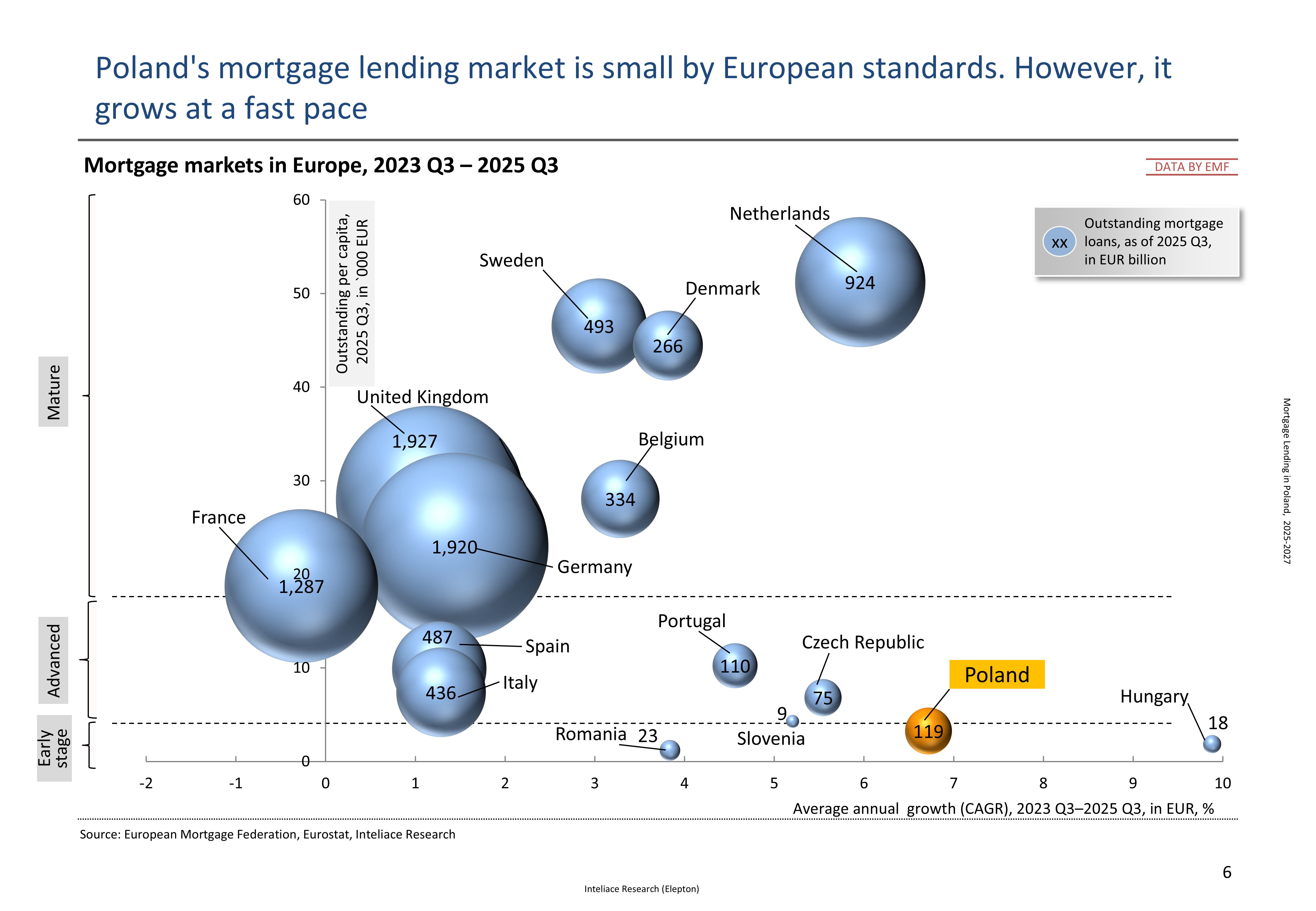
Mortgage lending in Poland, 2026-2028
The housing sector exhibited stabilization throughout 2025. Building permits and housing starts declined slightly, while completions continued to increase modestly, reflecting a balanced market adjustment. Residential real estate prices have consolidated since 2024, stabilizing at current levels without significant upward or downward pressure. This price stabilization, combined with the absence of government subsidy programs, has encouraged a more measured approach among developers and buyers alike. The market appears to have reached an equilibrium where supply and demand dynamics support sustainable activity levels without excessive price volatility. Mortgage lending activity strengthened considerably in Poland in 2025, with new mortgage originations exceeding PLN 103 billion and demonstrating double-digit growth in both value and volume. Despite this robust expansion, the number of active mortgage contracts continues to decline, currently standing at 2.15 million. This contraction reflects ongoing refinancing activity and the systematic closure of legacy foreign-exchange-denominated loans, which have been a persistent challenge for borrowers and lenders alike. The resilience in new lending reflects improved borrower affordability, driven by robust wage growth and tightening labor market conditions. Poland's mortgage market is positioned for moderate growth through 2028, supported by improving affordability dynamics. Wages are expected to continue rising while residential property prices consolidate, collectively enhancing household purchasing power and lending capacity. In a baseline scenario, outstanding mortgage balances are projected to reach PLN 627 billion by 2028, corresponding to approximately 14% of GDP. This represents accelerated growth of 8% year-over-year, compared to the 5% annual growth observed between 2023 and 2025. However, a significant downside risk exists from potential interest rate increases driven by accelerating global inflation and elevated energy prices. Any such monetary tightening could materially constrain borrowing affordability and dampen the projected expansion of mortgage lending activity. For more information on recent developments in the Polish banking sector, please refer to the full publication.
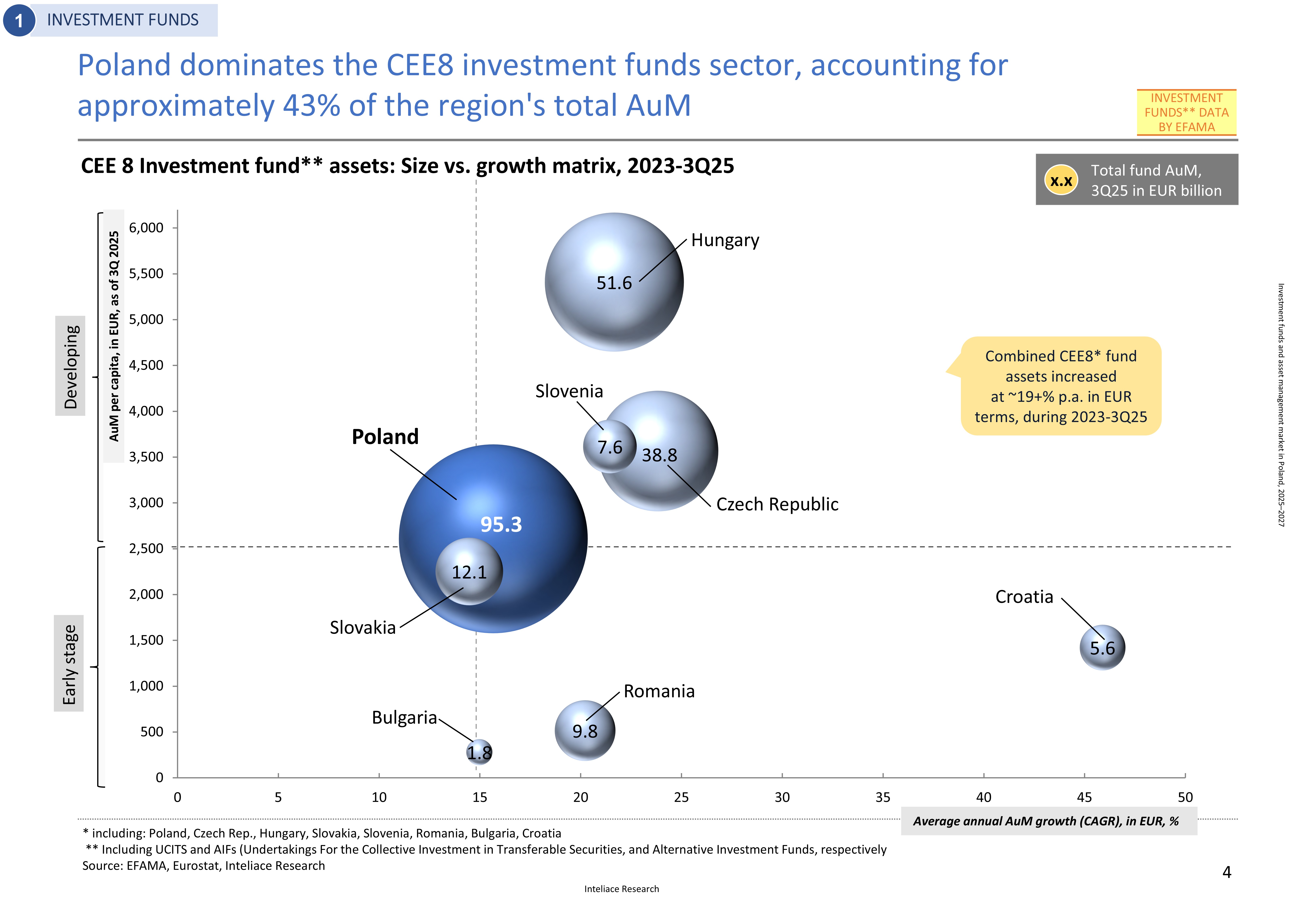
Investment funds and asset management market in Poland, 2025
In recent years, the asset management sector in Poland has demonstrated healthy growth, recovering from the contraction observed in 2022. All key market segments* have experienced consistent expansion, leading to a combined total of PLN 907 billion (EUR 214 billion) in assets under management (AuM) by Q2/Q3 2025. Investment funds remain the dominant segment, with AuM of PLN 390 billion, followed by second-pillar pension funds (OFE) at PLN 270 billion and insurance companies’ reserves at PLN 180 billion.
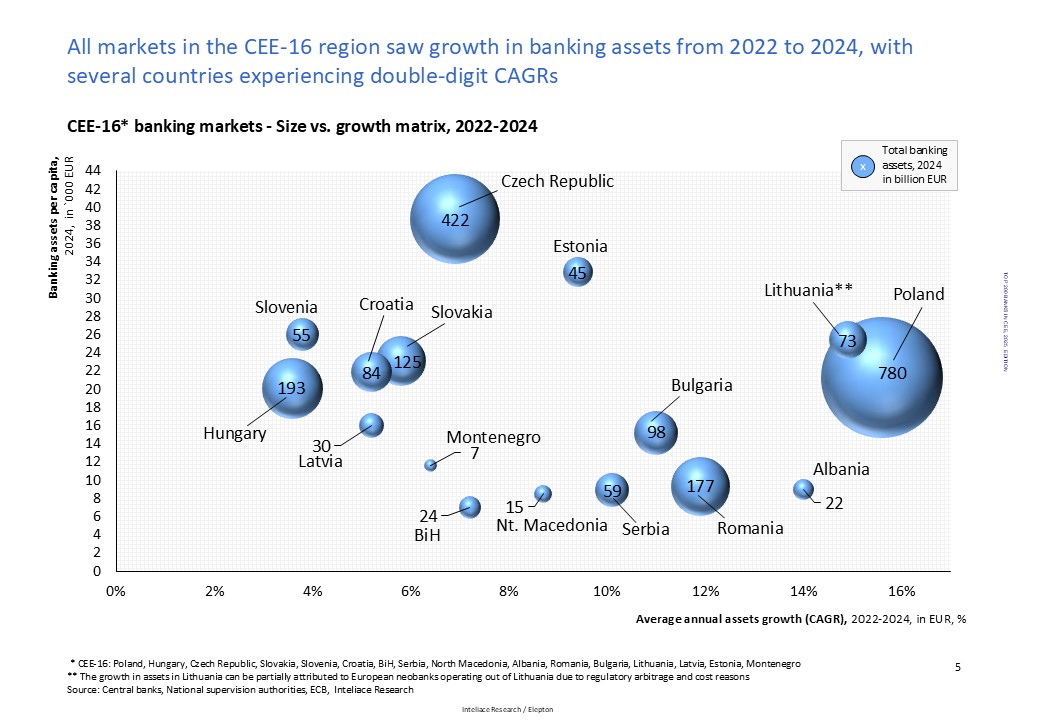
List of Top 200 banks in Central and Eastern Europe /2025 edition/
Total banking assets in the CEE16* region reached a record high of EUR 2.2 trillion by December 2024, reflecting an annual increase of 8.3%. This sustained expansion underscores the continued momentum of the Central and Eastern European banking sector, with nearly all 16 countries contributing positively to growth. Notably, Lithuania, Albania, and Poland stood out with annual growth rates exceeding 12%, highlighting the universal strength of the region’s financial ecosystem.

Insurance market in Poland, 2025-2027
Poland's insurance market continues to demonstrate exceptional resilience and growth potential, according to the latest comprehensive analysis from Inteliace Research. Despite broader economic uncertainties, the sector is capitalizing on the country's position as one of the EU's fastest-growing economies, with total insurance premiums estimated to surpass PLN 90 billion (€21 billion) by end-2025. The Polish economy's remarkable 2.9% GDP growth in 2024, with projections accelerating to 3.2-3.6% in 2025, provides a solid foundation for insurance sector expansion. Recovering consumption patterns, moderating inflation now at 2.9%, and rising wage levels are creating favorable conditions for both life and non-life insurance growth. Market dynamics reveal interesting competitive shifts. While PZU maintains its dominant position with 44% and 27% market share in life and non-life segments respectively, mid-tier competitors like Warta (Talanx) are gaining ground through organic growth strategies, notably surpassing PZU in the large motor TPL segment. The non-life segment continues outperforming expectations, projected to reach PLN 66 billion (€15.5 billion), significantly outpacing the life segment at PLN 24.5 billion (€5.7 billion). Digital transformation is reshaping distribution channels, with price comparison platforms expanding rapidly and providing enhanced consumer choice while intensifying competition. Corporate agents and multi-agents now account for the largest sales volume portion, while direct insurer distribution gradually declines in importance. Looking ahead, the medium-term outlook through 2027 remains highly favorable. Strong private consumption, investment activity, and wealth accumulation support new premium growth, with combined life and non-life premiums forecast to exceed PLN 103 billion (€24+ billion) by 2027. Poland's commanding 39% share of the Central and Eastern Europe insurance market, valued at ~€53 billion, underscores its regional significance. For more information on recent developments in the Polish insurance sector, please refer to the full publication.
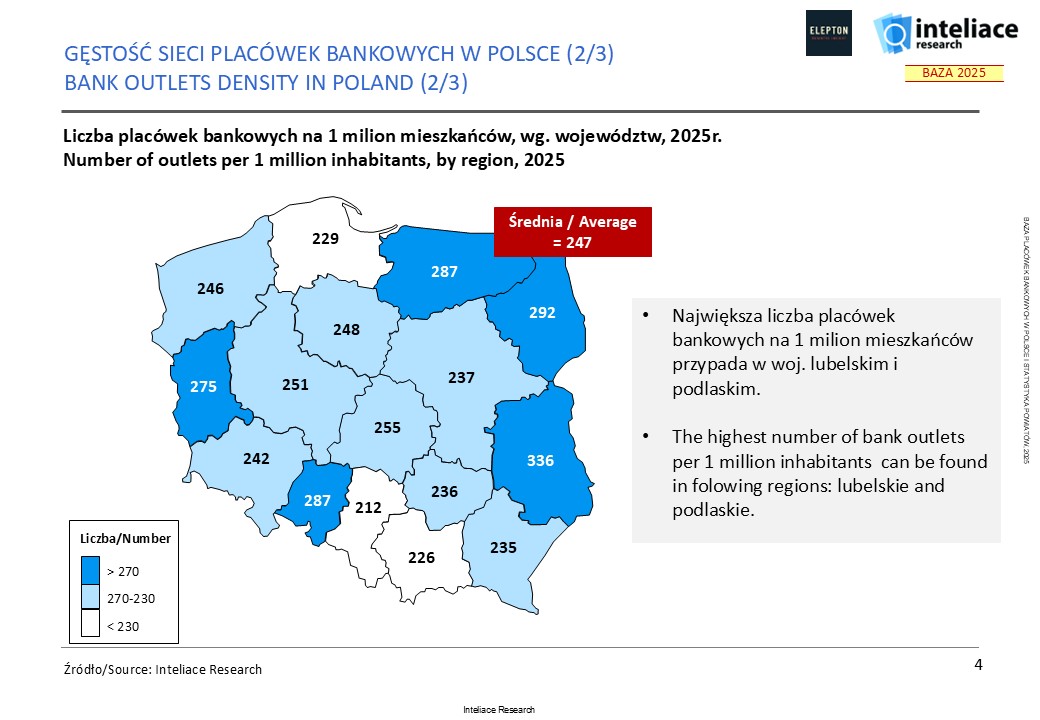
Bank outlets in Poland, 2025
Bank outlets in Poland - network size near equilibrium As of April 2025, Poland had a total of 9,287 bank branches. The number declined by 2.2% during the previous 12-month period, which is in line with the long-term trend of reducing bank distribution networks. However, the pace of closures has significantly slowed down. This may indicate that banks are nearing a minimal viable branch network size, where further reductions could risk alienating customers and negate the cost savings from fewer operational branches. In the past year, 206 bank branches were closed in Poland, a notable decrease compared to the period before, which experienced more than 350 closures annually. The recent reduction has been particularly pronounced in urban areas, where banks are consolidating their operations by closing redundant branches. As a result, urban regions now have fewer branches per capita than rural areas, although they still maintain a higher density of branches per square kilometer. This shift reflects a strategic focus among banks on ensuring essential access in sparsely populated regions while optimizing resources in cities. Major banking centers like Warsaw, Kraków, and Wrocław continue to host the highest number of branches, with 375, 162, and 141 branches, respectively, despite an overall decline in branch numbers within these cities. Interestingly, some mid-sized cities, such as Rzeszów and Bydgoszcz, have seen a slight increase in branch numbers. This suggests that banks may be intentionally strengthening their physical presence in specific locations to remain competitive and foster customer loyalty. Regional developments and new investment projects might also encourage banks to open new outlets to attract additional customers. For more information on the current structure of the bank branch network in Poland, please refer to the full publication/database.
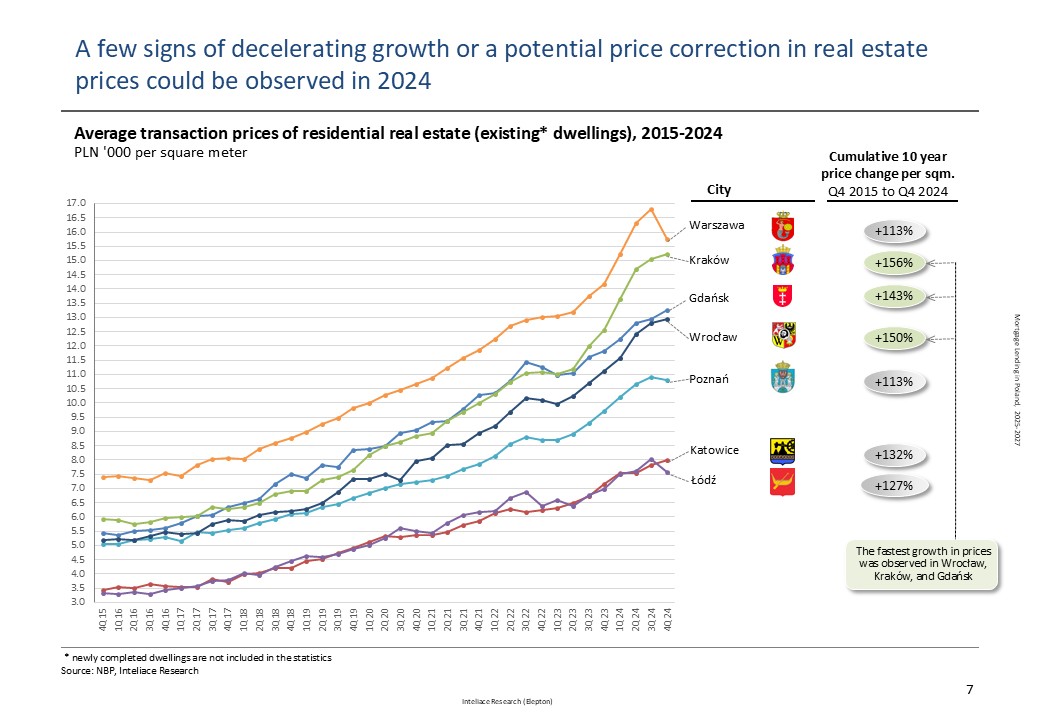
Mortgage lending in Poland, 2025-2027
The housing sector reflected divergent trends in 2024. While building permits and housing starts recovered, completions declined to 200,000 units (down from 221,000 in 2023). This contraction can be linked to persistently elevated real estate prices and the discontinuation of government subsidy programs. Developers have adopted a cautious approach by delaying sales amid softening demand at current price levels, potentially anticipating renewed first-time buyer incentives. Notably, the absence of such subsidies in 2024 contributed to moderating property price inflation, though future policy support remains uncertain. Poland’s mortgage market is poised for steady growth through 2027, supported by sustained economic momentum and improving housing affordability. Despite the lack of confirmed government interventions for first-time buyers, moderating property prices and rising disposable incomes are expected to sustain lending volumes. Under a baseline scenario (assuming no major policy shifts), outstanding mortgage balances are projected to reach PLN 647 billion by 2027, with the mortgage-to-GDP ratio recovering from 13% to 15%. A critical risk to this outlook remains the trajectory of interest rates. The Monetary Policy Council (RPP) faces mounting pressure to sustain a restrictive monetary policy to offset expansionary fiscal measures. Any recalibration of rates—whether upward or downward—would materially influence borrowing costs, affordability, and ultimately, lending activity. For more information on recent developments in the Polish banking sector, please refer to the full publication.
Payments in Poland, 2025
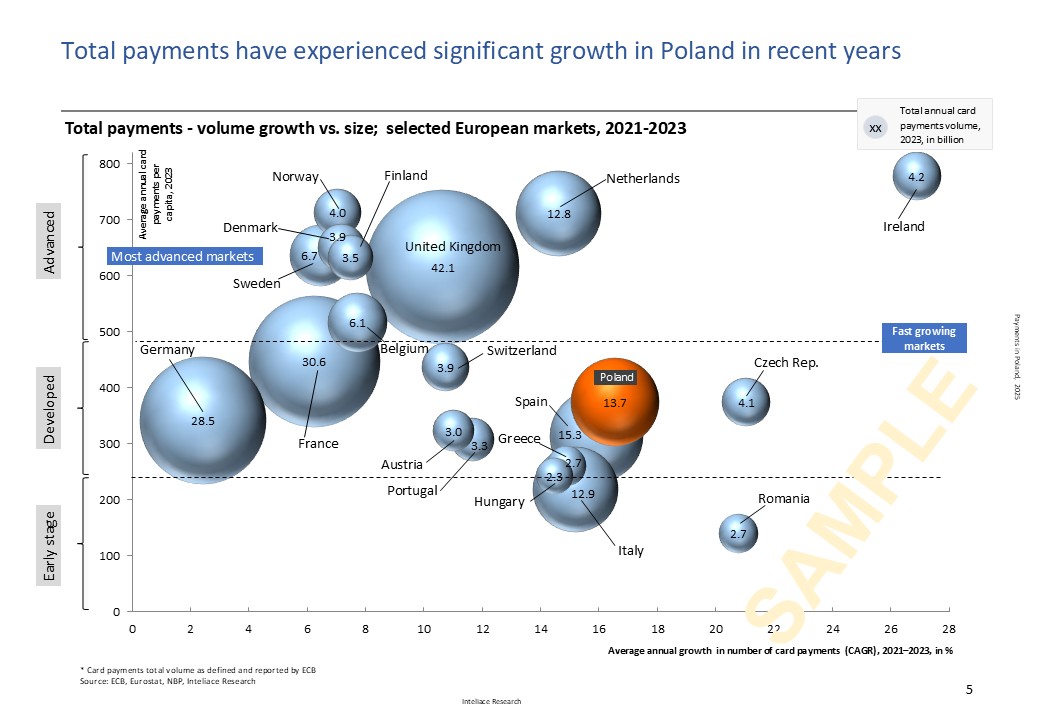
Poland's payment market continued its rapid expansion through 2024. The total number of payments in Poland exceeded 15.4 billion transactions, or approximately 420 transactions per capita, marking a robust 12% year-over-year growth. The largest portion of payment volumes—approximately 10 billion transactions—can be attributed to payment cards, which account for roughly 65% of all payments processed in the country. The remaining volume is almost evenly split between ACH credit transfers and BLIK, the leading domestic mobile payment system. In a broader European context, Poland ranks fifth in terms of payment volume, trailing only the UK, Germany, France, and Spain. Outlook The payments market is currently in a phase of rapid growth, and barring extraordinary events, this trajectory is expected to continue at least through 2026. As the Polish economy expands and eCommerce volumes are projected to grow further, the payments market is likely to sustain double-digit growth over the next two years. Key drivers will include the continued expansion of BLIK—which is expected to contribute the most—and payment cards, which, despite slower growth, will still account for a significant share of overall volume increases. Additionally, Express Elixir volumes, closely linked to BLIK, may experience a surge once payment deregulation progresses. However, there are a number of risk factors to consider moving forward, including regulatory issues. Although Poland is part of the Single Euro Payments Area (SEPA), it is not a Eurozone member. This status has allowed Poland to partially delay implementing extensive EU regulatory frameworks in the payments sector—historically benefiting local financial institutions but potentially dampening innovation. The significant upcoming changes affecting retail transactions and the shift towards real-time payments could have a substantial impact, although the outcome remains difficult to project. --------------------------------------------------------------------------------------------------------------------------------------
Investment funds and asset management market in Poland, 2024
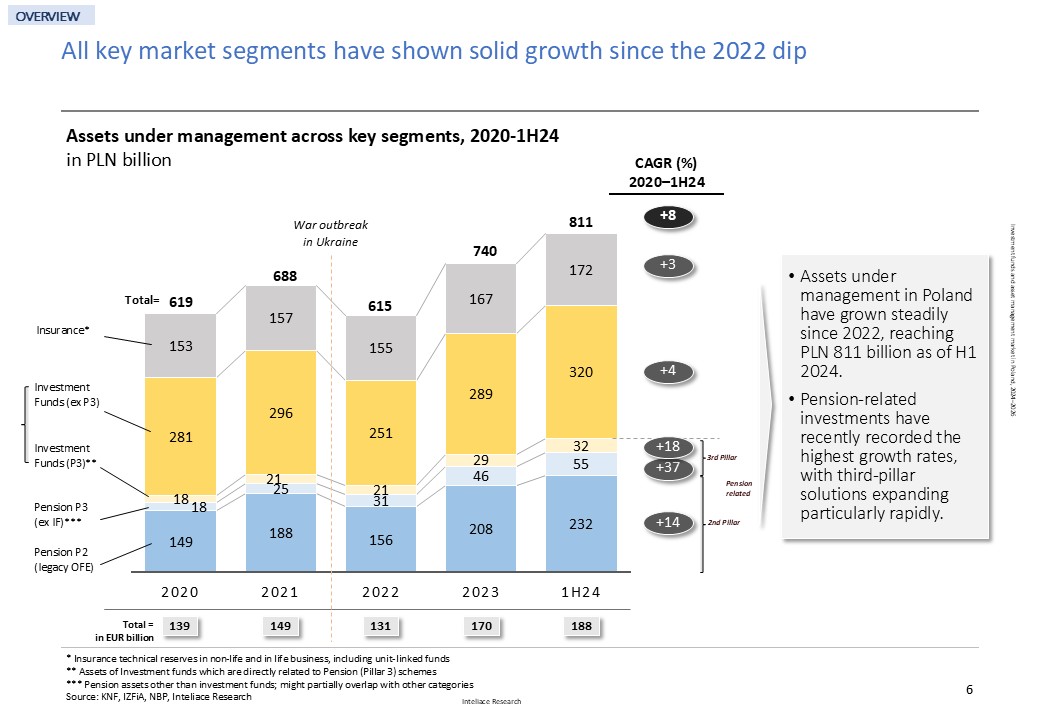
Over the past two years, the asset management sector in Poland has shown healthy growth, recovering from the contraction seen in 2022 due to geopolitical tensions following the outbreak of the war in Ukraine. Since late 2022, all key market segments have experienced consistent expansion, leading to a combined total* of PLN 811 billion (EUR 188 billion) in assets under management (AuM) by the first half of 2024. Investment funds remain the dominant segment, with AuM of PLN 352 billion, followed by second-pillar pension funds (OFE) at PLN 232 billion, and insurance companies’ reserves at PLN 172 billion. The most dynamic growth has been observed in third-pillar pension funds, which reported a remarkable increase in AuM, reaching PLN 55 billion (excluding PPK) as of June 2024. Market leadership in the asset management industry is concentrated among a few key players. PZU holds the leading position, managing PLN 163 billion in assets and capturing a 21% market share. Allianz follows with AuM of PLN 97 billion and a 13% share. Two mid-tier players, Nationale Nederlanden and PKO, each command approximately 9% of the market. Collectively, the top four players account for over 52% of the total market share, highlighting the fairly consolidated nature of the industry. Poland has the largest investment funds sector in Central and Eastern Europe, with over 86 billion EUR in assets under management (AuM). Recently, the growth of fund assets in Poland has accelerated, and the country's share of the region's AuM exceeded 45% in 3Q 2024. However, despite having the highest market value, Poland still lags behind some of its peers in terms of asset value per capita and assets relative to GDP. The outlook The asset management market, which includes three main segments—investment funds, insurance reserves, and pension assets—is expected to grow by more than 25% between the first half of 2024 and 2026. By December 2026, total assets under management (AuM) are projected to exceed PLN 1 trillion, with particularly strong growth anticipated for pension assets. *key categories included: Investment funds, Insurance assets, Pension assets (2nd and 3rd pillar); Excluded are bank and structured deposits, equities, and bonds held directly --------------------------------------------------------------------------------------------------------------------------------------
List of Top 200 banks in Central and Eastern Europe /2024 edition/
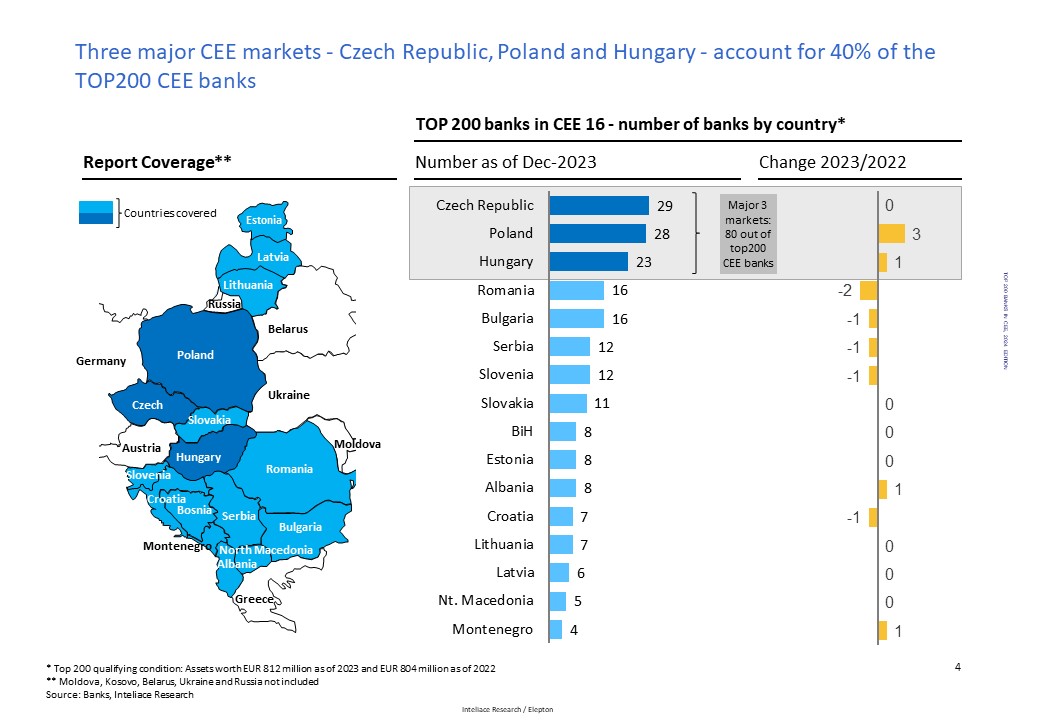
Total banking assets in CEE16* exceeded EUR 2.06 trillion as of December 2023 after growing by approximately 11.8% YoY. The year 2023 marked another robust performance for banks operating in Central and Eastern Europe (CEE16*), as the region experienced a significant asset growth of approximately 11.8% YoY, reaching a combined €2.06 trillion by December 2023 for the 16 countries in the region. The expansion in the CEE financial sector was evident in nearly all countries within the region, with some markets like Lithuania, Poland, and Hungary achieving double-digit growth rates. This recent surge in financial markets across CEE is a testament to the thriving economies, supported by healthy GDP growth and increasing individual incomes. Remembering the challenging year of 2020, when bank profits experienced a significant hit and key profitability benchmarks were more than halved, regional bankers have shown optimism with a gradual improvement in profitability since 2021. By 2023, the average Return on Assets (ROA) for the top 200 CEE banks reached 1.28%, while the average Return on Equity (ROE) was 11.5%. These figures represent a clear recovery and even surpass pre-pandemic levels, indicating a robust return to financial health. Moreover, the ongoing consolidation in the banking sector suggests a future dominated by a handful of top players who will effectively control the CEE markets. This trend towards consolidation around leading groups like Erste, KBC, PKO Bank, OTP, UniCredit, and Raiffeisen is likely to enhance market stability and drive further growth. For more information about developments in the banking sectors in CEE, please review the full publication. ------------------------------------------------------------------ *CEE16 include: Poland, Czech Republic, Hungary, Slovak Republic, Romania, Bulgaria, Estonia, Latvia, Lithuania, Croatia, Slovenia, Serbia, Bosnia and Herzegovina, Albania, Montenegro and North Macedonia.
Insurance market in Poland, 2024-2026
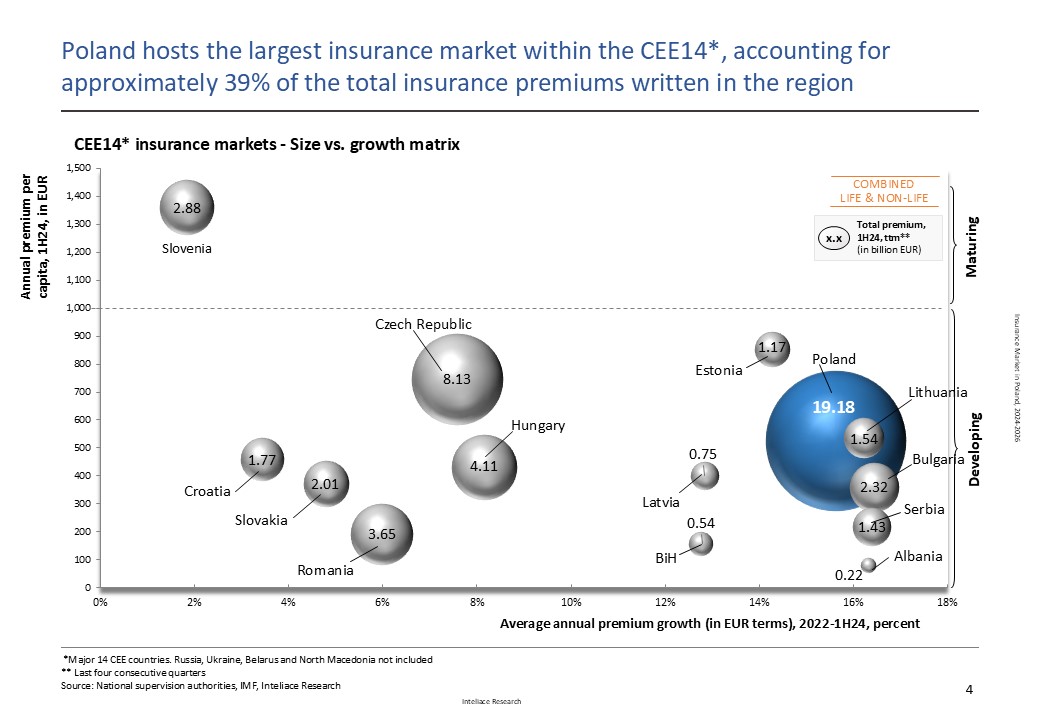
As of H1 2024, Poland, with nearly €19.2 billion in gross written premiums (GWP), accounted for approximately 39% of the total regional premium in Central and Eastern Europe. (CEE14*) Poland’s insurance sector experienced solid premium growth in 2023, with these trends continuing through the first half of 2024. The non-life segment performed particularly well, with premiums increasing by 12% year-on-year in H1 2024. In the life insurance segment, growth was lower but still significant, with premiums rising nearly 5% on an annual basis. Consistent with long-term trends, a small number of top insurers continue to expand their market share, while the collective share of smaller players is declining. This trend is likely driven by recent mergers and acquisitions (M&A) and the economies of scale enabling larger insurers to offer more competitive rates. The mid-term outlook for premium income remains positive. Projections suggest that from 2024 to 2026, the nominal growth of gross written premium (GWP) will remain stable, albeit slightly below historical averages, at approximately 8% for the non-life segment and 5% for the life segment. By 2026, combined life and non-life insurance premiums are expected to exceed PLN 98 billion (EUR 23+ billion). For more information on recent developments in the Polish insurance sector, please refer to the full publication.
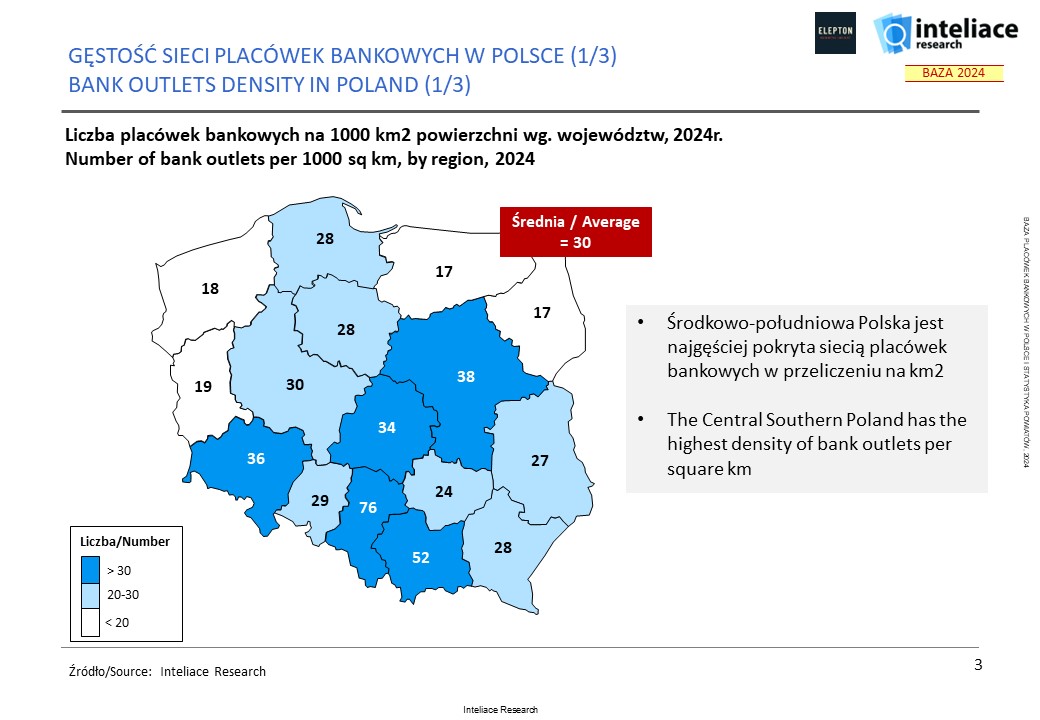
Bank outlets in Poland, 2024
Decline in Polish Bank Branches Slows As of April 2024, the total number of bank branches in Poland has decreased to below 9500, marking a 3.6% year-on-year decline. This ongoing reduction in bank networks mirrors previous trends, yet it's noteworthy that this year's closure rate is the lowest in over a decade. It remains uncertain whether this slowdown indicates that banks are nearing a minimal viable network size, where further closures could lead to significant customer loss, outweighing the savings from reduced operating costs. Over the past year, more than 350 branches were closed. Consequently, there are now approximately 4,000 individuals for each bank branch. Access to branches is predominantly easier in urban areas compared to rural regions. Lately, banks have shown a preference for shutting down excess urban branches rather than eliminating the sole service points in sparsely populated areas. The major banking centers like Warsaw, Kraków, and Wrocław continue to lead with 387, 165, and 144 branches respectively. There is an increasing trend of banks exercising caution before closing last branches in mid-sized and smaller cities to avoid losing customers who value in-person banking services—predominantly older individuals who eschew digital banking in favor of traditional, cash-based transactions. A careful cost-benefit analysis may persuade banks to maintain a certain number of branches open to prevent larger customer attrition to competitors. For more information on the current structure of the bank branch network in Poland please refer to the full publication/database.
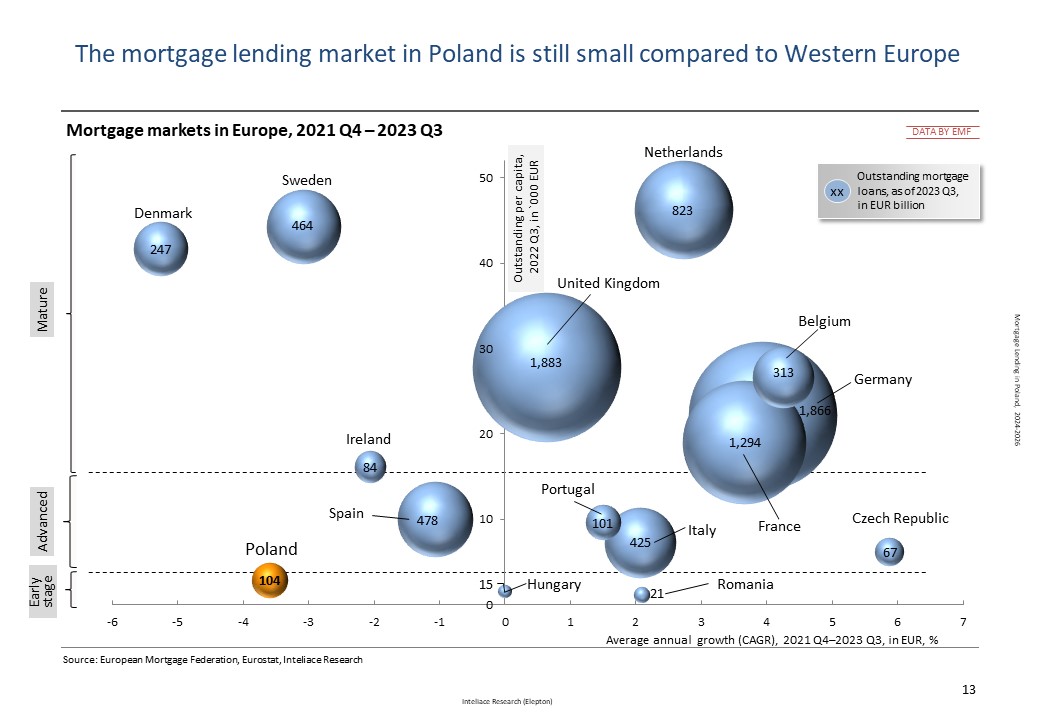
Mortgage lending in Poland, 2024-2026
The residential construction industry in Poland continued to be impacted by negative trends that began in 2022. Declines in building starts (-9% YoY), permits (-19% YoY), and completions (-8% YoY) were recorded in 2023. This reduced supply of new real estate, combined with demand stimulation resulting from a new government-sponsored program dedicated to first-time homebuyers, was reflected in accelerating real estate prices. As the prices of real estate break all-time records, the affordability for buyers keeps falling, which is a key factor supporting the growth in new mortgage lending. The recent downturn in real estate construction, seen in 2022 and 2023, is expected to reverse due to rising property prices and new governmental support programs that are anticipated to boost demand. The impact of the monetary factor—namely high interest rates—is projected to diminish in 2024 and 2025, which should further support growth in new mortgage lending. This sector is poised for additional momentum from a new government lending support scheme planned for 2024. Assuming these conditions, our base scenario forecasts a slight increase in overall mortgage lending in 2024, followed by a more significant rise in 2025 and 2026. Total outstanding lending is estimated to reach PLN 545 billion by 2026, with the loan-to-GDP ratio expected to stabilize at approximately 13%. For more information on recent developments in the Polish banking sector, please refer to the full publication.
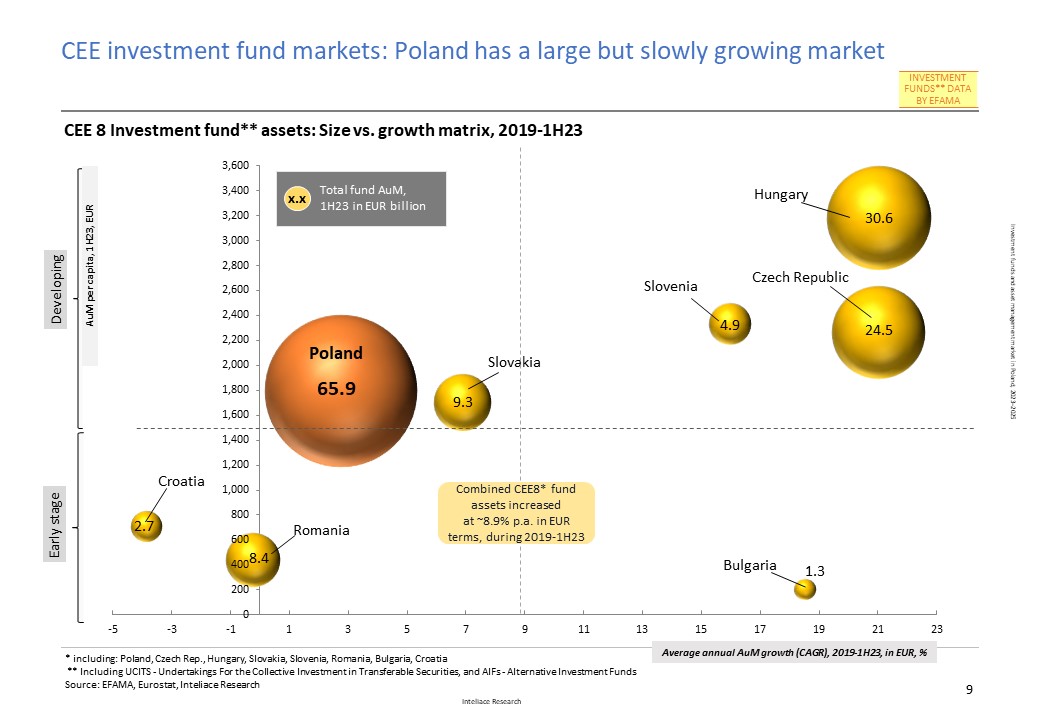
Investment funds and asset management market in Poland, 2023
Over the last five years, the asset management sector in Poland has experienced stagnation, characterized by temporary fluctuations but lacking substantial growth in managed assets. However, 2023 brought some relief, with total assets under management in key segments* reaching over PLN 700 billion in the third quarter of the year, compared to PLN 636 billion at the end of 2022. Investment funds remained the key asset group, surpassing PLN 304 billion, followed by second-pillar pension funds with PLN 179 billion and insurance companies' reserves at PLN 162 billion. The smallest segment, third-pillar pension funds, saw a surge to PLN 60 billion in assets under management, exhibiting the fastest growth among all categories. If compared to the other markets in the region, Poland has clearly the largest investment funds sector within the CEE. However, the value of managed assets has been growing slower than in most other CEE markets recently.Consequently, despite having the largest fund market by value, Poland is still behind a few peers in terms of assets value per capita or assets per unit of GDP. The outlook The total value of assets under management in Poland is anticipated to grow by over 40% between 2022 and 2025, marking the end of multi-year stagnation. High growth is expected in pension assets, particularly within the "new" third pillar (PPK). *key categories included: Investment funds, Insurance assets, Pension assets (2nd and 3rd pillar); Excluded are bank and structured deposits, equities and bonds held directly --------------------------------------------------------------------------------------------------------------------------------------
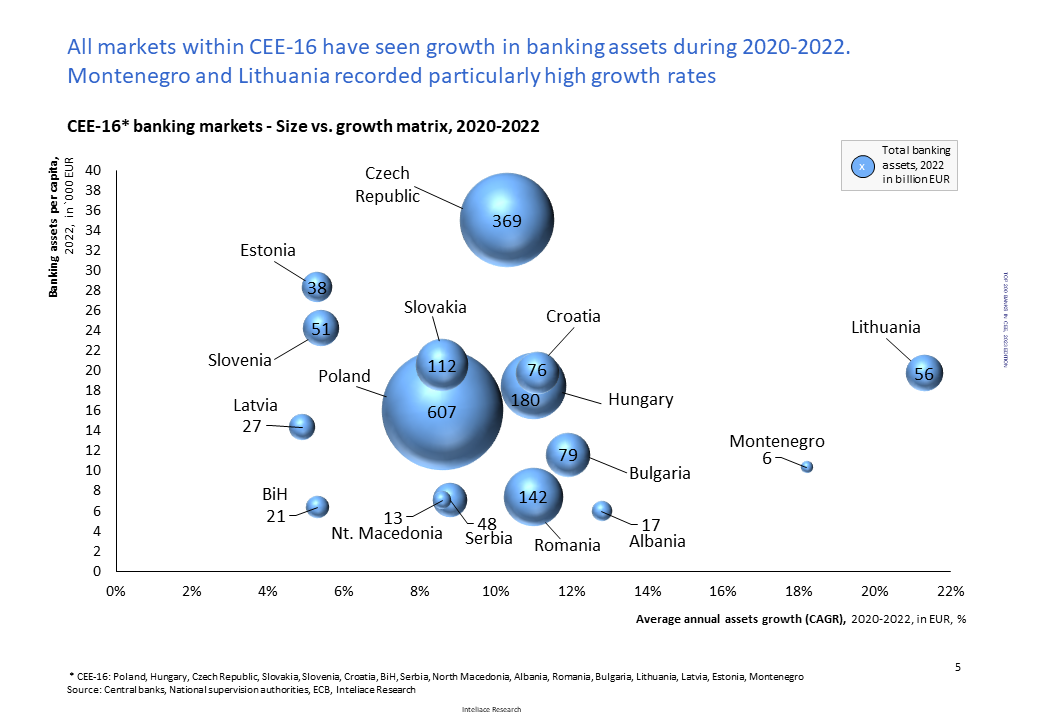
List of Top 200 banks in Central and Eastern Europe /2023 edition/
Total banking assets in CEE16* exceeded EUR 1.84 trillion as of December 2022 after growing by over 8% YoY. The year 2022 marked a robust performance for banks operating in Central and Eastern Europe (CEE16*), as the region experienced a remarkable asset growth of over 8% YoY, reaching a combined €1.84 trillion by December 2022, for 16 countries in the region. The expansion in the CEE financial sector was evident in nearly all countries within the region, with some markets like Croatia, Bulgaria, Romania, Albania, and Montenegro achieving double-digit growth rates. This recent surge in financial markets across CEE is a testament to the thriving economies, supported by healthy GDP growth and increasing individual incomes. Remembering the challenging year of 2020, when bank profits experienced a significant hit and key profitability benchmarks were more than halved, regional bankers have shown optimism with a gradual improvement in profitability since 2021. By 2022, the average Return on Assets (ROA) for the top 200 CEE banks reached 0.92%, while the average Return on Equity (ROE) was 9.9%. Although these figures are still below the levels recorded in the years 2016-2019, there is an expectation that regional banks will manage to return to their historical performance. For more info about developments in banking sectors in CEE please review the full publication. ------------------------------------------------------------------ *CEE16 include: Poland, Czech Republic, Hungary, Slovak Republic, Romania, Bulgaria, Estonia, Latvia, Lithuania, Croatia, Slovenia, Serbia, Bosnia and Herzegovina, Albania, Montenegro and North Macedonia.
Insurance market in Poland, 2023-2025
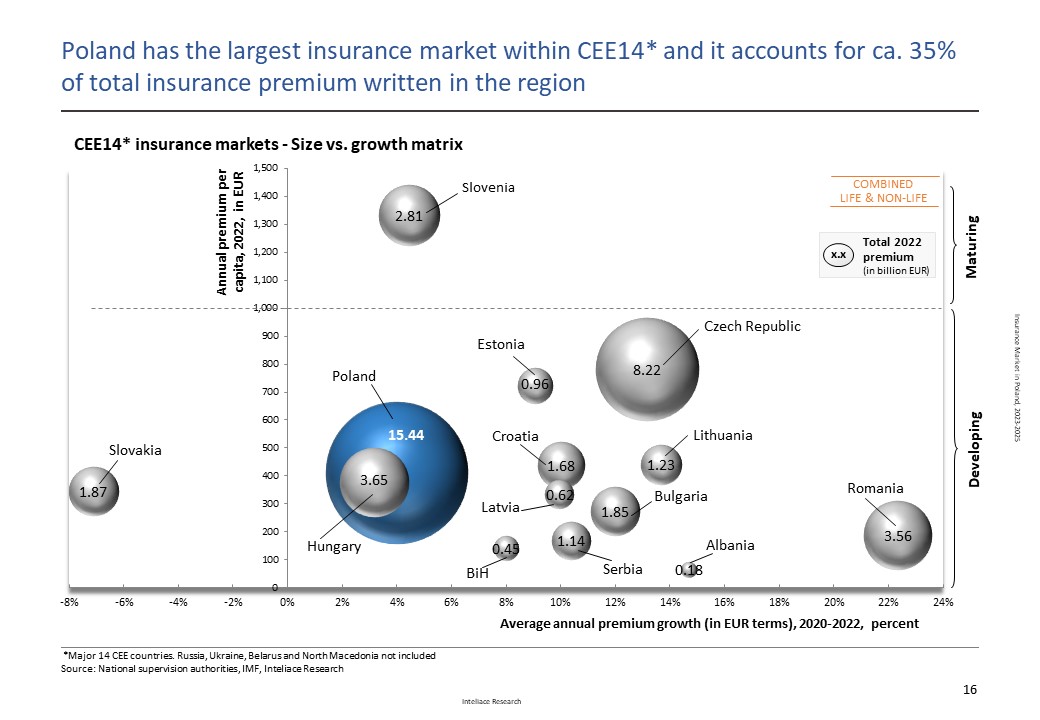
As of 2022, Poland had the largest insurance sector in CEE14 (Central and Eastern Europe*) with nearly € 15.4 billion in premium written p.a. and a 35 % share in the region. The insurance sector in Poland is undergoing a gradual evolution, with consolidation being one of key processes. Recently, a few players decided to leave the market and a number of M&A deals have been closed. Prominent transactions include the acquisition of Aegon by VIG, the acquisition of Aviva by Allianz, and the integration of MetLife by Nationale Nederlanden. Through consolidation, mid-sized insurers are able to scale up their operations and enhance profitability in the face of rising costs, required investments, and tariff pressures. Consolidation within the sector presents various benefits. It allows companies to achieve economies of scale, expand their customer base, enhance their product portfolios, and improve operational efficiency. Additionally, consolidation supports the development of stronger, more financially resilient players capable of meeting the evolving needs of policyholders. The outlook for insurers in terms of premium income is predominantly positive. By 2025, the combined premium written for life and non-life business in Poland is likely to top EUR 20 billion. However, while premium income is projected to accelerate in the mid-term, insurers' profitability is likely to stagnate. Insurers will need to make substantial investments to effectively defend their profitability. For more information on recent developments in the Polish insurance sector, please refer to the full publication.
Bank outlets in Poland, 2023
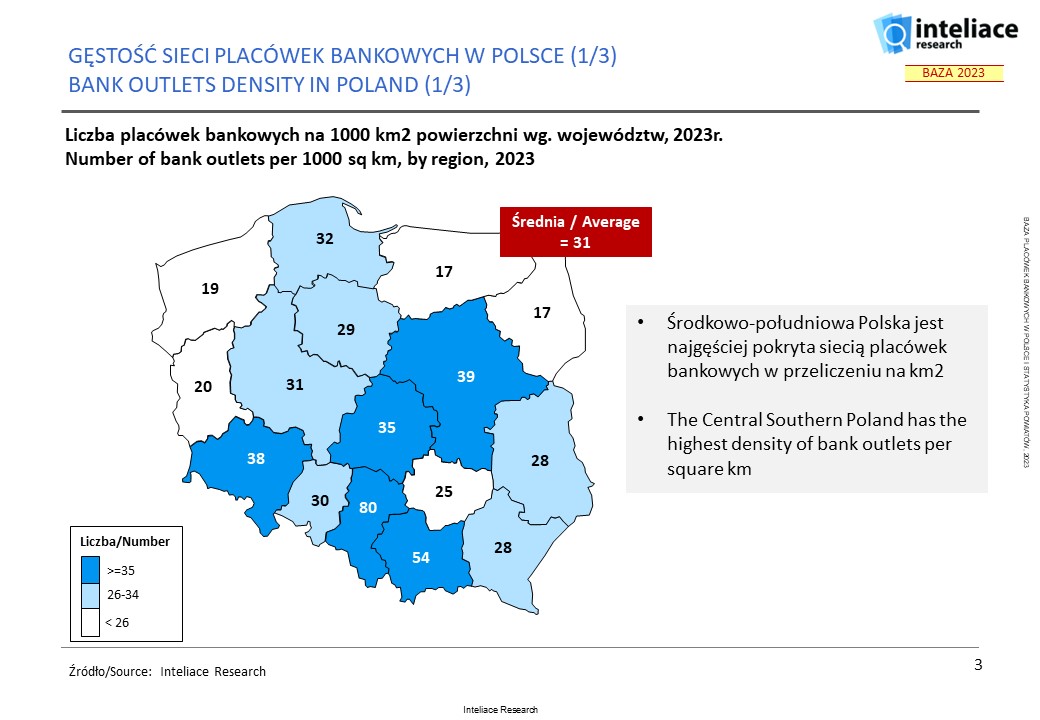
The year 2023 marked a significant milestone in the modern history of the banking sector in Poland. After more than 25 years, the number of bank outlets dropped below 10,000. According to data from the 2023 Bank Outlets Database, compiled by Inteliace Research, the number of bank outlets in Poland decreased by 425 units to 9,845 in April 2023 compared to 10,270 in April 2022. This represents a year-on-year drop of 4.1%. If calculated per capita, the ratio of individuals per single bank branch increased from 3.68 thousand to 3.84 thousand over the course of a year. Despite this decline, it is worth noting that the 4.1% annual loss in the number of bank outlets is the smallest decrease recorded in a decade. This could potentially indicate a deceleration in the rate at which banks are closing branches. While the number of branches in large and big cities remains relatively high—for example there are still 402 outlets in Warsaw, 175 outlets in Kraków, and 153 outlets in Wrocław—banking networks in smaller locations are already very limited. Banks may be hesitant to further close branches in mid-sized and small cities due to the risk of losing customers to competitors who still maintain a physical presence. Although the younger generation in Poland is embracing digital and remote banking, older people often reject electronic banking and prefer traditional services and cash payments. Therefore, catering to the needs of different customer segments might stop banks from more drastic moves, i.e. closing the last branches in smaller locations For more information on the current structure of the bank branch network in Poland please refer to the full publication/database.
Banking Market in Poland, 2023-2025
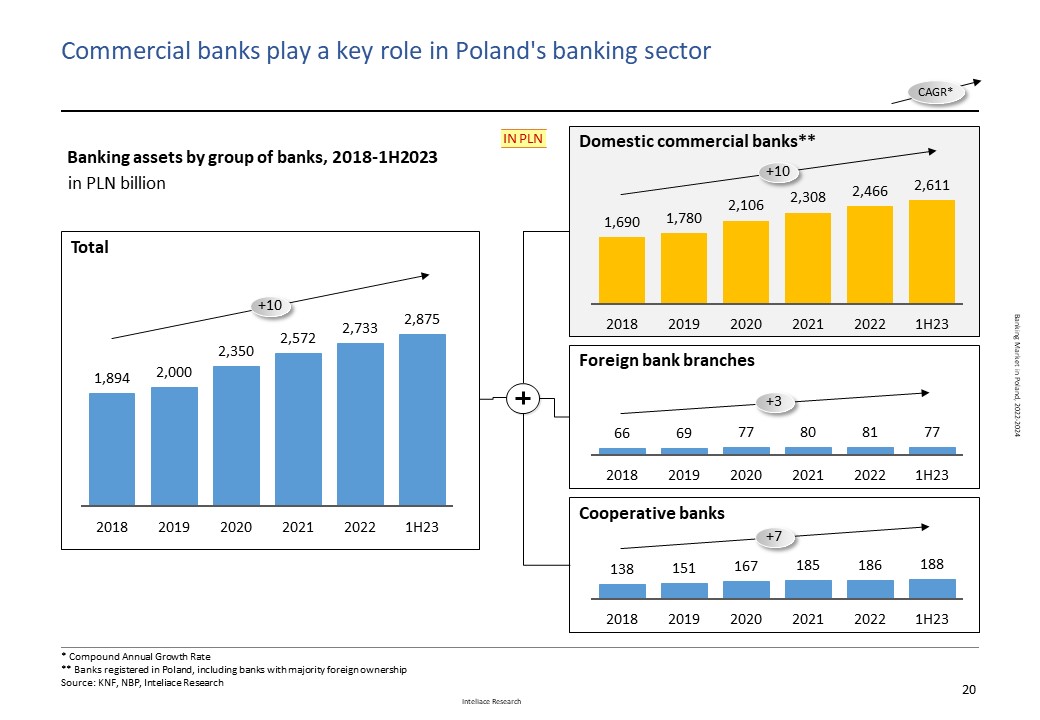
The competitive landscape within the Polish banking sector has not changed much over the past few years. The group of major commercial banks remained unchanged, concurrently increasing its market share slightly, indicating a trend toward growing concentration. Noteworthy in this context is the government-owned SPV Bank - BGK, which has ascended the top list of banks due to its exclusive rights in distributing support and lending funds from both the government and the EU. While there has been little M&A activity in the banking sector recently, an exception from this trend is Velo Bank. This institution is currently available for acquisition following a compelled restructuring and takeover by the government of the erstwhile Getin Noble Bank. The sales tender is presently open, with expectations for closure early in 2024. The surge in market interest rates, rising from zero to approximately 6.5% in 2022, had a profound impact on the banking sector. The escalating cost of money significantly influenced the new investment demand of corporations, while simultaneously limiting the capacity of individuals to secure new loans. Conversely, the notably higher interest rates, though still below inflation, spurred interest in depositing funds in banks. Consequently, overall client deposits at banks reached PLN 1.92 trillion in Q2 2023, reflecting an 11%+ change over 1½ years since the end of 2021. Concurrently, client loans experienced a contraction of over 2%, decreasing from PLN 1.29 trillion at the close of 2021 to PLN 1.26 trillion in Q2 2023. Despite many challenges, the future outlook for key banking volumes remains favorable. Total banking assets are projected to grow steadily, potentially reaching PLN 3.5 trillion by the end of 2025. For more information on recent developments in the Polish banking sector, please refer to the full publication.
Mortgage lending in Poland, 2023-2025
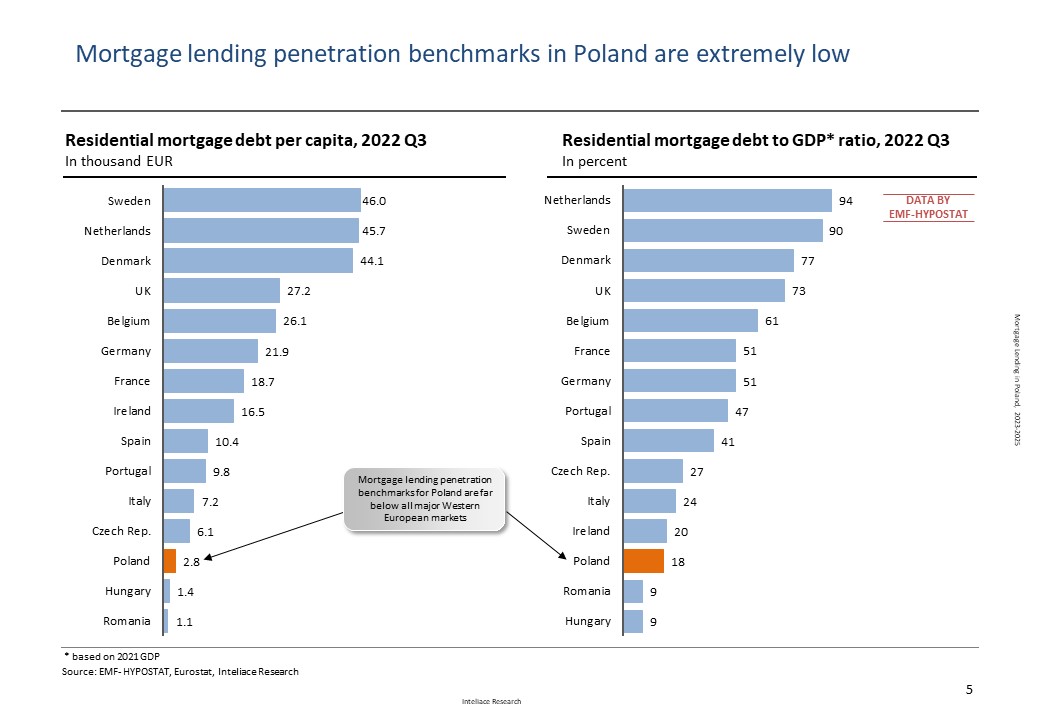
In Poland, in 2022, an abrupt decline in building starts (-28%) and new permits (-13%) was recorded. At the same time, the long-term trend of growing real estate prices slowed down visibly in the most expensive locations, such as Warsaw. An increasing number of existing homes being put on the market and more generous discounts offered by developers indicate that 2023 might see a stabilization or a slight correction in real estate prices. The rapid monetary tightening cycle of the Monetary Policy Council (RPP), which raised interest rates by nearly 7% within a year, has taken its toll on mortgage lending. Sales of new mortgage loans collapsed by nearly 75% year-over-year in late 2022. The negative momentum in the real estate market and in new mortgage lending is likely to persist through 2023. Assuming that there will be no further interest rate hikes, even the current level of rates is highly negative to new lending. The market is still far from equilibrium, and the growth in lending would require either significantly less expensive credit or lower real estate prices, both of which seem unlikely to materialize at least in 2023. For more information on recent developments in the Polish banking sector, please refer to the full publication.
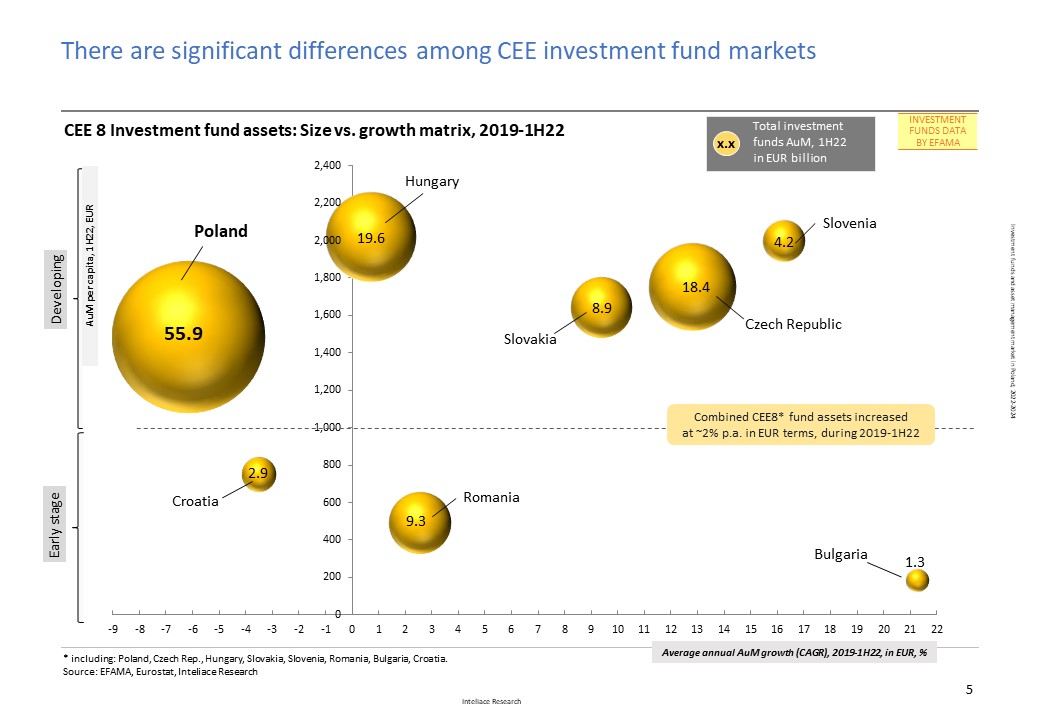
Investment funds and asset management market in Poland, 2022
2022 was a difficult year for asset managers operating in Poland. The industry had to deal with a rare case of simultaneous declines in valuations of multiple asset classes including stocks and bonds. Nevertheless, asset managers coped well with lower asset prices and with increased funds volatility. Total assets* under management in Poland fell sharply in the first half of 2022, reaching PLN 621 billion as compared to PLN 708 billion at the end of 2021, and they remained in a declining trend through the third quarter of the year. The outlook The total value of assets under management is expected to recover in 2023 and then to grow subsequently in 2024 and 2025. A likely rebound in asset valuations will provide a relief while new flows, in particular within insurance 3rd pillar and retail investment funds are likely to drive total AuM to new highs in 2024/2025. The planned dismantling of the old 2nd pillar pension funds (OFE) is still a big question mark and the government might postpone the decision past the upcoming 2023 parliamentary elections. * Across key categories: Investment funds, Insurance assets, Pension assets (2nd and 3rd pillar); Excluded are bank and structured deposits, equities and bonds held directly by private individuals --------------------------------------------------------------------------------------------------------------------------------------
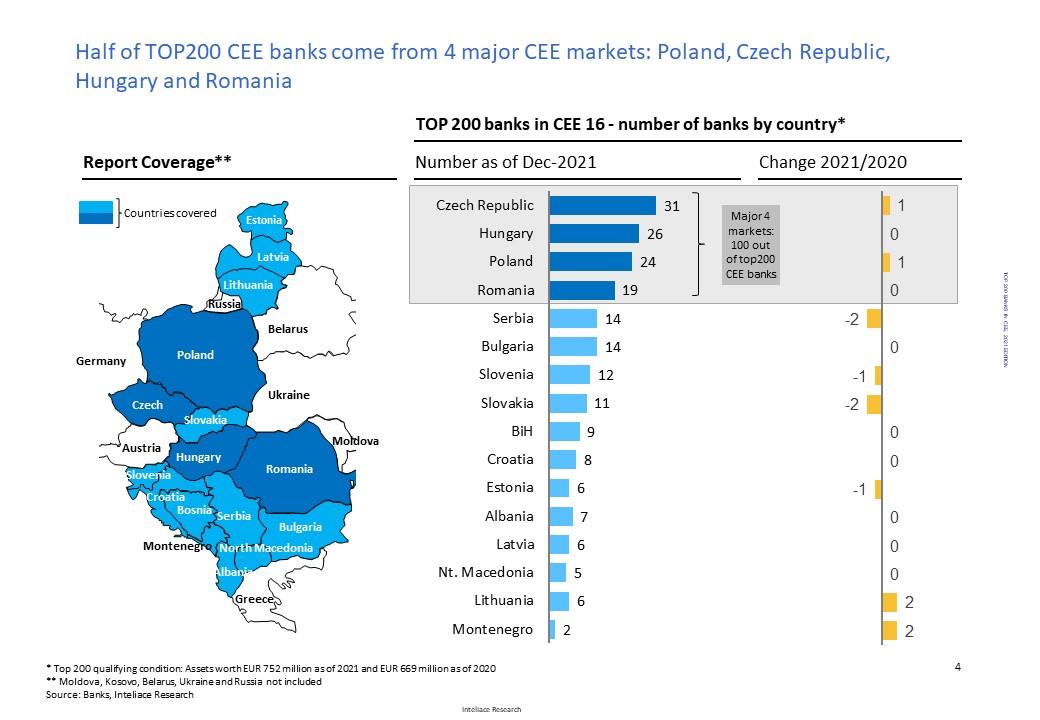
List of Top 200 banks in Central and Eastern Europe /2021 edition/
Total banking assets in CEE16* topped EUR 1.7 trillion as of December 2021, growing at 11% YoY. It has been a good time for most banks operating across Central and Eastern Europe recently. Despite continued COVID-19 related lockdowns and business disruptions, as well as in view of new regulatory and tax burdens, CEE banks seem to have coped well with all the headwinds. All countries in the region had a positive contribution to this growth with leaders experiencing YoY growth rates of 14%+. With € 138+ billion in assets, Austrian Erste Group remains at the top of regional players. KBC follows the suit with assets worth € 122 billion. Other groups with a market share of 5%+ include: UniCredit, PKO Bank Polski, OTP Bank and Raiffeisen. Overall top 10 largest groups control nearly 52% of regional bank assets. ------------------------------------------------------------------ *CEE16 include: Poland, Czech Republic, Hungary, Slovak Republic, Romania, Bulgaria, Estonia, Latvia, Lithuania, Croatia, Slovenia, Serbia, Bosnia and Herzegovina, Albania, Montenegro and North Macedonia.
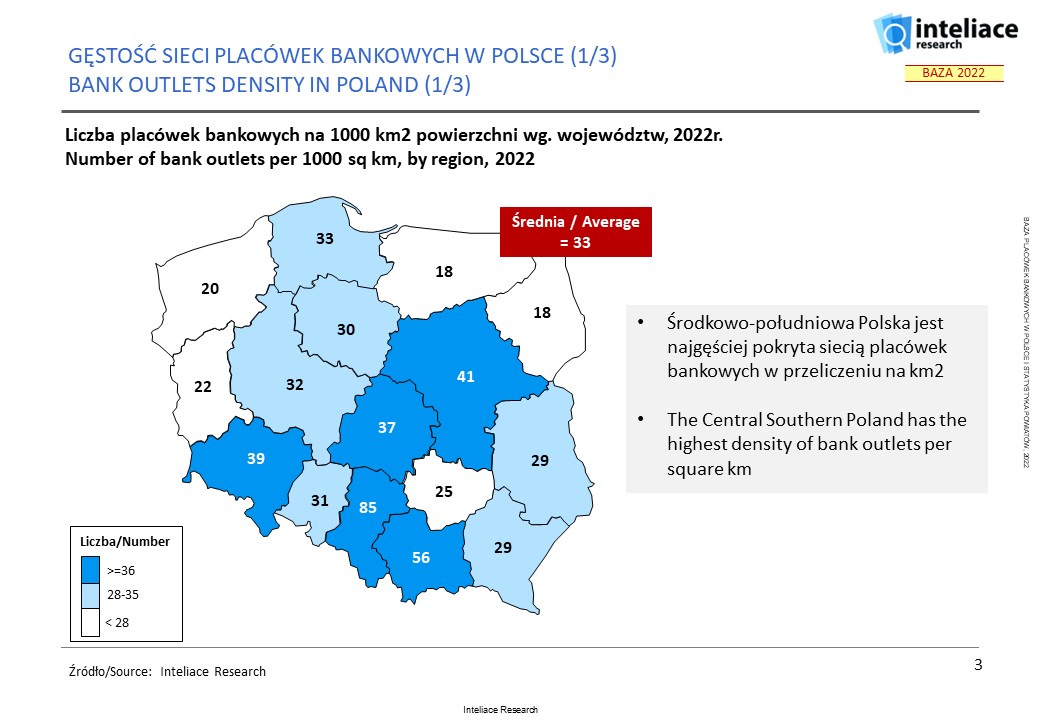
Bank outlets in Poland, 2022
During 2021 and early 2022, banks in Poland continued to optimize their branch networks. In the last year, the total number of outlets fell by 1151 units (10%), and there were 10,270 bank and credit union outlets as of May 2022. Although a significant portion of bank branches have been shut down recently, there is no indication of a reversal or even a slowdown in the trend. We sustain our forecast made last year that the number of branches (manned outlets) is likely to fall to 6.5 thousand by 2026.For more information on the current structure of the bank branch network in Poland please refer to the full publication/database.
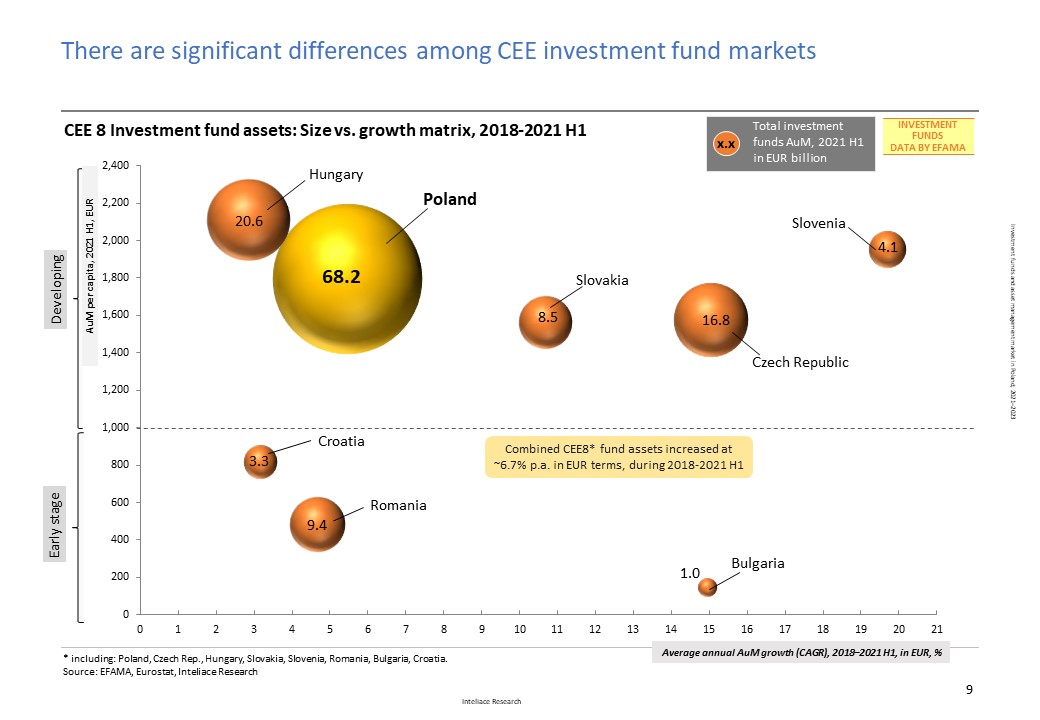
Investment funds and asset management market in Poland, 2021
After multiple years of stagnation, the asset management sector experienced solid growth in H1 2021. Total assets* increased to PLN 702 billion in H1 2021 driven by favourable performance, a few consecutive quarters of positive inflows and an extra boost provided by the launch of new 3rd pillar vehicles (PPK). The outlook Overall assets under management in Poland are expected to grow steadily in 2022 and in following years while negative real interest rates, which are likely to persist, will further benefit investments linked to capital markets relative to no interest bank deposits. Besides investment funds, which are gaining interest of retail investors, it is also the 3rd pillar pension segment which will experience significant new flows with defined contributions driving AuM over initial years of the programme. * Across key categories: Investment funds, Insurance assets, Pension assets (2nd and 3rd pillar); Excluded are bank and structured deposits, equities and bonds held directly by private individuals --------------------------------------------------------------------------------------------------------------------------------------
List of Top 200 banks in Central and Eastern Europe /2021 edition/
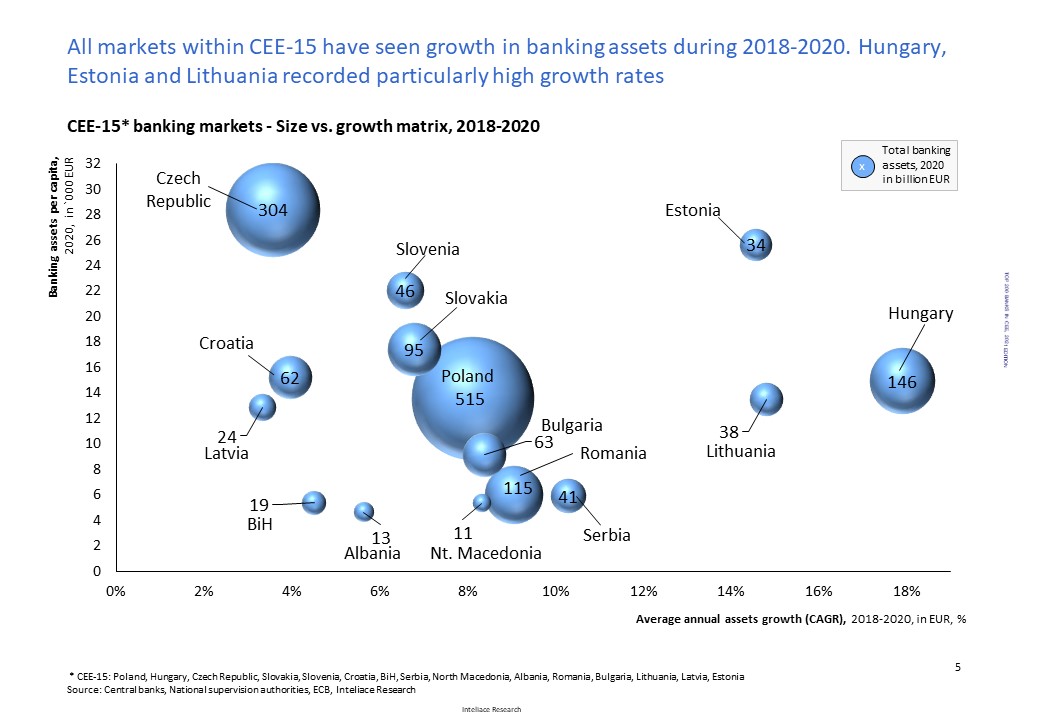
Total banking assets in CEE15* exceeded EUR 1.5 trillion in December 2020, after adding over 8% last year. Multiple banking markets in the region recorded double digit growth rates, and in a few countries, including Lithuania and Estonia the growth rate exceeded 20%. However, the growth came at the price of profits. Profitability ratios for top CEE banks plunged in 2020 with ROA and ROE falling to 0.53% and 5.0% respectively. The top banking groups in the region did not change and Erste, KBC and UniCredit remaind top banking groups. Nevertheless, the consolidation processes continued with regional players getting stronger, in particular OTP, which continued to consolidate more assets in the southern part of the region. ------------------------------------------------------------------ *CEE15 include: Poland, Czech Republic, Hungary, Slovak Republic, Romania, Bulgaria, Estonia, Latvia, Lithuania, Croatia, Slovenia, Serbia, Bosnia and Herzegovina, Albania, and North Macedonia.
Insurance market in Poland, 2021-2023
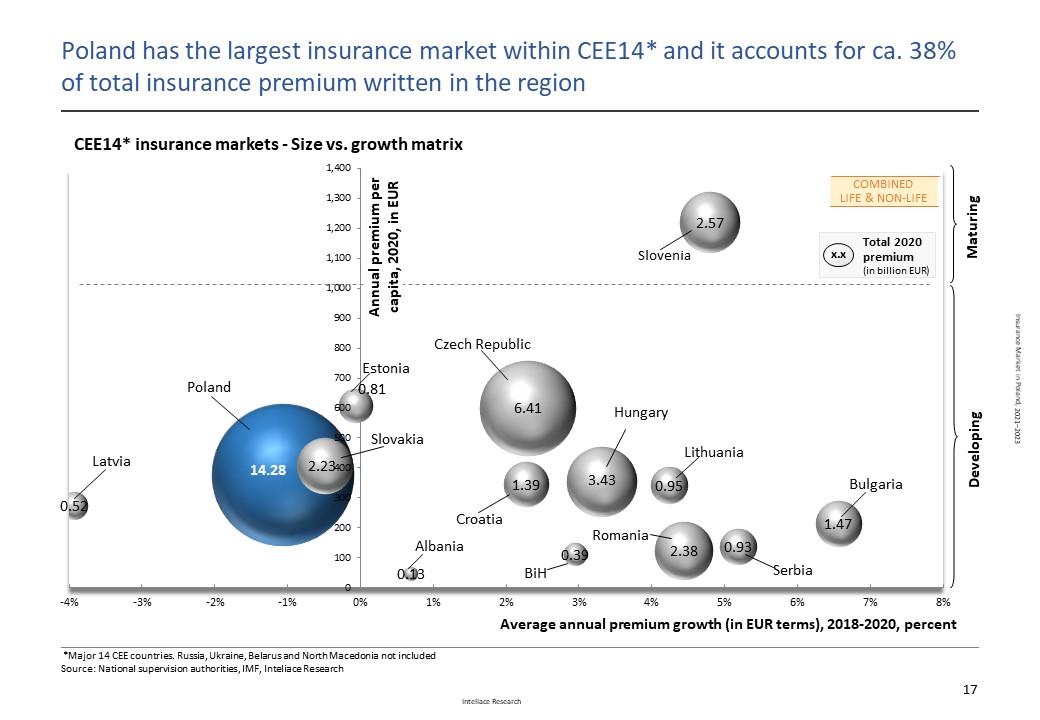
Poland has the largest insurance sector in CEE14 (Central and Eastern Europe*) with nearly € 14.3 billion in premium written p.a. and a 38 % share in the region. In 2021, premium is expected to continue its growth, and to add at least 7% and 6% in non-life and in life segment respectively. A few last years have been challenging for insurers in Poland not only because of pandemics and lockdowns, but mostly due to record-low interest rates impacting gains on investments combined with rising operating costs and also considering unfavourable regulatory developments in life insurance segment. All those circumstances combined led to the falling profitability of insurers. In 2020, the net profit of non-life insurers went down by 15% to PLN 3.9 billion while the same benchmark for life insurers dropped 14% to PLN 2.2 billion. Market fragmentation and regulatory requirements result in ongoing market consolidation. After the withdrawal of AXA - acquired by Uniqa and Aegon - to be purchased by VIG, even larger deals were announced last year, e.g. Aviva to be taken over by Allianz and MetLife to be sold to Nationale Nederlanden. The outlook for insures operating in Poland remains positive. The life insurance segment is expected to continue the rebound after a long period of declines caused by the regulatory overhaul. The non-life segment is likely to benefit from the recent appreciation of value of properties, which is caused by accelerating inflation but also by increasing value of insured assets and overall growth in the wealth of individuals. For more information on recent developments in the Polish insurance sector, please refer to the full publication.
Bank outlets in Poland, 2021
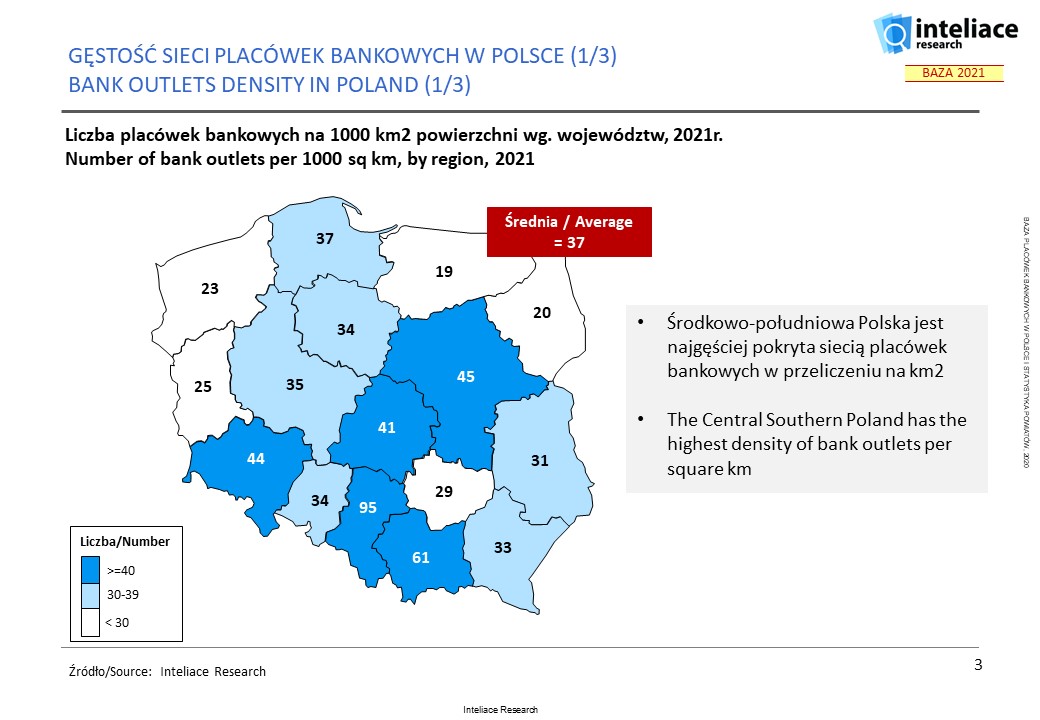
The reduction in bank outlet networks in Poland accelerated in 2020 as increasing cost pressures combined with lockdowns encouraged banks to shut more branches. The total number of outlets fell by nearly 1054 outlets (8%) last year and there were 11,421 operational bank and credit union outlets countrywide as of May 2021. The closing of bank outlets in Poland is expected to persist in future and their number (manned outlets) is likely to fall to 6.5 thousand by 2026.For more information on the current structure of the bank branch network in Poland please refer to the full publication/database.
Mortgage lending in Poland, 2021-2023
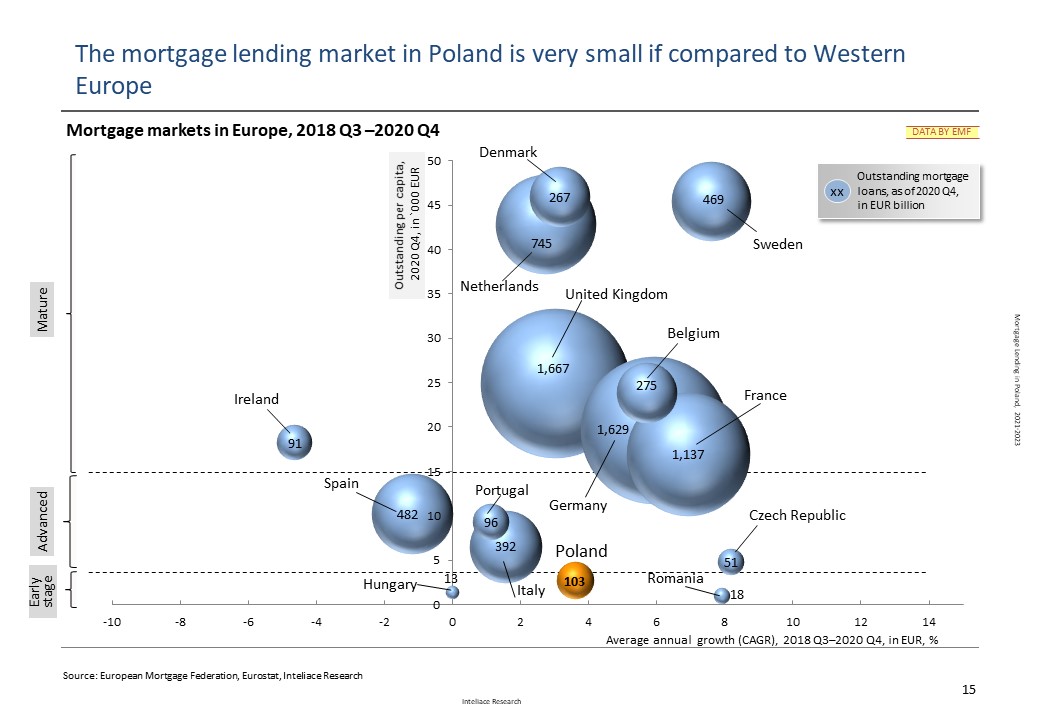
The residential construction in Poland remained hot in 2020 with home completions increasing by over 7% YoY and reaching a multi-year high at 222k. Nevertheless, there have been also first signs of stabilization with permits growing just by fraction and home starts falling slightly vs. 2019. At the same time, real estate prices continued to climb very fast, fuelled by more and more negative real interest rates and by accelerating CPI, which surpassed 4% in March 2021. By contrast to real estate prices, mortgage lending cooled down slightly with new sales of mortgage loans decreasing by 10% and 3% YoY in terms of volume and value respectively in 2020. Slower sales of new mortgage on the growing real estate market could be attributed mostly to the impact of COVID-19 with lockdowns and stricter lending rules at banks. Nevertheless, mortgage lending is expected to rebound fast once the pandemics eases and it might hit new records already in 2021. For more information on recent developments in the Polish banking sector, please refer to the full publication.
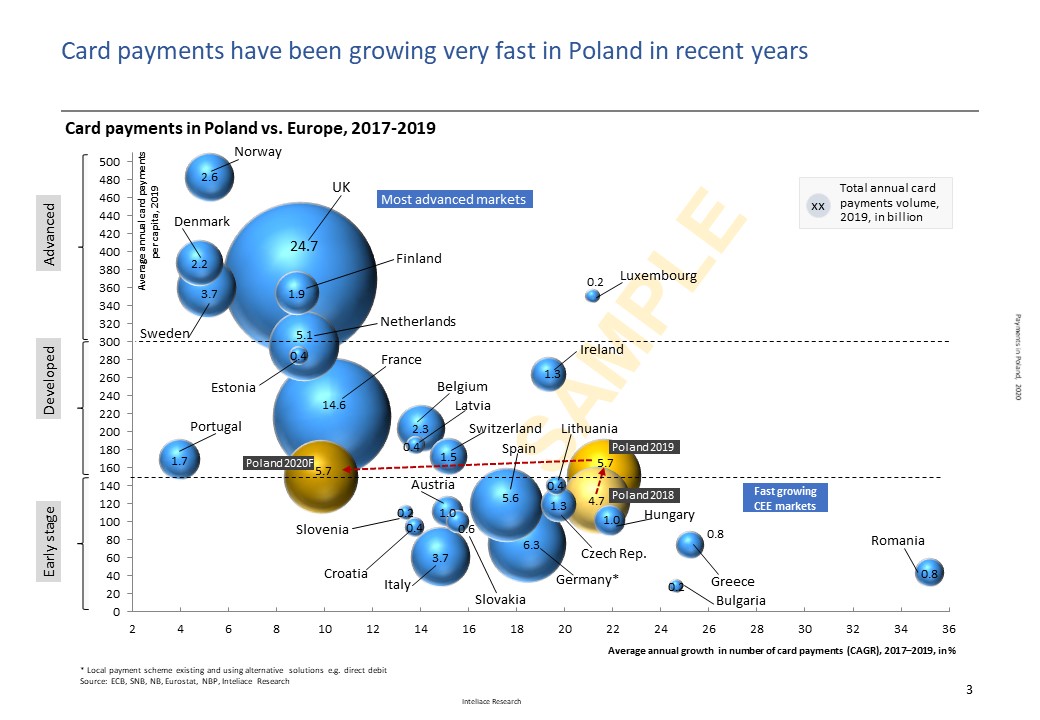
Payments in Poland, 2020
Poland's payment market had been growing fast until early 2020 when the trend came to an abrupt halt due to covid19 related business closures and highly reduced economic activity. While the total number of payments in Poland exceeded 8.8 billion in 2019, after increasing over 17% yoy, it is expected to stagnate and fall slightly in 2020. Outlook It can be expected that after the temporary stagnation in payment volumes, triggered by covid-19, the payment industry in Poland will gradually resume the growth. This will be, in particular, an effect of strong growth in eCommerce, replacing traditional, cash-intensive retail (B&M). Consequently, the very payment methods which are heavily used on the Internet are likely to benefit the most. --------------------------------------------------------------------------------------------------------------------------------------

Investment funds and asset management market in Poland, 2020
In line with trends observed in previous years, assets under management in Poland remained very volatile in 2019 and in the 1st half of 2020. Total assets* went down to PLN 588 billion in H1 2020 and this drop could be attributed to a very weak performance of equity markets impacted by accelerating Covid-19. The extraordinary situation has negatively affected all segments of the AM sector, although this was not equally visible across particular segments, in particular in the case of the 3rd pillar, where strong new inflows more than offset falling valuations. As of June 2020, assets of investment funds** contracted to PLN 281 billion, reserves of insurance companies remained almost unchanged at PLN 148*** billion, second-pillar pension funds plummeted to 132 billion, and third pillar pension assets increased slightly to PLN 27 billion. Overall, the asset management sector remained medium-concentrated with the top four groups: PZU, Aviva, NN, and Ipopema controlling over 52% of the entire market. the outlook Overall assets under management in Poland are expected to fall in 2020 but then rebound through 2022. Particularly promising will be the 3rd pillar pension segment where significant new flows will drive AuM regardless of their initial performance. The new legal framework, in force since mid-2019, has mandated employers to enrol their employees and to match employee contributions. A further boost to 3rd pillar assets will be supplied by the final dismantling of 2nd pillar pension funds, expected around 2021-2022, although this is going to be a zero-sum game for the AM sector as a whole. As far as the profitability of asset managers is concerned, the fund management fee cap is a negative element, however, fund managers will intensify their efforts to offset limited revenues by reducing operating costs, increasing the share of passive strategies, and consolidating operations (through M&A). * Across key categories: Investment funds, Insurance assets, Pension assets (2nd and 3rd pillar); Excluded are bank and structured deposits, equities and bonds held directly by private individuals ** Figures reported by the National Bank *** Technical reserves of non-life and life insurers, including unit-linked life funds as reported by KNF --------------------------------------------------------------------------------------------------------------------------------------
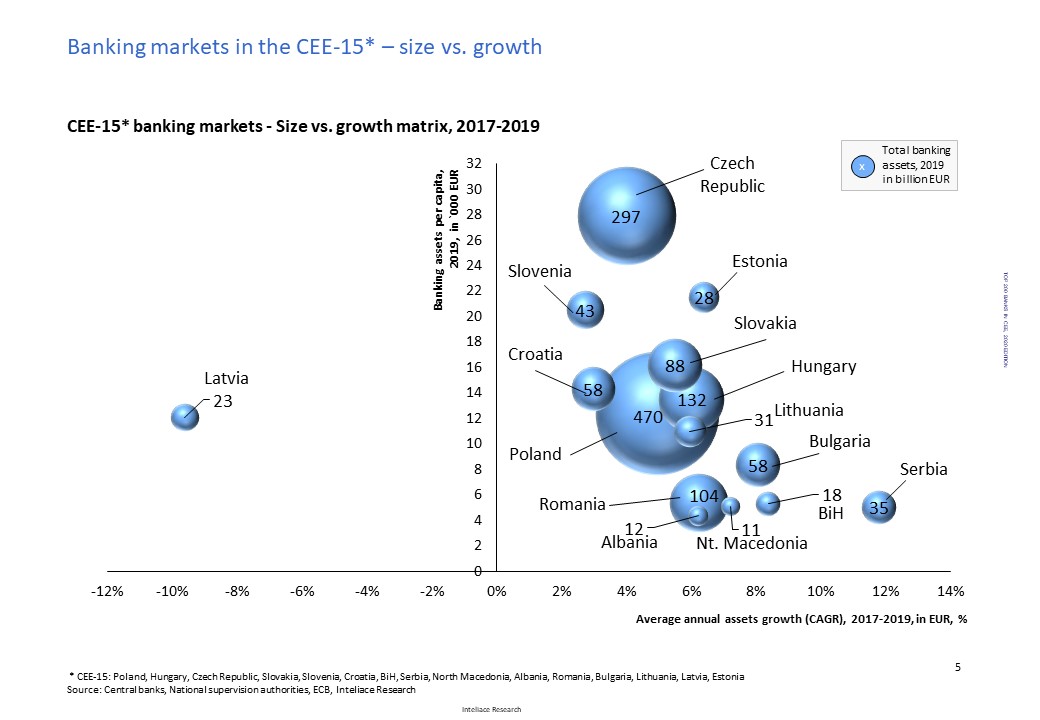
List of Top 200 banks in Central and Eastern Europe /2020 edition/
Total banking assets in CEE15* exceeded EUR 1.4 trillion in December 2019, after adding over 6% last year. Markets in the Southern part of the region including Serbia and North Macedonia have been growing most rapidly. In a few largest markets, e.g. in Poland and Czech Republic the nominal growth in assets has been boosted by appreciating currency. The profitability of major CEE banks remained almost unchanged in 2019 with ROA and ROE stabilizing at 1.15% and 10.4% respectively. The top banking groups in the region: Erste, KBC and UniCredit did not change. However, the consolidation processes continued with regional players getting stronger, e.g. OTP and PKO and a few foreign players reducing their presence in the region, e.g. Société Générale or Raiffeisen. ------------------------------------------------------------------ *CEE15 include: Poland, Czech Republic, Hungary, Slovak Republic, Romania, Bulgaria, Estonia, Latvia, Lithuania, Croatia, Slovenia, Serbia, Bosnia and Herzegovina, Albania, and North Macedonia.
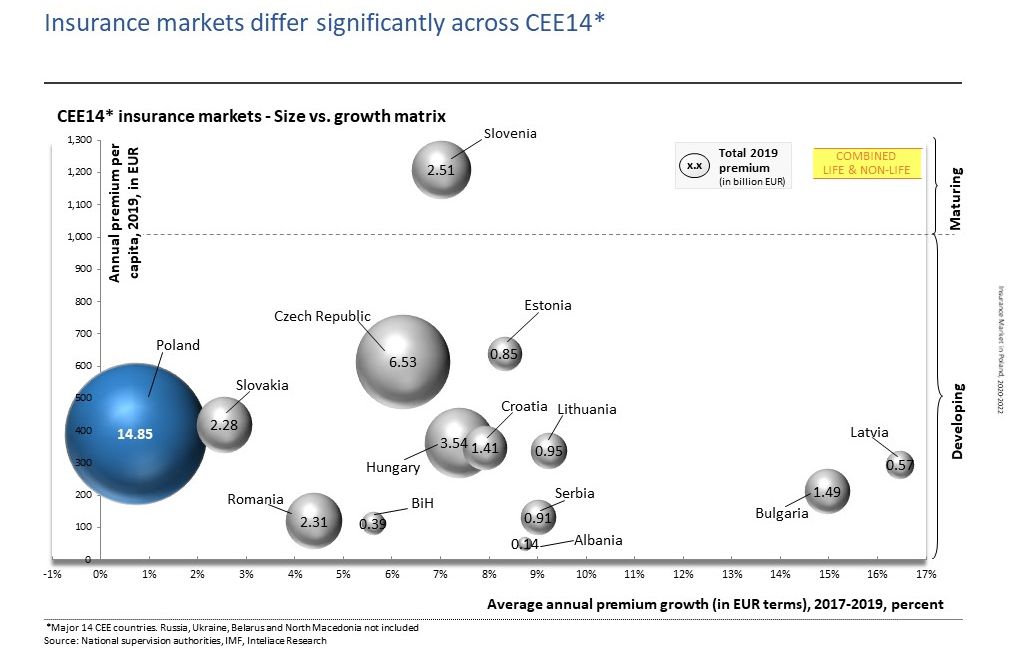
Insurance market in Poland, 2020-2022
The impact of COVID-19 on the insurance sector in Poland has been noticeably across various product classes e.g. falling premium in car insurance or growing premium in property/accident insurance. However, the overall effect on the sector can be assessed as close to neutral. Premium in non-life segment remained flat in Q1-Q3 2020 if compared to the same period of the previous year. By contrast, within life insurance, premium contracted by ~3% YoY, however, the fall was not directly connected to COVID-19 but rather, it was a continuation of a long-term declining trend in life insurance-based investment products suffering from increasingly restrictive regulations. Tighter regulations are also quoted among triggers of recently observed consolidation. A few new M&A deals were announced in 2020, including withdrawal of AXA - to be acquired by Uniqa and Aegon to be purchased by VIG. Moreover, an even bigger transaction is in the cards for 2021 as Aviva considered disposing its Polish business For more information on recent developments in the Polish insurance sector, please refer to the full publication.
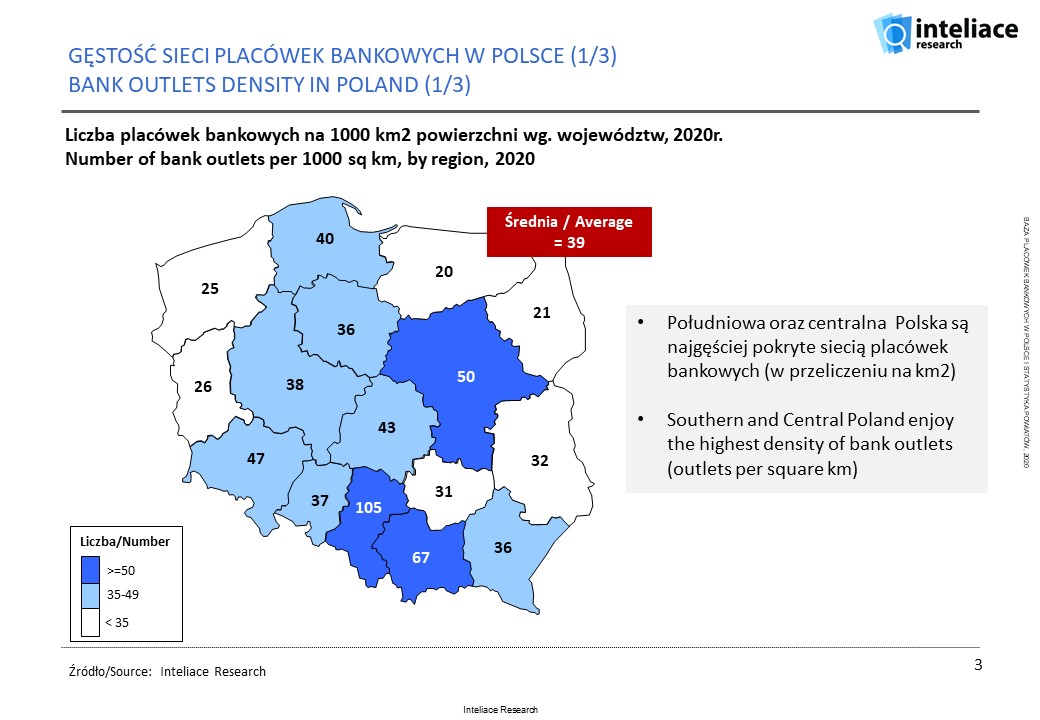
Bank outlets in Poland, 2020
The reduction in bank outlet networks in Poland has accelerated in 2019. The total number of outlets fell by nearly 1,100 outlets (8%) last year and there were 12,315 operational bank and credit union outlets countrywide as of May 2020. The process of closing bank outlets in Poland is likely to continue in future. The contributing factors including cost optimization and change in behaviour of clients are likely to be reinforced by COVID-19 induced drop in frequency of branch visits. For more information on current and historical developments in bank branch networks in Poland please refer to the full publication/database.
Banking Market in Poland, 2020-2022
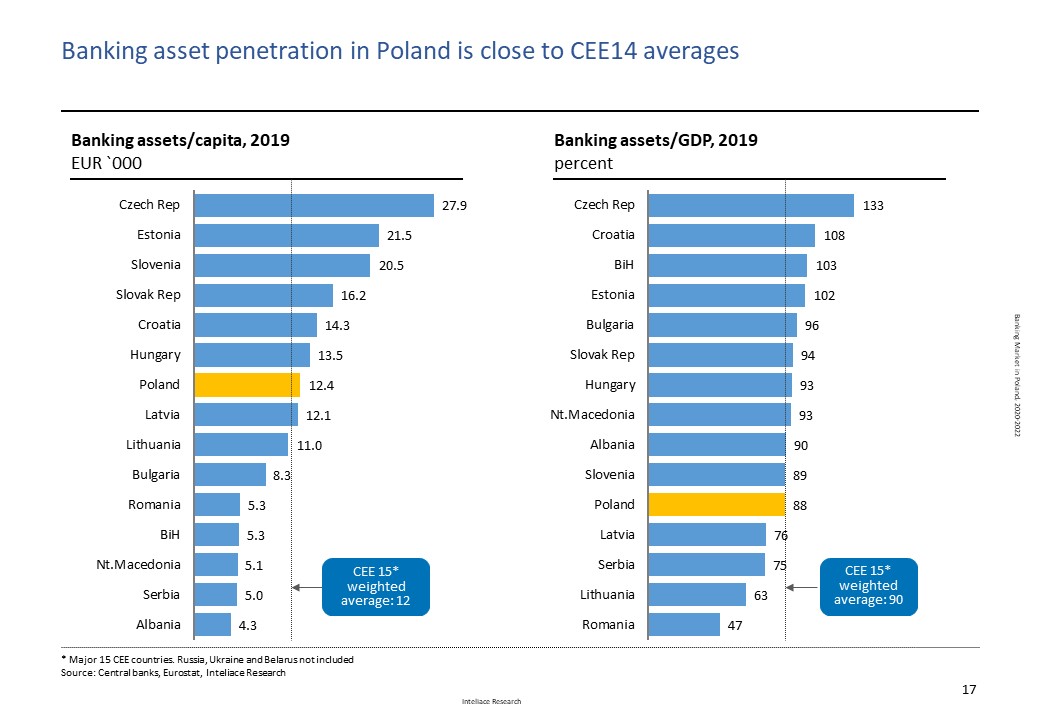
Banking volumes have continued to grow steadily during 2019 and Q1 2020. Deposits of non-financial clients at banks reached PLN 1.43 trillion after a 5% jump in Q1 2020 while client loans increased to PLN 1.26 trillion in Q1 2020, recording a 4% QoQ growth. The recent change in key volumes was balanced across all client segments. However, faster growth in deposits than in loans resulted in increasing liquidity within the sector. Total banking assets followed positive trends in client segments and they exceeded PLN 2.1 trillion as of March 2020. In terms of profitability, banks operating in Poland recorded a 9% jump in bottom line to PLN 14.2 billion in 2019 or a 9% YoY growth. The ROAA* and ROAE* benchmarks improved by a fraction to 0.73% and 6.88% respectively, in 2019. Nevertheless, this highly favourable outlook has been reversed in Q1 2020 when the Monetary Policy Council (RPP) started a new easing cycle. The dramatic shift in monetary policy in Q1 2020 combined with a weakening economy has created significant challenges to all banks operating in Poland. The series of interest rate cuts of 140 bp in Mar.-May 2020 alone is estimated to wipe ca. 33% of bank profits in 2020. Moreover, the predicted growth in regulatory charges, taxes and increased credit risk, will further cut into earnings. As a consequence, the bottom line of banks is likely to drop by over 50% in 2020 vs. the year before. This will be a major shock for banks as the over decade long period of stable profits has come to an end. Consequently missing profits will create a growth barrier for banks with thin equity buffers. For more information on recent developments in the Polish banking sector, please refer to the full publication.
Mortgage lending in Poland, 2020-2022
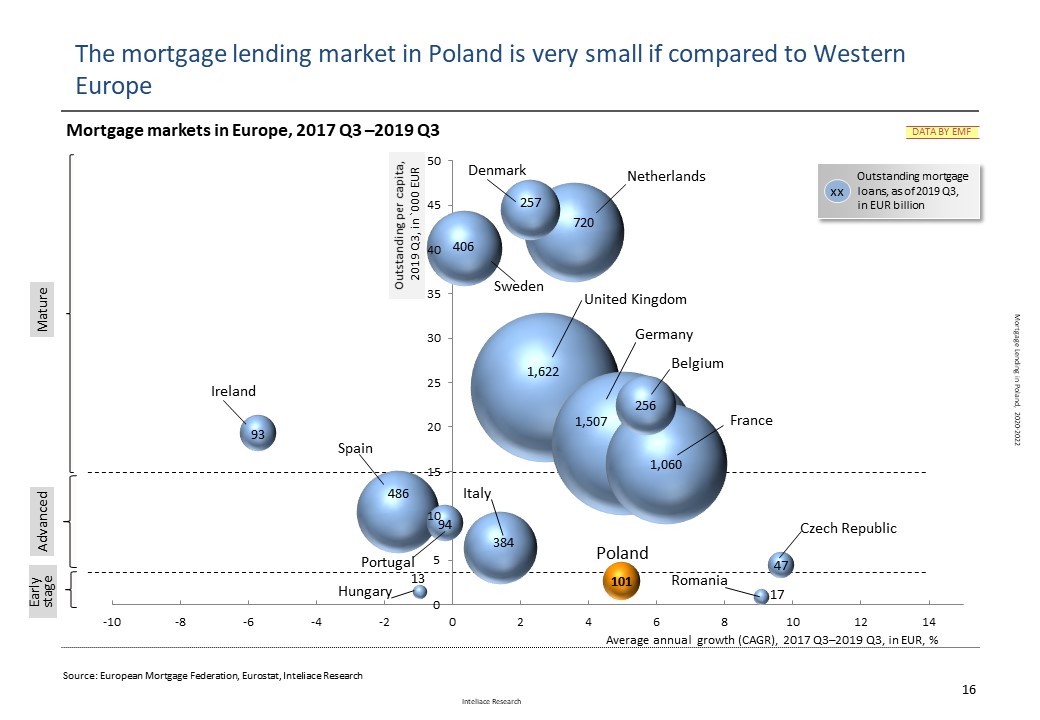
Residential construction in Poland sustained fast growth in 2019. The number of completions surged by nearly 12%, while the number of starts jumped by almost 7% in 2019. Recently, residential real estate has become increasingly popular among investots due to growing rents and a higher demand for rental properties. The boom is reflected in growing valuations, in particular, across large cities where prices are at multi-year highs. The growth in demand for real estate is also fuelled by negative real interest rates, which discourage individuals from holding bank deposits and which promote material investments, offering preservation of purchasing power. Mortgage lending accelerated in 2019. Sales of new contracts surged to over PLN 62 billon (EUR 14+ billion). Looking forward, in our base scenario, we expect new mortgage lending to cool-off slightly in 2020 but then to resume the solid growth in 2021 and 2022. For more information on recent developments in the Polish banking sector, please refer to the full publication.
Payments in Poland, 2019
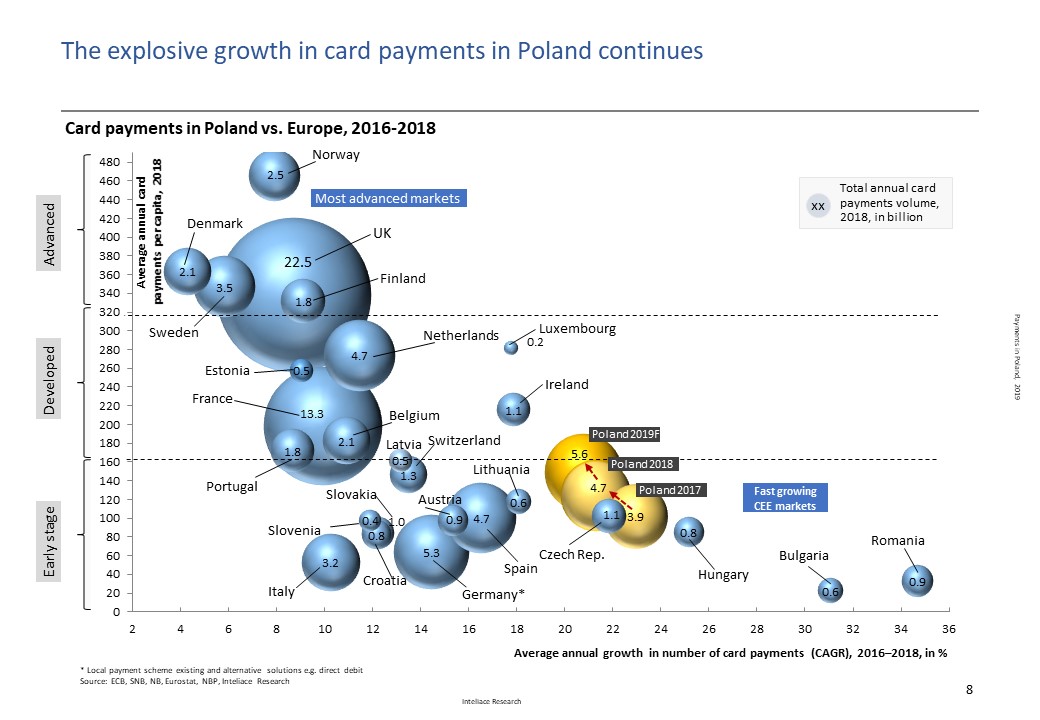
Poland's payment market continues to growth rapidly. The total number of payments exceeded 7.5 billion in 2018 and it remained on track to surpass 8.7 billion by 2019. Card payments alone reached nearly 4.7 billion transactions and they accounted for over 62% of all payments processed in the country. The persisting growth in card transactions can be attributed to fast expansion of the acceptance network and to increasing frequency in card use. In 2018, the average annual number of transactions per single card issued in Poland approached 114 tx. per card. Outlook The demand for convenient payment services and the ongoing support programs dedicated to the development of acceptance network, e.g. �Cashless Poland�, contribute to a gradual, although slow cash displacement. The current pace of growth in payment volumes is expected to remain strong, similarly to the dominating role of cards in overall payments. As a consequence, the total volume of payments in Poland is likely to reach 12 billion transactions by 2022. --------------------------------------------------------------------------------------------------------------------------------------
Investment funds and asset management market in Poland, 2019
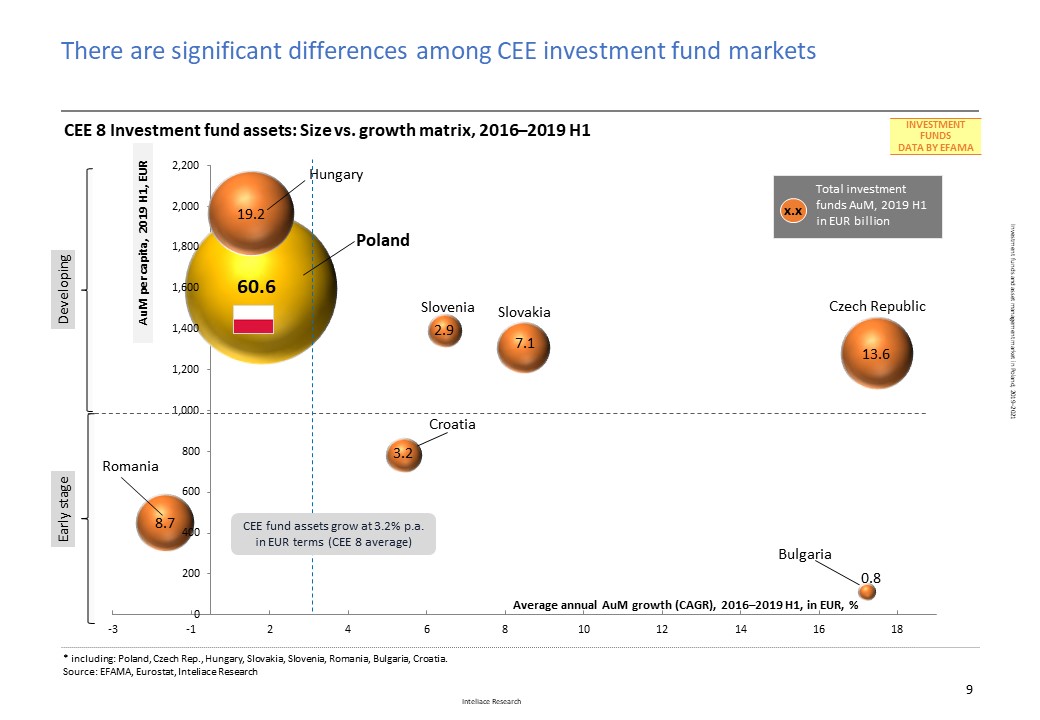
After the period of a very fast growth through 2017, total* assets under management in Poland decreased slightly to PLN 629 billion in H1 2019. The recently observed stagnation in total assets could be attributed to the weak performance of the local stock market. The recent correction affected mostly 2nd pillar pension funds, which by law have to overweight equities. Other segments remained relatively stable thanks to new contributions offsetting performance. As of June 2019, assets of regulated investment funds** reached PLN 293 billion, 3rd pillar pension assets exceeded PLN 25 billion and reserves of insurance companies remained almost unchanged at PLN 149*** billion. The asset management market remained medium-concentrated with top four groups: PZU, Aviva, NN and Ipopema managing roughly half of all assets in the market Outlook Assets under management in Poland are expected to sustain growth through 2021 while the most action is likely to take place within 3rd pillar pension funds. The new legal framework, in force since mid-2019, has mandated employers to enrol their employees and to match employee contributions. A further boost to 3rd pillar assets could be supplied by the final dismantling of 2nd pillar pension funds, although it would be initially a zero sum game or even a negative event for the sector as a whole
List of Top 200 banks in Central and Eastern Europe /2019 edition/
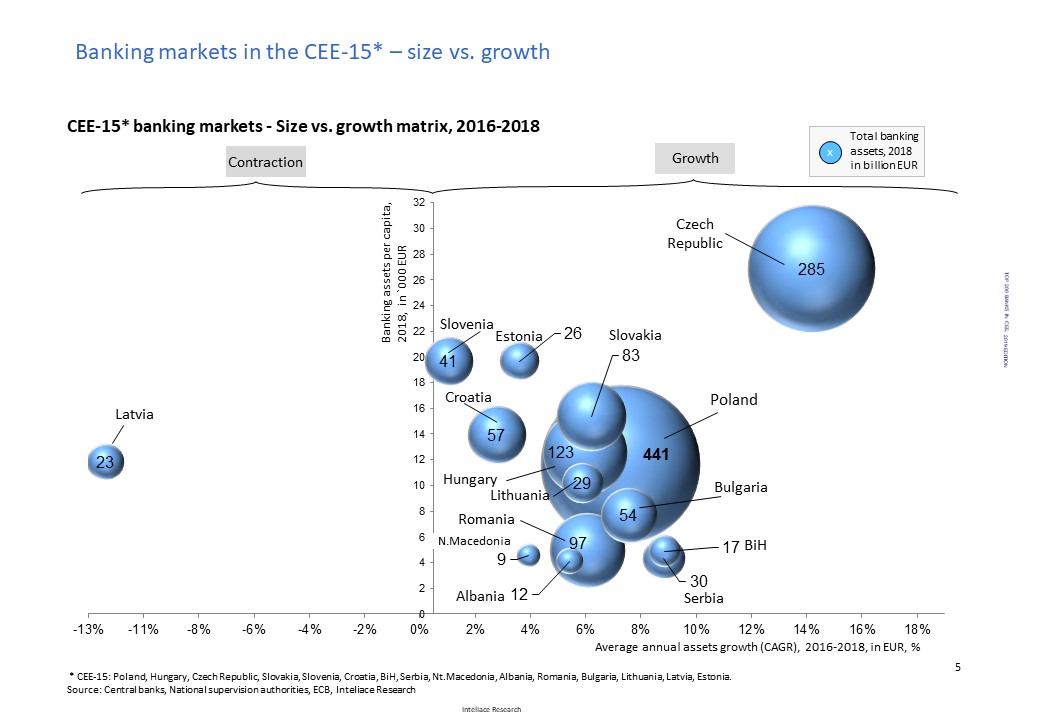
Total banking assets in CEE15* jumped to EUR 1.33 trillion in December 2018, after adding over 3.7% within last year. Markets in the Southern part of the region including Serbia, Bosnia and Bulgaria have been growing most rapidly. In a few big markets, e.g. in Poland the nominal growth in assets has been partially offset by depreciating currency. The profitability of major CEE banks improved slightly with weighted ROA and ROE improving to 1.16% and 10.4% respectively. The leading banking groups in the region: Erste, KBC and UniCredit did not change, however, the consolidation processes continued with local players getting stronger and smome foreign players reducing their presence in the region, e.g. Societe Generale or Raiffeisen. ------------------------------------------------------------------ *CEE15 include: Poland, Czech Republic, Hungary, Slovak Republic, Romania, Bulgaria, Estonia, Latvia, Lithuania, Croatia, Slovenia, Serbia, Bosnia and Herzegovina, Albania, and North Macedonia.
Insurance market in Poland, 2019-2021
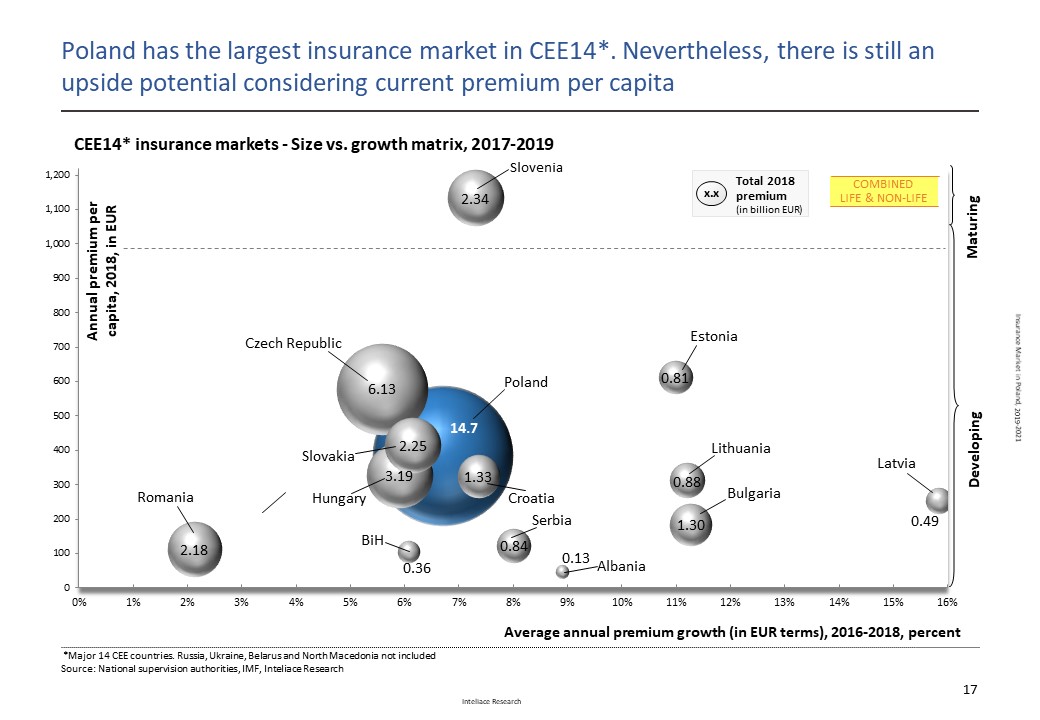
Poland has the largest insurance sector within the CEE with nearly €15 billion in premium written p.a. and almost 40% regional share in terms of GWP. There are mixed trends observed in the insurance sector in Poland recently. While the non-life segment continues with a strong growth, the life insurance segment struggles with re-adjusting of product and service offering to the new regulatory regime. Premium in the non-life segment jumped by 7% in 2018 and by 3% in 1H 2019, and it is expected to top PLN 42 billion by year end 2019. By contrast, the premium in the life segment continued to decline, falling by nearly 12% in 2018 and going down again by another 3% in 1H 2019. For more information on recent developments in the Polish insurance sector, please refer to the full publication.
Bank outlets in Poland, 2019
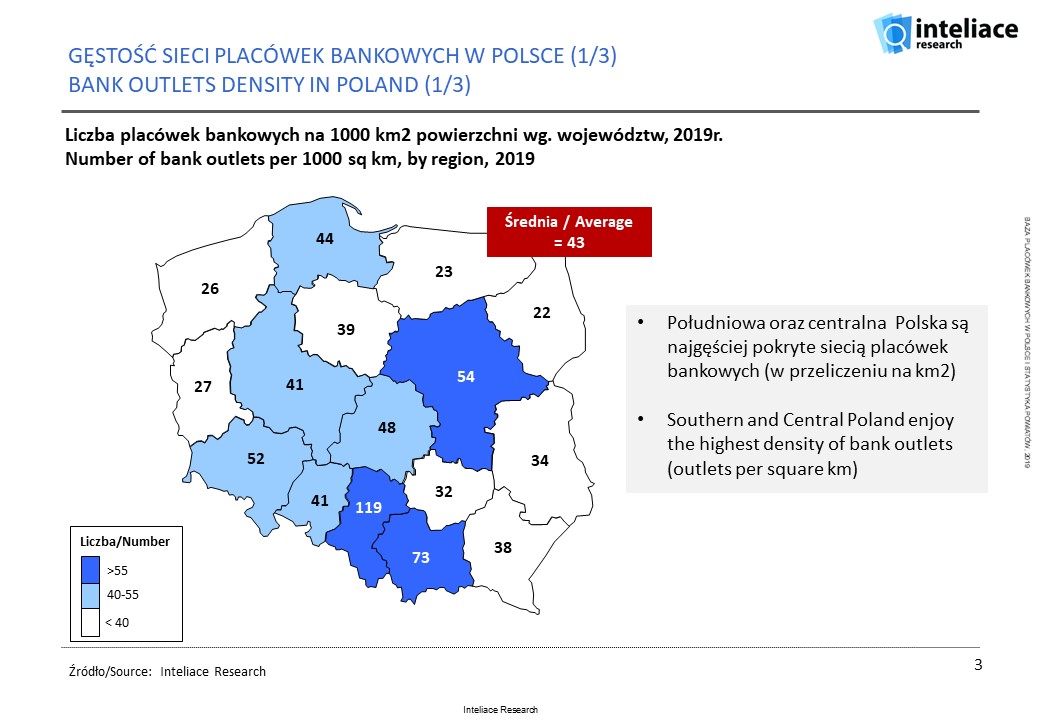
The number of bank outlets in Poland continues to fall. As of Q1 2019, there were 13412 bank and credit union outlets, which corresponded to 349 outlets per million capita. The total number of outlets fell in Q1 2019 vs. Q1 2018 by 746 outlets or by over 5% YoY. Looking forward, further bank outlet closures should be expected. An increasing use of remote channels, including mobile, and a growing personal service cost will put pressure on banks to close even more outlets. For more information please refer to the full publication/database.
Mortgage lending in Poland, 2019-2021
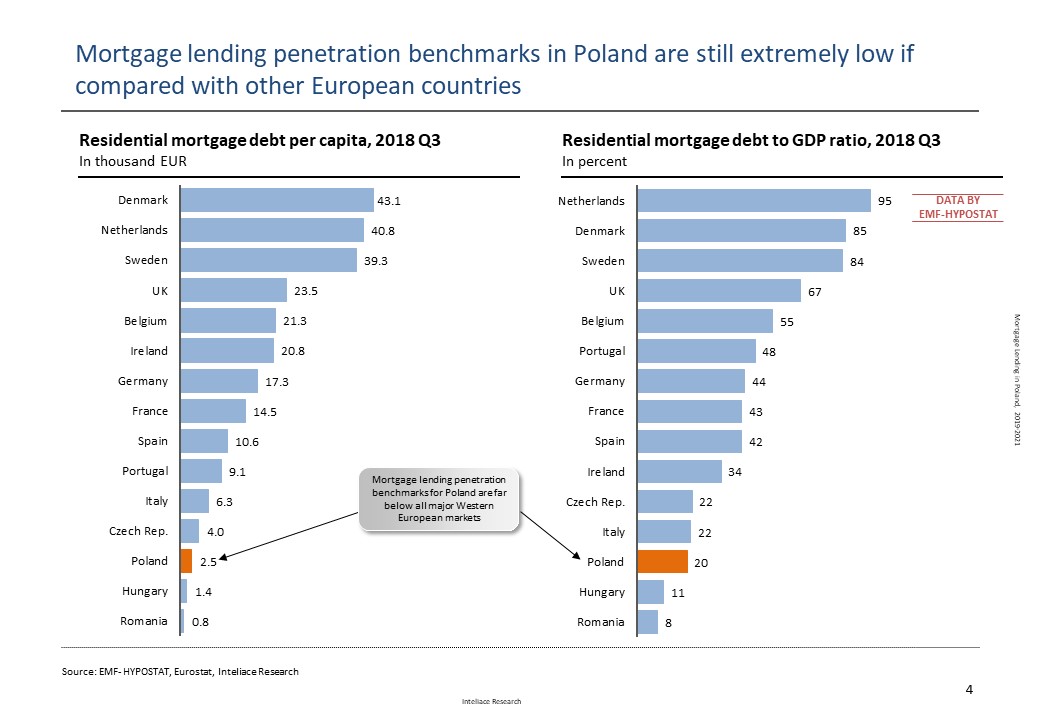
Residential construction in Poland accelerated again in 2018 extending growth trends observed since 2014. The number of completions jumped by 9%, the number of new permits increased by 3% and the number of starts surged by 19% in 2018. The key driving forces of new residential construction remained unchanged. Stable interest rates, rising purchasing power of individuals and positive consumer sentiment fuel new purchases. Moreover, real estate investments are increasingly popular in view of growing residential rents and due to low opportunity cost of holding cash or deposits. Mortgage lending accelerated in 2018. Sales of new mortgage loans increased by 11% and 20% in terms of volume and value respectively, while the average loan ticket size increased by 9%. Looking forward, in our base scenario, we expect new mortgage lending to keep growing steadily through 2021. The total outstanding is likely to increase by 6% p.a. For more information on recent developments in the Polish banking sector, please refer to the full publication.
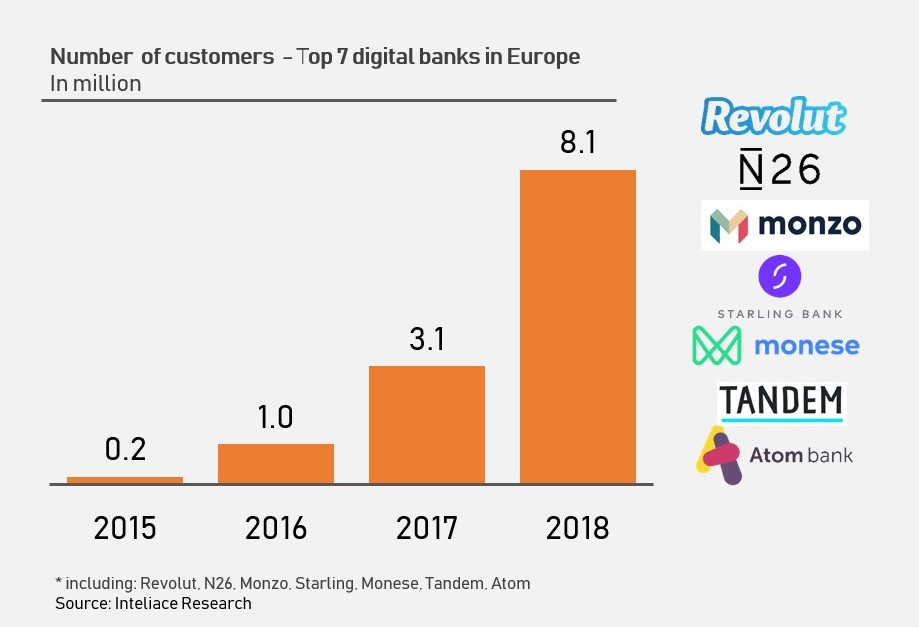
Bank challengers in Europe 2019, company profiles
Digital banks, challenger banks, neo-banks, bank challengers in Europe A brief look at challenger banks & fintech companies in Europe reveals an exceptional growth in their customer base during last few years. While the total number of customers for the sample of 7 key players was just 0.2 million in 2015, it surged to over 8 million in 2018. --------------------------------------------------------------------------------------------------------------------------------------
Payment apps and systems in Europe 2019, company profiles
Payments Payment / P2P apps and payment systemsUser engagement is highly correlated with adoption rates. So far, only three apps managed to break the vicious cycle of low adoption & low engagement - MobilePay (Denmark), Vipps (Norway) and Swish (Sweden). --------------------------------------------------------------------------------------------------------------------------------------
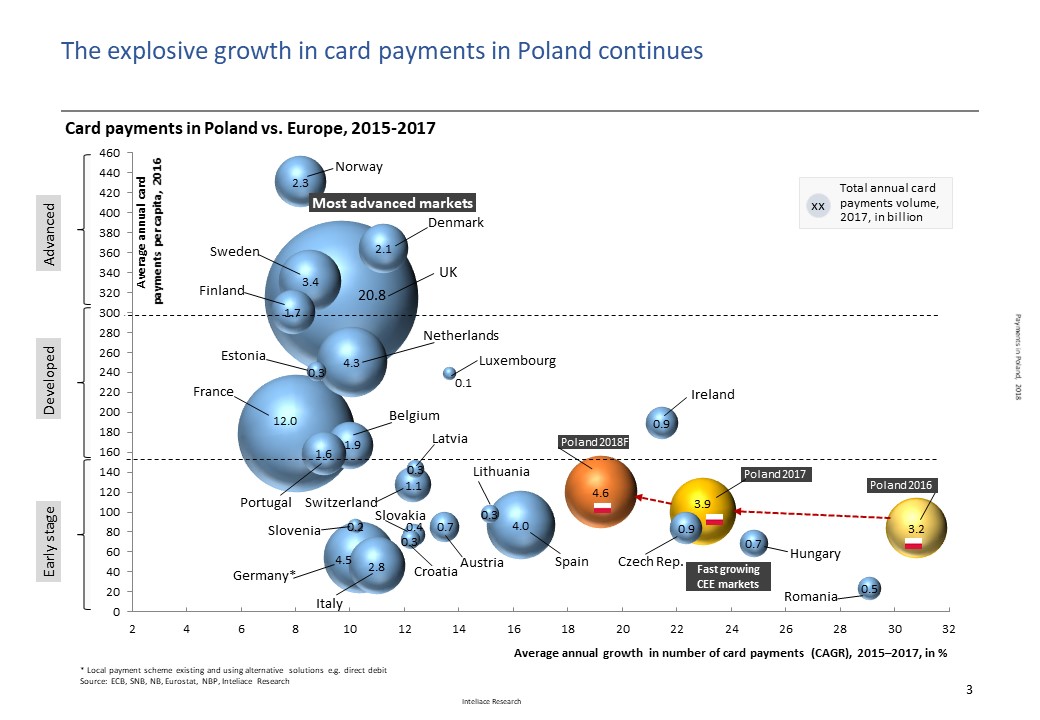
Payments in Poland, 2018
Poland's payment market has continued to experience explosive growth recently. The total number of payments exceeded 6.5 billion in 2017 and it remains on track to exceed 7.4 billion by 2018. Card payments alone reached nearly 3.9 billion tx level and they accounted for more than 59% of all payments processed in the country. The persisting growth in card transactions can be attributed to fast expansion of the acceptance network and to increasing frequency in card use. In 2017, the average annual number of transactions per single card issued in Poland approached 100 tx. per card and this ratio has more than doubled since the year 2014. Outlook The demand from consumers for convenient payment services and the ongoing support programs dedicated to the development of acceptance network, e.g. "Cashless Poland", contribute to a gradual, although slow cash displacement. It can be assumed that the growth in payment volumes will remain strong, similarly to the dominating role of cards in overall payments. The total volume of payments in Poland is likely to reach 11 billion transactions by 2022.
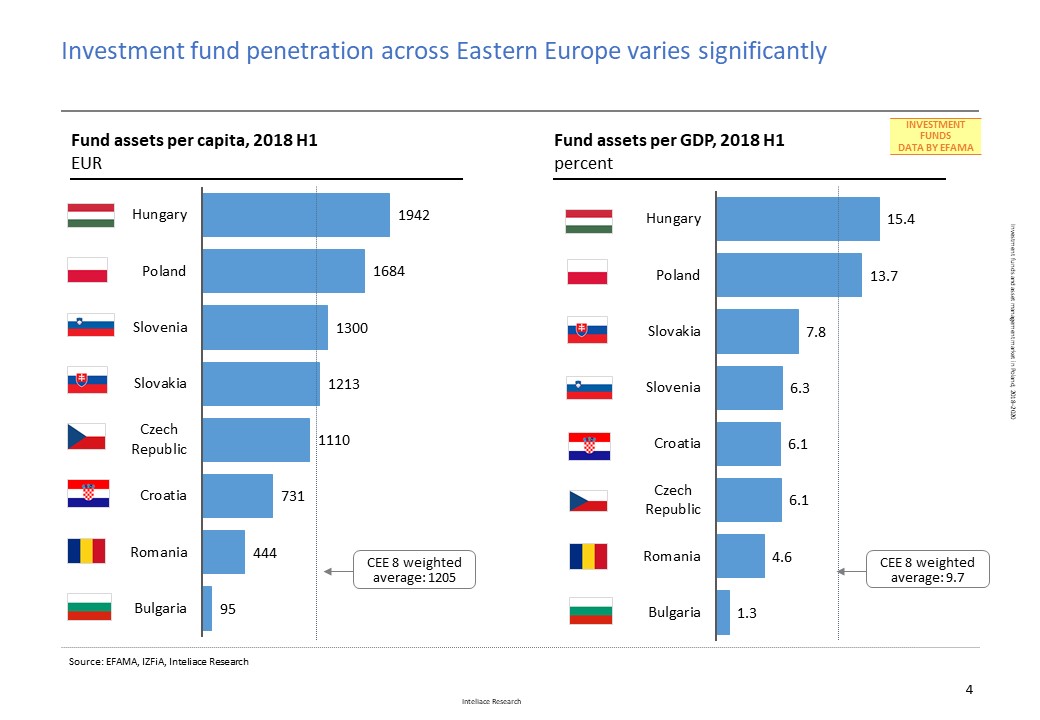
Investment funds and asset management market in Poland, 2018
After the period of a very fast growth during 2016-2017, total* assets under management in Poland decreased slightly in H1 2018 to PLN 627 billion. This was largely an effect of weaker performance of the local stock market in the first half of 2018 which translated into lower valuations of equity portfolios. The recent correction affected mostly 2nd pillar pension funds, which by law have to overweight equities. Other segments remained relatively stable thanks to new contributions offsetting weaker performance. As of June 2018, assets of regulated investment funds** reached PLN 297 billion, 3rd pillar pension assets exceeded PLN 23 billion and reserves of insurance companies stagnated at PLN 149*** billion. The asset management market remained medium-concentrated with top four groups: PZU, Aviva, NN and Ipopema managing roughly half of all assets in the market Outlook Assets under management in Poland are expected to sustain a solid growth through 2020. The most action is likely to take place within 3rd pillar pension funds since the new legal framework will mandate employers to enrol all employees and to finance contributions to employee plans. Also insurance assets and investment funds are likely to grow thanks to key driving forces: increasing wealth of individuals and low interest rates at banks.
Banking market in Romania, 2018
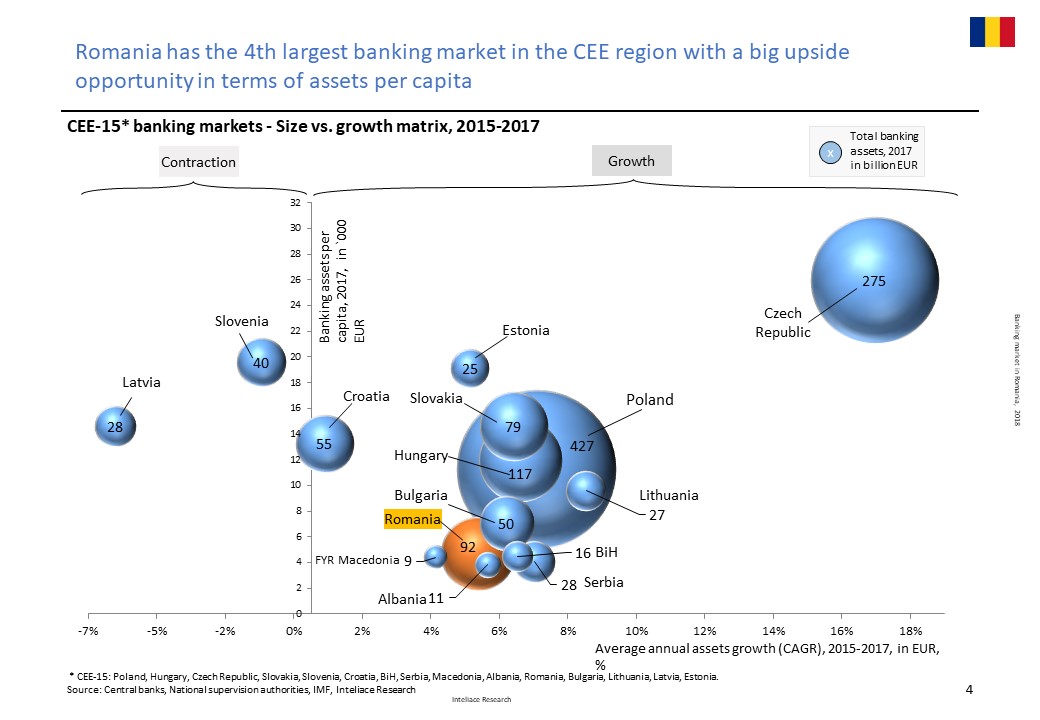
Total banking assets in Romania increased by 9% YoY in 2017 and they also sustained fast growth in the first three quarters of 2018, hitting a record high of RON 445 billion as of September 2018. Client deposits at banks recorded slightly slower rate of growth to nearly RON 368 billion with household deposits remaining strong. By contrast, outstanding client loans grew faster than in the past and reached RON 257 billion as of Q3 2018. The faster pace of growth in outstanding loans has been accompanied by the falling ratio of non-performing loans. The NPL ratio has more than halved since 2016 and reached 5.7% (EBA ratio) as of June 2018. The sector has also made further progress in containing currency related risks as the share of outstanding loans denominated in foreign currency has been reduced substantially, in particular, in case of mortgage loans. For more information on recent developments in the banking sector in Romania, please refer to the full publication.
List of Top 200 banks in Central and Eastern Europe /2018 edition/
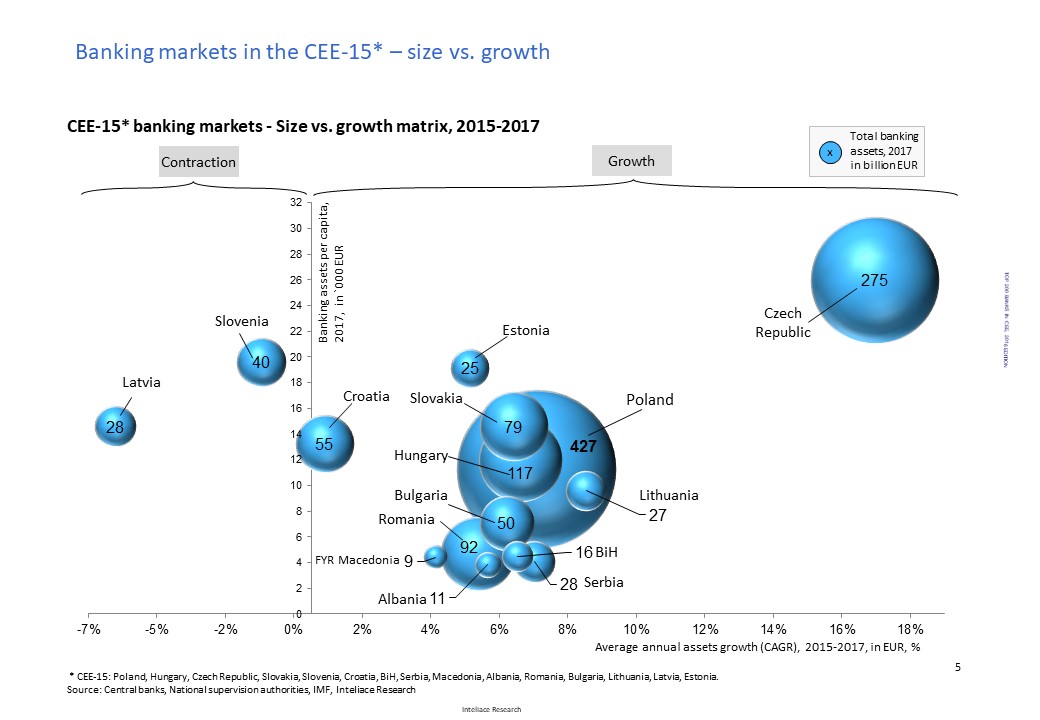
Total banking assets in CEE15* jumped to EUR 1.28 trillion in December 2017, after adding over 10% within last year. Czech Republic and Poland were the most rapidly growing markets. Growing assets were boosted by the nominal asset increases and appreciating currencies. By contrast to growing assets, the profitability of major CEE banks declined slightly with weighted ROA and ROE contracting to 1.13% and 9.8% respectively. The leading banking groups in the region: Erste, KBC and UniCredit did not change, however, the consolidation processes continued with local players getting stronger and smaller foreign players seeking to exit. ------------------------------------------------------------------ *CEE15 include: Poland, Czech Republic, Hungary, Slovak Republic, Romania, Bulgaria, Estonia, Latvia, Lithuania, Croatia, Slovenia, Serbia, Bosnia and Herzegovina, Albania, and FYR Macedonia.
Insurance market in Poland, 2018-2020
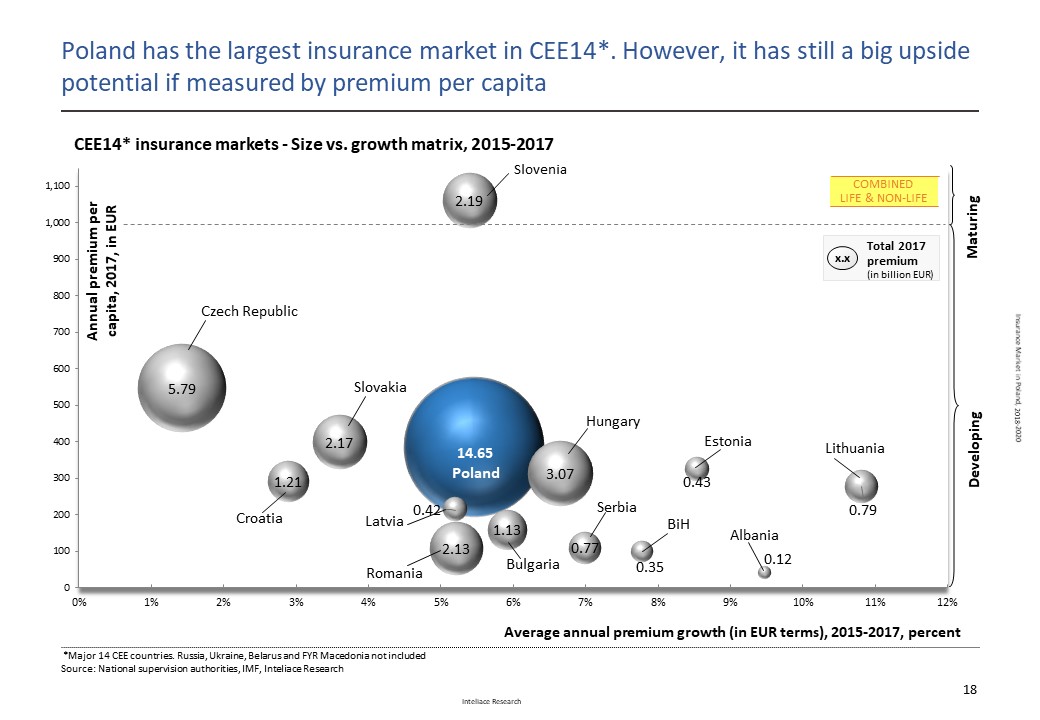
Poland has the largest insurance sector within the CEE with nearly € 15 billion in premium written p.a. and over 41% regional share in terms of GWP. 2017 was a good year for insurers operating in Poland. Premium written in non-life insurance surged by 18% YoY to nearly PLN 37.8 billion fuelled primarily by car insurance and benefiting from both higher tariffs and increasing number of insured cars. Also financial risks, health-related and property insurance sustained fast growth. By contrast, a remarkable reversal took place in the life insurance segment. After multiple years of declines, life insurance premium rebounded and started to grow again. This was possible thanks to much higher sales of unit-linked insurance – a result of multiple factors, including stronger equity markets and low interest rates at banks. Overall life insurance premium advanced by 3 %YoY and reached PLN 24.6 billion in 2017. For more information on recent developments in the Polish insurance sector, please refer to the full publication.
Bank outlets in Poland, 2018
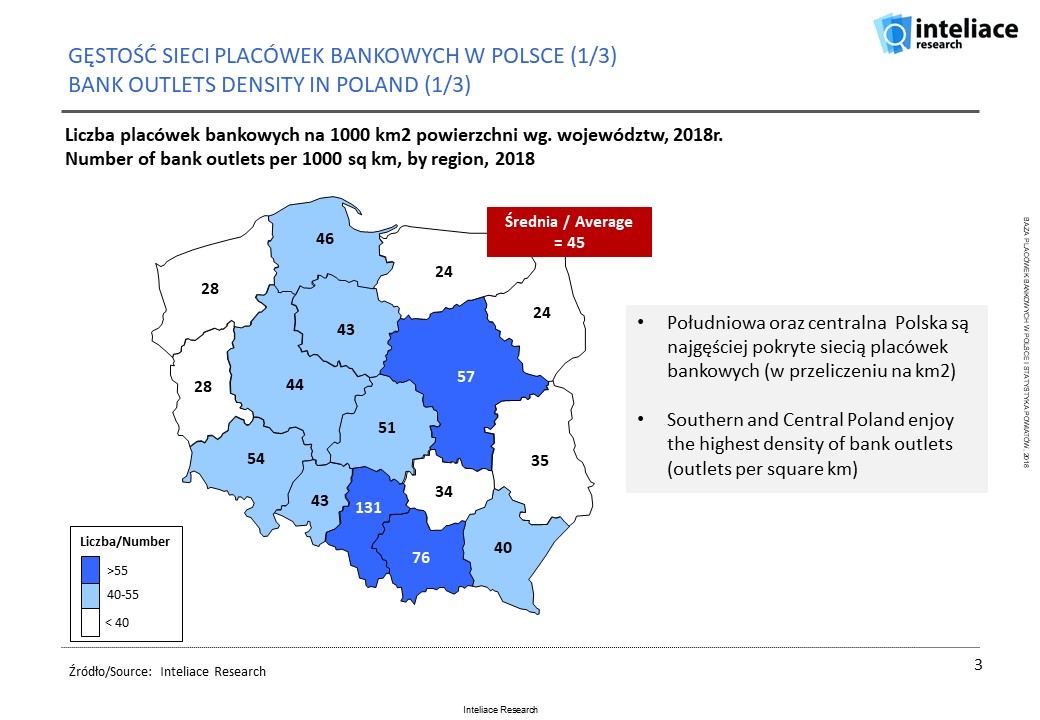
The number of bank outlets in Poland continues to fall. As of Q1 2018, there were 14158 bank and credit union outlets, which corresponds to 368 outlets per million capita. The total number of outlets fell in Q1 2018 vs. Q1 2017 by 917 outlets or by over 6% YoY. Looking forward, further bank outlet closures should be expected. An increasing use of remote channels, including mobile, and a growing personal service cost will put pressure on banks to close even more outlets. For more information please refer to the full publication/database.
Banking Market in Poland, 2018-2020
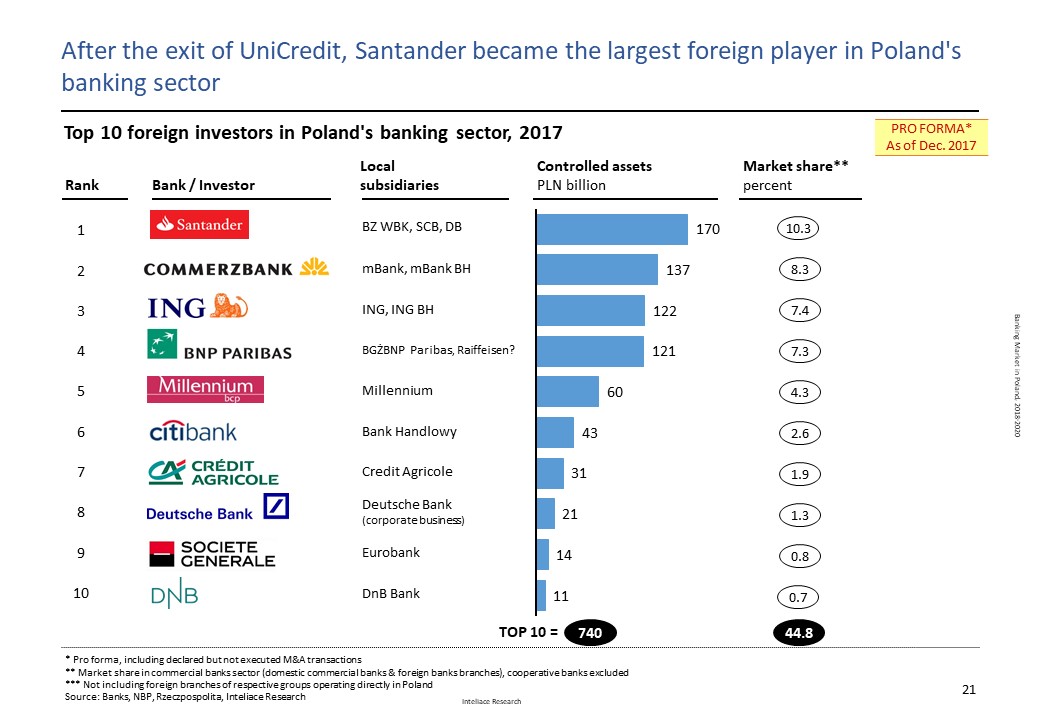
Banking volumes have continued to grow during 2017, however, they increased slower than in the past. Deposits of non-financial clients at banks reached PLN 1.14 trillion after a 4% YoY growth while client loans increased to PLN 1.15 trillion, recording a 3% YoY growth. The recent change in key volumes was balanced across all client segments, however, corporate lending advanced slightly faster than other variables. As a consequence of growing client volumes, total banking assets went also up and reached PLN 1.78 trillion as of December 2017. Consolidation trends observed in previous years continued also in 2017. Santander`s subsidiary - BZ WBK secured the acquisition of retail and SME activities of Deutsche Bank Polska while BGŻ BNP Paribas was the winner in negotiations for the business of Austria's Raiffeisen bank leaving Poland. As a consequence of recently announced deals, the banking market will soon become pretty concentrated with 6 major banks managing assets in excess of PLN 100 billion each and holding a combined market share in excess of 55%. For more information on recent developments in the Polish banking sector, please refer to the full publication.
Mortgage lending in Poland, 2018-2020
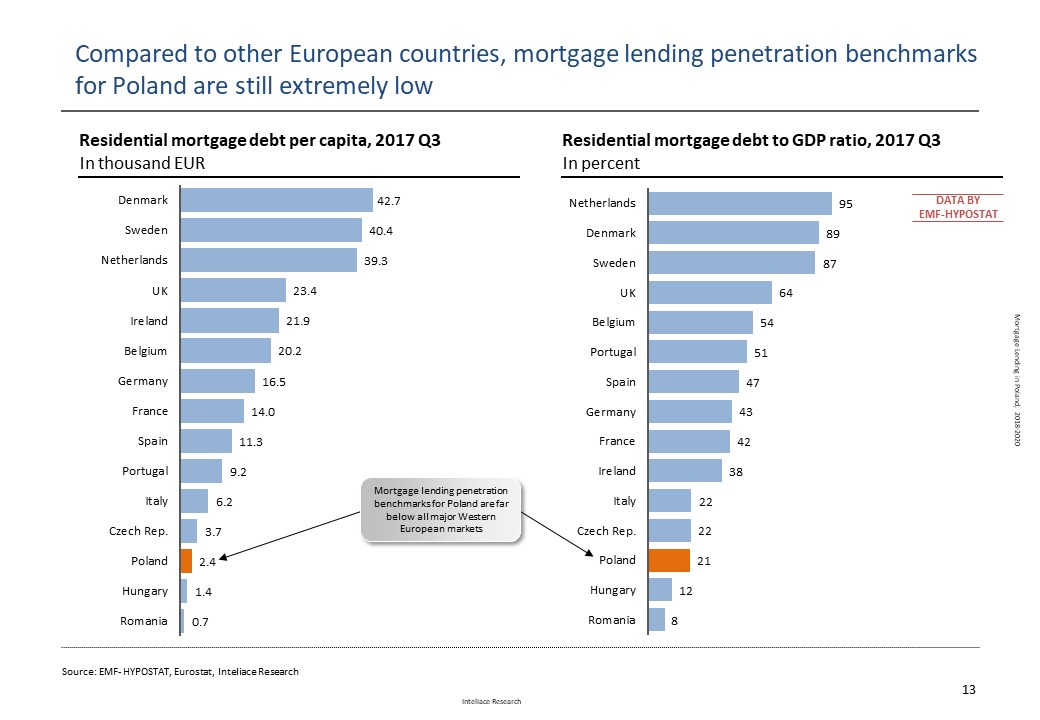
Residential construction in Poland accelerated again in 2017 extending growth trends observed since 2014. While the number of completions jumped by 9%, the number of new permits surged by nearly 18% in 2017 alone. The key driving forces of new residential construction remained unchanged. Stable, record-low interest rates and rising purchasing power of individuals fuel new purchases. Moreover, real estate investments have been increasingly popular in view of growing residential rents and due to low opportunity cost of holding cash or deposits. After multiple years of stagnation mortgage lending has seen some recovery during 2017. Sales of new mortgage loans increased by 5% and 11% in terms of volume and value respectively, which also reflected growing average loan ticket size. Looking forward, in our base scenario, we expect new mortgage lending to keep growing at moderate rates through 2020. The total outstanding is likely to increase by 5% p.a. For more information on recent developments in the Polish banking sector, please refer to the full publication.
Payments in Poland, 2017
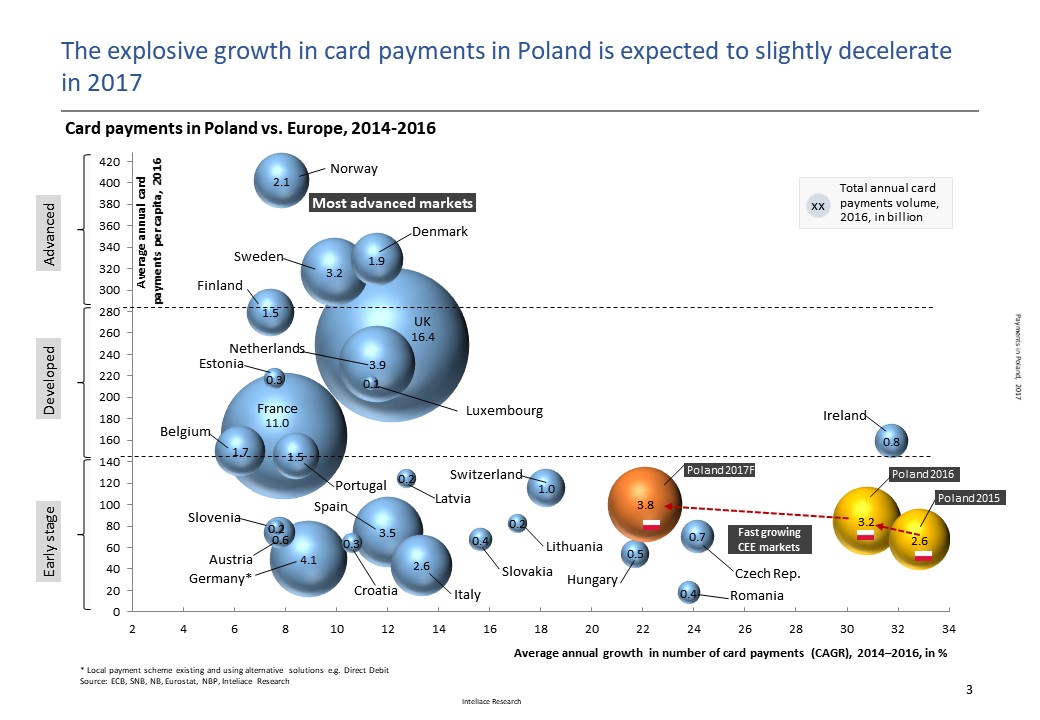
Poland's payment market is growing rapidly. The total number of payments exceeded 5.6 billion as of 2016 and it is estimated to top 6.4 billion in 2017. Most transactions executed in Poland involve payment cards and the share of cards in total payments exceeded 57%, corresponding to over 3.2 billion transactions in 2016. The fast growth in card transactions could be attributed to increasing frequency in card use and a gradual displacement of cash. Outlook The growth in payment volumes in Poland is likely to continue as will the role of cards in overall payments. Thanks to the proliferation of POS terminals and alternative payment solutions, in particular, in sectors where they have not been applied before, e.g. in public administration, the Post Office, local authorities and in smallest stores etc, cash will continue to be displaced. Assuming that no change in current trends will occur, the total volume of payments in Poland is likely to reach 10 billion transactions within next five years.
Investment funds and asset management market in Poland, 2017
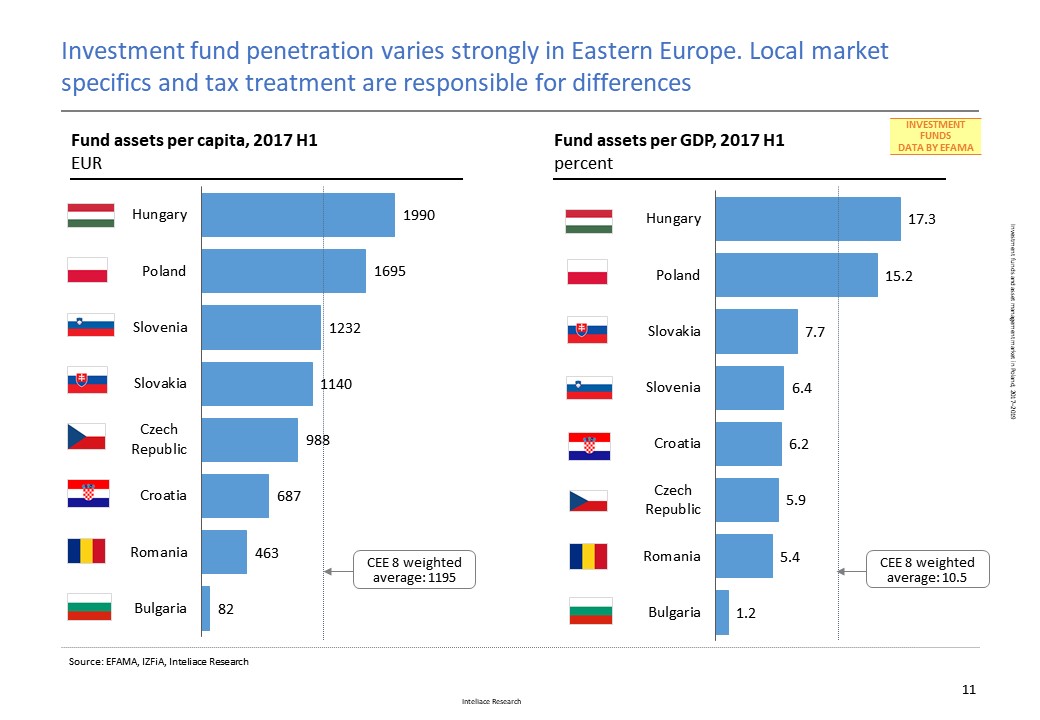
The growth in Poland's asset management sector has accelerated across all its segments, during 2016-2017H1. Assets of regulated investment funds reached PLN 272* billion, while reserves of insurance companies increased to PLN 148** billion, as of June 2017. At the same time, assets in the mandatory second pillar and in the voluntary third pillar III pension funds jumped to PLN 175 billion and PLN 21 billion respectively. As a consequence, the overall value of assets under management (AuM) in Poland topped PLN 632 billion or nearly EUR 150 billion in June 2017. Three largest firms: PZU, Aviva and NN managed AuM of over PLN 236 billion in total and their combined market share exceeded 40%. Outlook Assets under management in Poland are expected to experience solid growth in 2017 and to remain in an upward trend through 2019.
Banking market in Romania, 2017
Total banking assets in Romania increased by 4.4% YoY to a record of RON 394 billion as of December 2016. Client deposits at banks recorded strong 12% YoY growth to nearly RON 333 billion with government and household deposits increasing most quickly. By contrast, outstanding client loans increased only by a fraction in 2016 and reached RON 231 billion. This was a consequence of a continued contraction in corporate lending and a still slow growth in retail loans. One of the most encouraging trends has been the falling ratio of non-performing loans which has halved since 2014. Banking sector in Romania has also made a significant progress in reducing currency risk as the share of outstanding loans denominated in foreign currency has fallen substantially, in particular in case of corporate and mortgage loans. For more information on recent developments in the banking sector in Romania, please refer to the full publication.
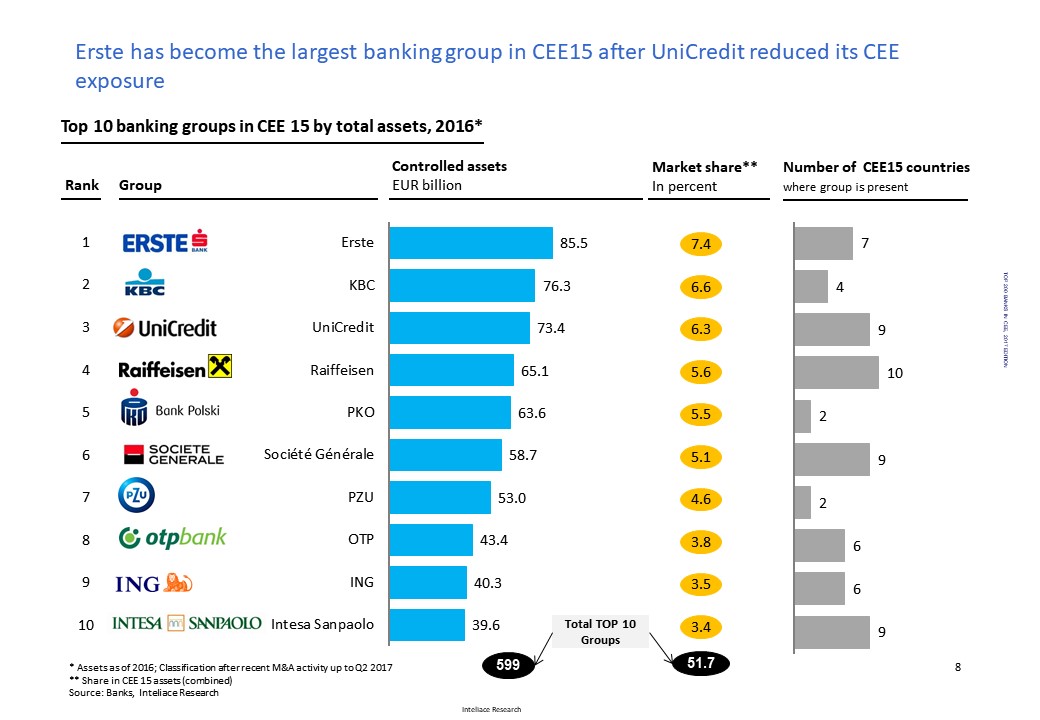
List of Top 200 banks in Central and Eastern Europe
Total banking assets in CEE15* reached 1.16 trillion EUR as of December 2016, after adding ca.4% value within a year. The profitability of major CEE banks surged with weighted ROA and ROE jumping to 1.18% and 10.2% respectively in 2016. Despite recently observed convergence trends, there are still significant differences among CEE countries in terms of banking intermediation levels. While banking assets per capita exceeded EUR 20k in Czech Republic, the benchmark was nearly 6 times lower for Albania and Bosnia-Herzegovina.The level of financial intermediation for most of CEE is still extremely low if compared to Western Europe and the gap is expected to narrow gradually. -------------------------------------------------------------------------------------------------------------------------------------- *CEE15 includes Poland, Czech Republic, Hungary, Slovak Republic, Romania, Bulgaria, Estonia, Latvia, Lithuania, Croatia, Slovenia, Serbia, Bosnia and Herzegovina, Albania, and Macedonia.
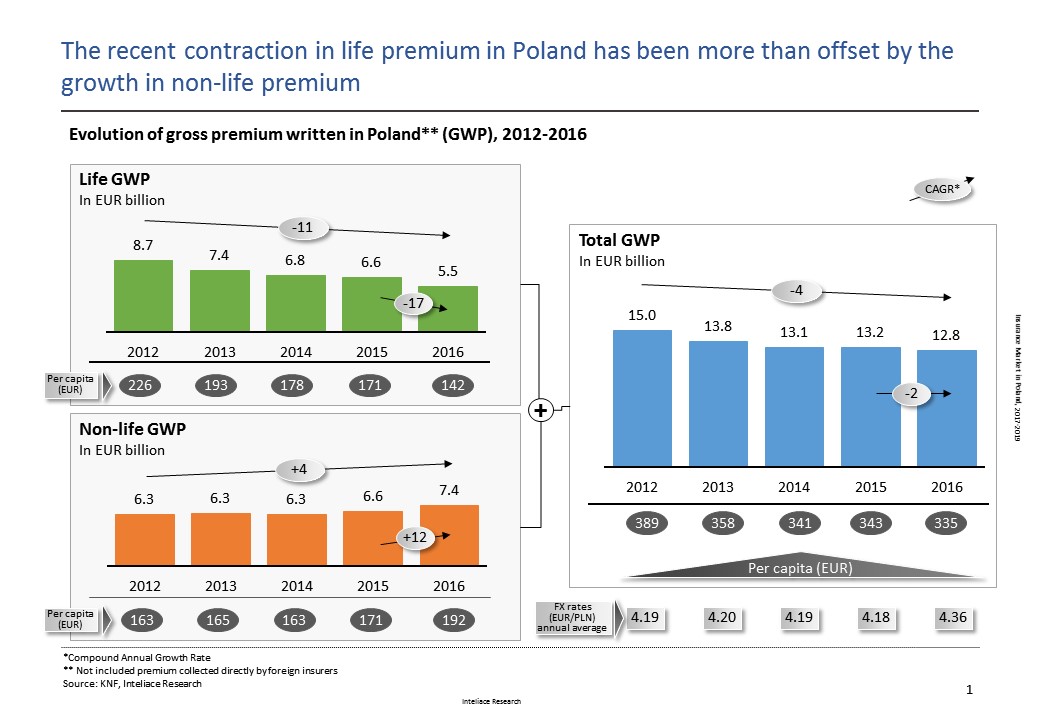
Insurance market in Poland, 2017-2019
Poland has the largest insurance sector in the CEE with nearly € 13 billion in premium written p.a. and a 40 % regional GWP share. After overcoming the recent stagnation, total insurance premium in Poland is expected to increase at ~7% p.a. through 2019. The non-life insurance segment is likely to continue the fast growth driven by increasing tariffs and a higher number of contracts. Also the improving situation of enterprises is expected to fuel more demand for specialized insurance products in the corporate sector including property insurance. A rebound in new premium is expected to take place in the life business, after a tighter regulatory regime is fully implemented in 2017. Considering the extremely high competition among insurers and a persisting trend for higher claims, it is expected that profitability of insurers will improve only slightly in 2017-2018. For more information on recent developments in the Polish insurance sector, please refer to the full publication.
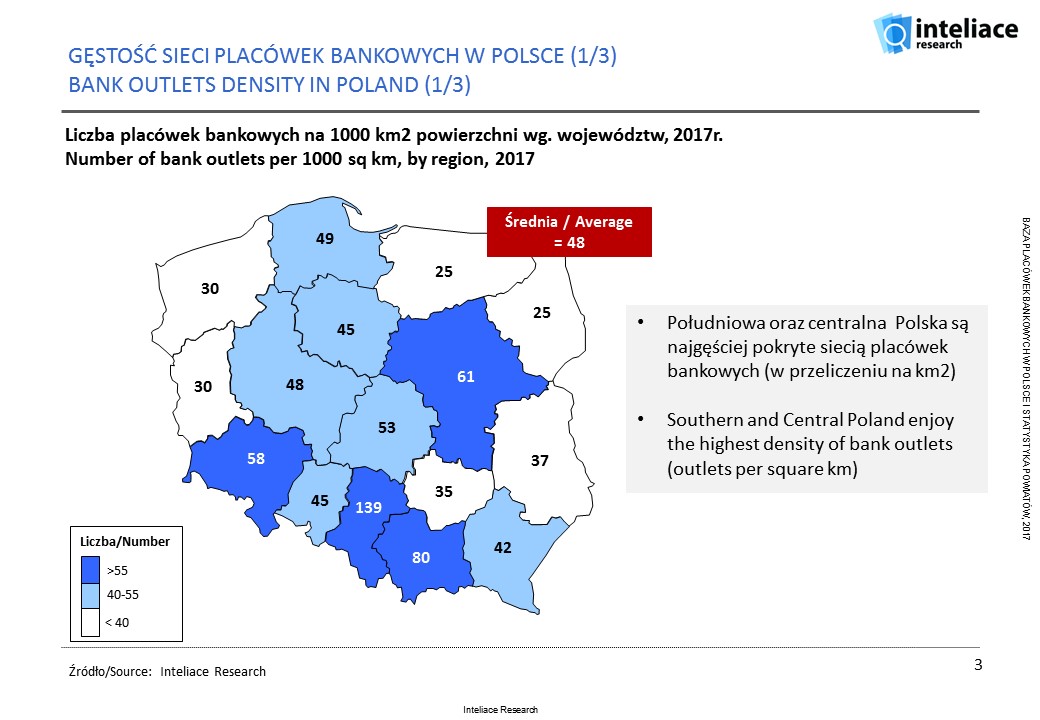
Bank outlets in Poland, 2017
The number of bank outlets in Poland continues to fall. As of Q1 2017, there were 15093 bank and credit union outlets, which corresponds to 393 outlets per million capita. The total number of outlets fell in Q1 2017 vs. Q1 2016 by 917 outlets or by nearly 6% YoY. Looking forward, further bank outlet closures should be expected. An increasing use of remote channels, including mobile, and a growing personal service cost will put pressure on banks to close even more outlets. For more information please refer to the full publication/database.
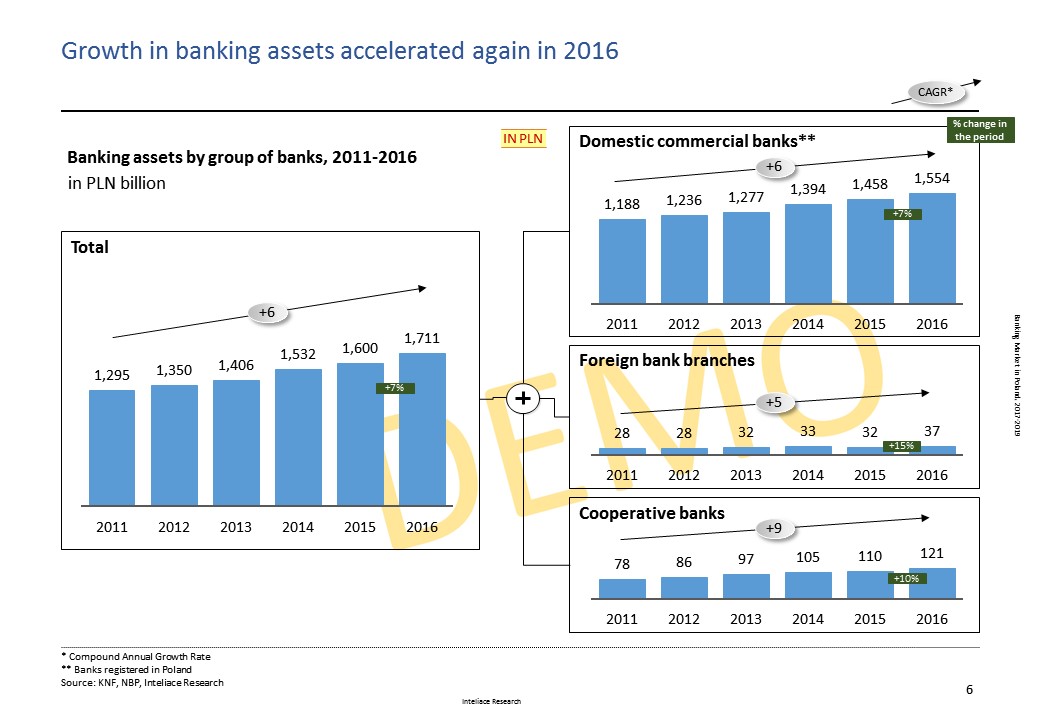
Banking market in Poland, 2017-2019
Banking sector. Banking volumes have continued to grow fast during 2016, despite relatively unfavourable regulatory environment. Deposits of non-financial clients at banks recorded a strong 11% YoY increase to nearly PLN 1.1 trillion while lending increased a bit slower, at 5% YoY to PLN 1.11 trillion. The growth of volumes was balanced across all client segments, however, retail deposits advanced particularly fast. As a consequence of growing key volumes, total banking assets increased by 7% YoY to a record of PLN 1.71 trillion as of December 2016. For more information on recent developments in the Polish banking sector, please refer to the full publication.
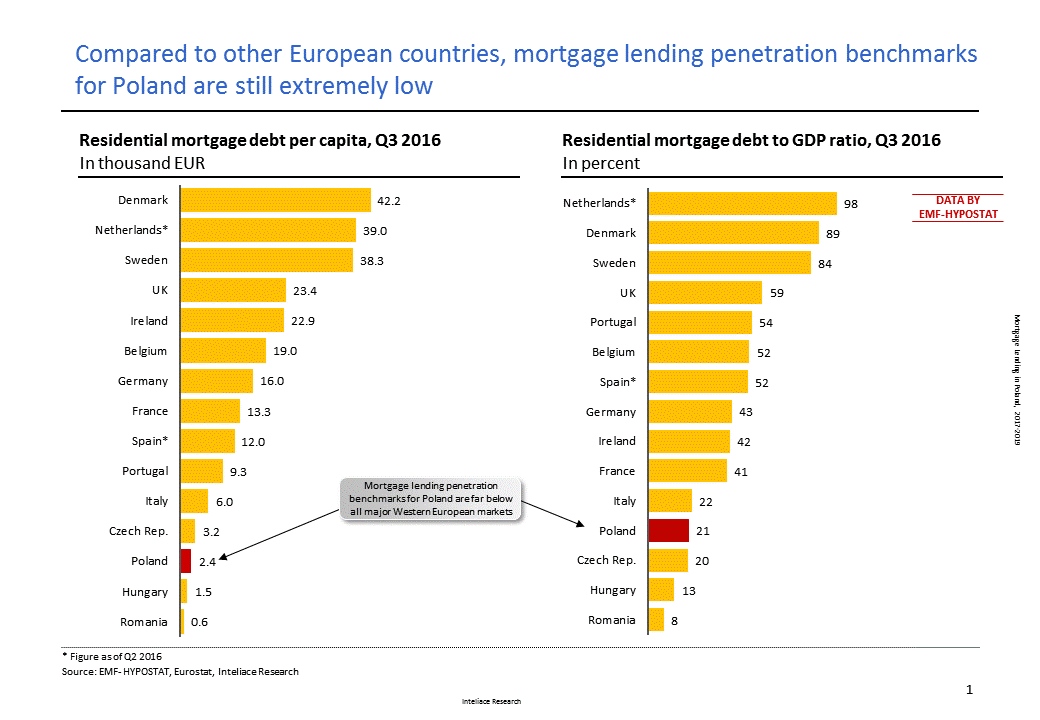
Mortgage lending in Poland, 2017-2019
The growth in Poland's residential construction observed since early 2014 persisted throughout 2016. The number of new permits and starts increased to 212k and 174k respectively in 2016. Key driving forces of new residential construction have been record-low interest rates encouraging investment-type transactions and rising purchasing power of individuals. In 2016, average wages and salaries increased by +2.7% and the unemployment rate fell to 8.3% as of Dec. 2016 vs. 9.7% a year before. At the same time, residential real estate prices have been pretty stable with -3% to +5% YoY change as of Q3 2016, depending on location. Nevertheless, it is worth noting that housing prices are still lower by 2% to 10% if compared to 2010 levels. In contrast to strong residential construction sector, new mortgage lending by banks remained depressed in 2016. New sales of mortgage loans were almost unchanged in terms of value and they contracted by 2% if measured by volume. There are multiple reasons of weak sales of new mortgage loans by banks. One of them is higher share of buyers paying with cash, which is a consequence of increasing investment demand due to low interest rates (property for rent). Moreover, mortgage loans have been more expensive due to growing interest margins as banks have been passing increasing fees and taxes on clients. Finally, the range of mortgage lending offered by banks in Poland is still inadequate. While fixed interest rate contracts are very rare, variable rate loans, adjusted on a quarterly or half-yearly basis dominate in banks offer. For more information on recent developments in the Polish banking sector, please refer to the full publication.
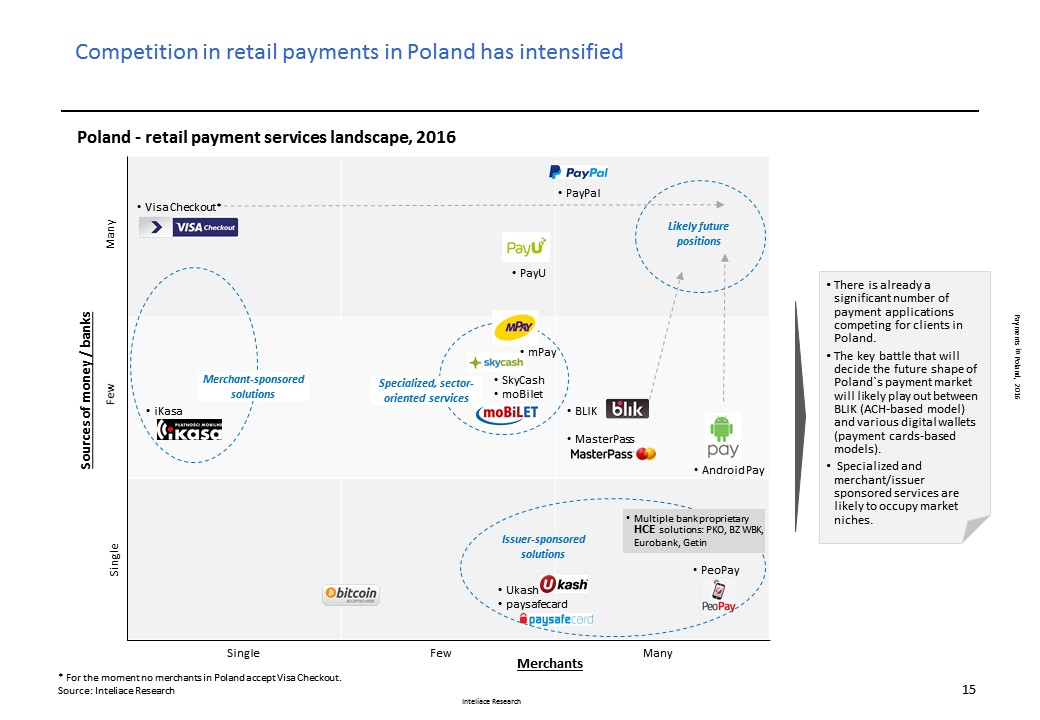
Payments in Poland, 2016
Poland's payment market has experienced an explosive growth during recent years. The number of card payments has more than doubled since 2013 and it has exceeded 3 billion by 2016. As consumers embraced card payments, Poland advanced to top six European markets by the number of transactions. The key factor of surging use of cards in Poland are contactless payments. Outlook The payment market will continue to expand in future as relatively high share of cash in Poland's economy offers a lot room for growth, in particular within: retail payments, P2P, public transport and public fees & duties. There is a clear opportunity in cash displacement and market participants are likely to address it. One can expect that over next five years a dominating mobile payment standard for mobile payments will evolve itself. It seems for the moment that the new standard will be based on payment cards rather than on ACH.
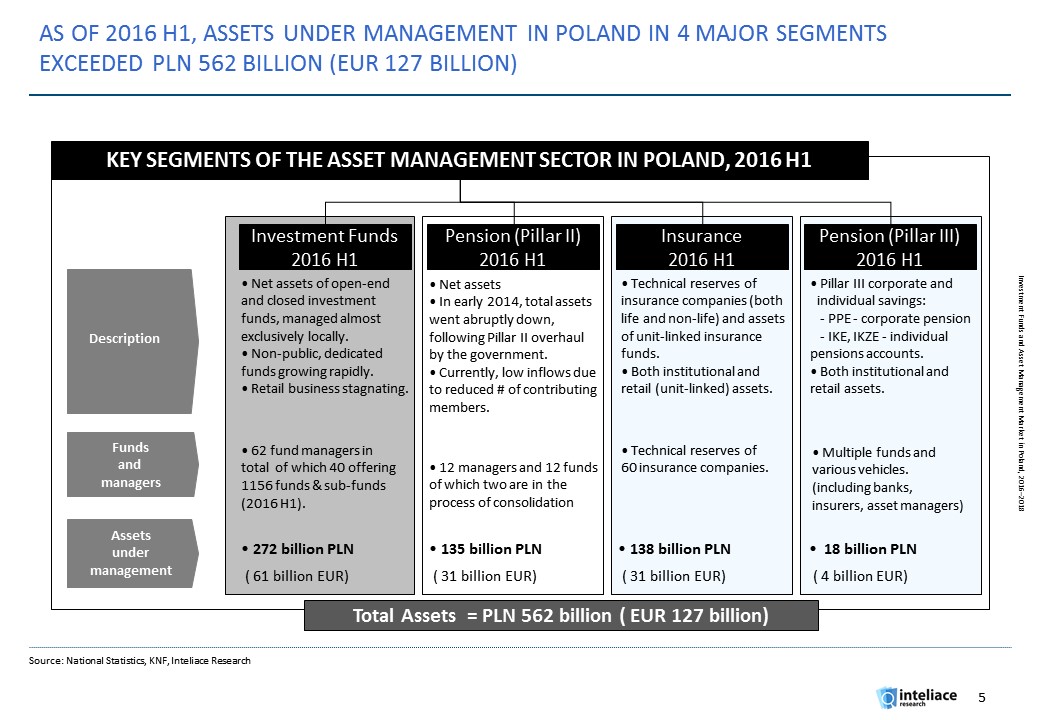
Investment funds and asset management market in Poland, 2016
Total assets under management in Poland topped PLN 562 billion or EUR 127 billion across all key categories in H1 2016. The largest part of AM market are investment funds with assets of PLN 272 billion. Outlook The asset management sector in Poland is likely to see a further growth in assets under management thanks to increasing households' wealth and corporate savings. Assets are expected to increase across all segments, whereas the highest growth rates could be anticipated in the third pillar pension sector. Although, until recently, most of newly created personal wealth has ended up in investments in productive assets, in banks as deposits or in real estate, future trends are likely to change. Based on historical evidence of more advanced economies, a gradual increase of fund component in savings, could be expected. This will, however, require asset managers to adjust the offer of vehicles and investment strategies to address key issues like: weak local equity market, low efficiency and regulatory developments. Moreover, the current fragmentation in fund management business is unlikely to persist, in view of ongoing consolidation in banking and insurance sectors. Therefore a new wave of consolidation of fund managers is likely to take place. Fund managers will need to increase the scale of operations or they will be forced to quit.
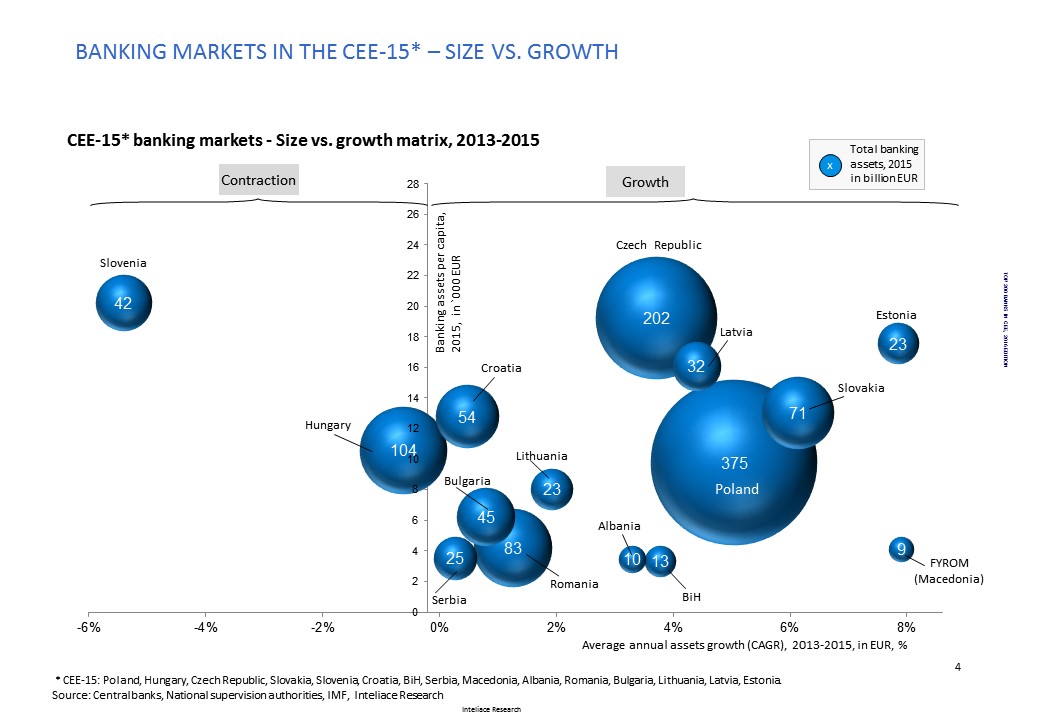
List of Top 200 banks in Central and Eastern Europe
Total banking assets in CEE15* exceeded 1.11 trillion EUR as of December 2015, after adding ca.3% value within a year. The profitability of major CEE banks has improved significantly with weighted ROA and ROE growing to 0.79% and 6.81% respectively in 2015. Despite recently observed convergence trends, there are still significant differences among CEE countries in terms of banking intermediation levels. While banking assets per capita exceeded EUR 20k in Slovenia, the benchmark was nearly 6 times lower for Albania and Bosnia-Herzegovina.The level of financial intermediation for most of CEE is still extremely low if compared to Western Europe and the gap is expected to narrow gradually. -------------------------------------------------------------------------------------------------------------------------------------- *CEE15 includes Poland, Czech Republic, Hungary, Slovak Republic, Romania, Bulgaria, Estonia, Latvia, Lithuania, Croatia, Slovenia, Serbia, Bosnia and Herzegovina, Albania, and Macedonia.
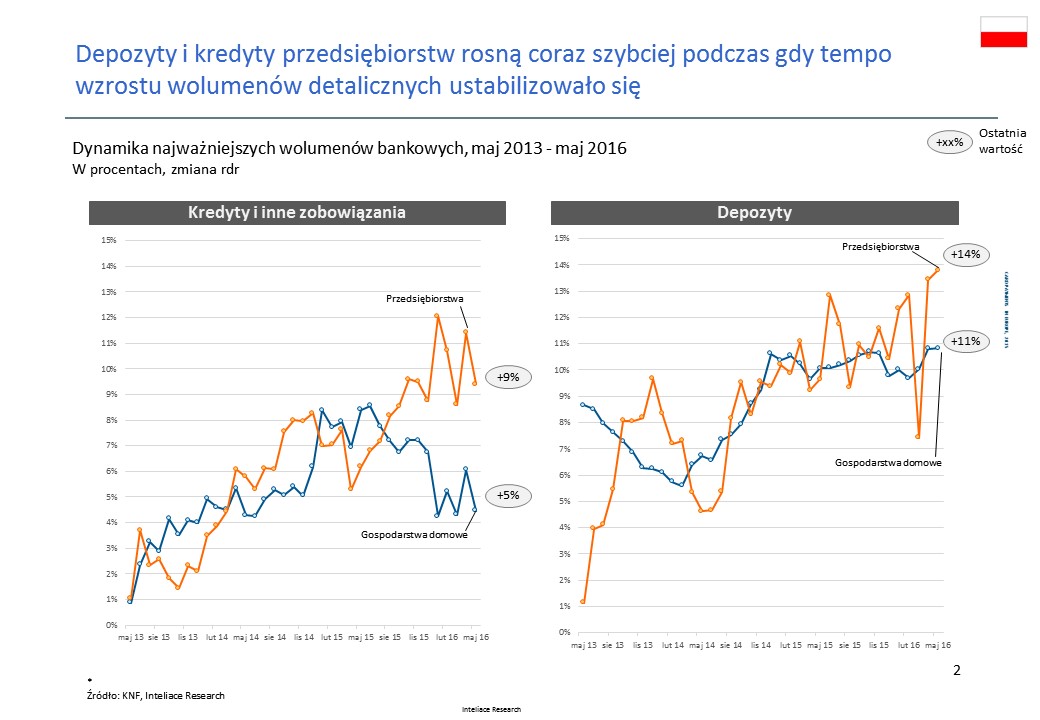
Sektor bankowy w Polsce
1. Depozyty i kredyty przedsiębiorstw rosną coraz szybciej podczas gdy tempo wzrostu wolumenów detalicznych ustabilizowało się. 2. W ciągu ostatnich 12 miesięcy gospodarstwa domowe zaoszczędziły w bankach 67 miliardów PLN, z czego około 40 miliardów PLN to wzrost zasobów netto (Wzrost salda depozytów - wzrost salda kredytów). 3. Banki podnoszą najniższe marże w wyniku podatku bankowego. Marże kredytów mieszkaniowych i kredytów dla przedsiębiorstw rosną. Jednocześnie marże kredytów konsumpcyjnych spadają. Z punktu widzenia gospodarki taki trend nie napawa optymizmem... For more information, please refer to the full publication or contact us at info@inteliace.com.
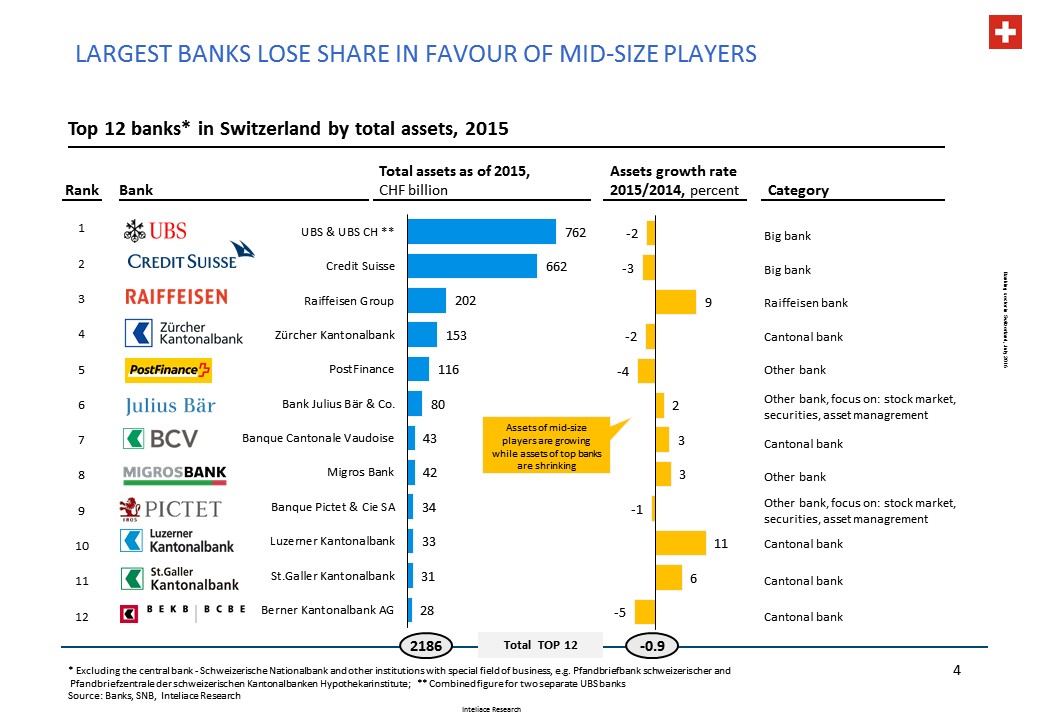
Swiss banks, 2016
Banks operating in Switzerland continue to grow. However, there are structural changes taking place in the Swiss financial sector. As largest banks slowly lose market share, the position of regional and cantonal banks is improving. The share of domestic assets is growing while the share of foreign assets decreases, which could be attributed to increasing regulatory and compliance requirements. It could be also a warning sign that the role of Switzerland among global banking centers is eroding. The profitability of banks in Switzerland improved significantly in 2015. However, the key driver was extraordinary result and not the ordinary business. By contrast, the cost-to-income ratio, reflecting the core banking activity has deteriorated to above 70%. Banks look for solutions to improve productivity by a range of measures including higher automation and alternative distribution channels. In the same time the physical distribution network and the number of employees are being gradually reduced. Raiffeisen Group and cantonal banks from Luzern and St. Gallen were the fastest growing banks among TOP 12 institutions, in terms of assets in 2015. For more information, please refer to the full publication or contact us at info@inteliace.com.
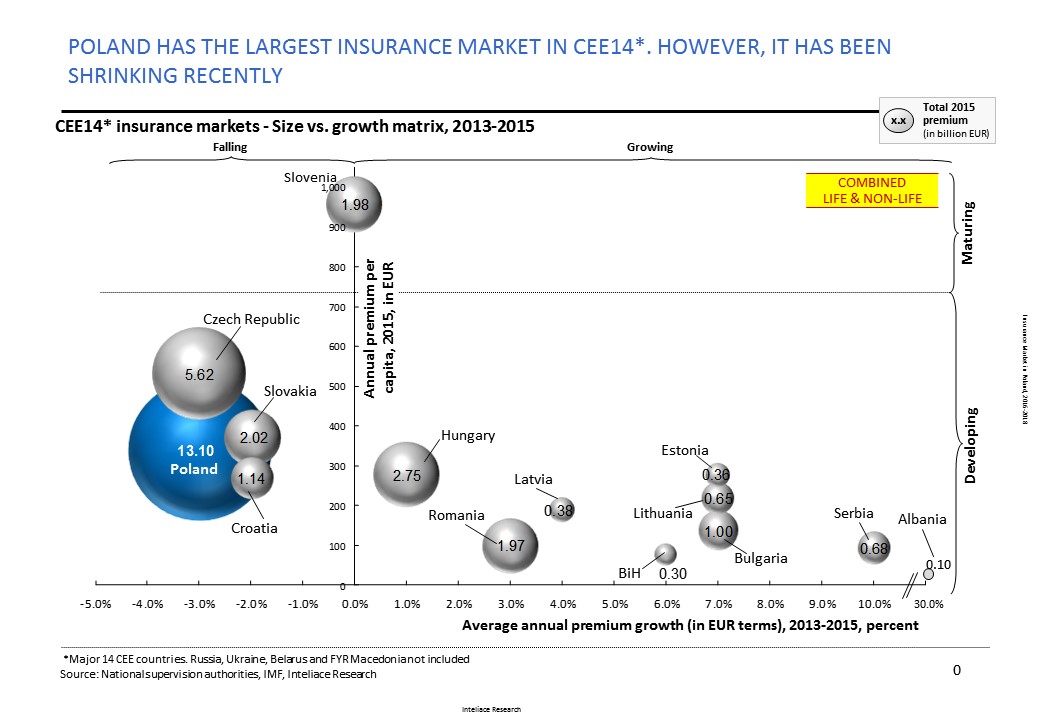
Insurance market in Poland, 2016-2018
In contrast to the general economy, the insurance sector in Poland has hardly benefited from improving situation of households and corporate subjects. While the total gross premium written in non-life business advanced by 4%, the life insurance premium fell by 4% YoY in 2015. Key drivers of recent change in life premium have been changes to the regulatory and tax regime as well as external factors including ultra-low interest rates. The recent growth in non-life premium has been primarily a result of increasing tariffs in car insurance, which was an immediate effect of rapidly growing claims and substantial losses incurred on TPL policies. For more information on recent developments in the Polish insurance sector, please refer to the full publication.
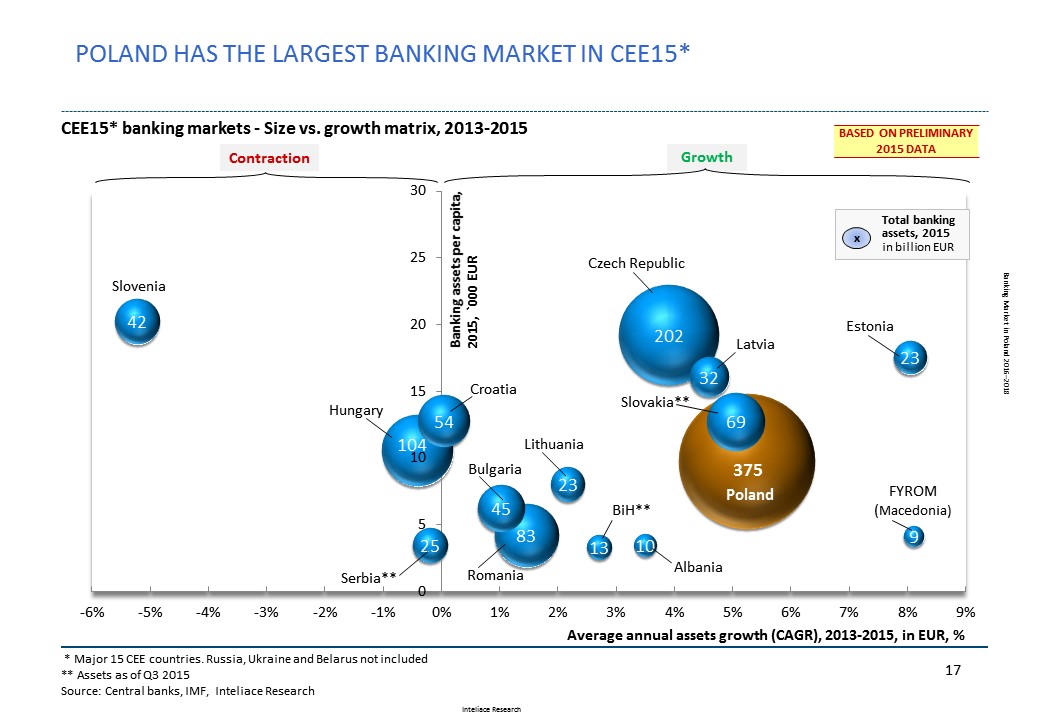
Banking market in Poland, 2016-2018
Poland's economy accelerated in 2015 with Gross Domestic Product (GDP) advancing at 3.6% annual rate. Banking volumes have continued to grow fast in course of 2015, reflecting favorable developments in the economy and higher consumer confidence. Total banking assets hit a record PLN 1.6 trillion as of December 2015, which corresponds to a 4% YoY growth rate. In our base-case scenario, we see Poland's economy remaining strong in 2016 but decelerating in 2017 and 2018. We assume a continued growth in key banking volumes, in particular in retail deposits and in corporate lending. For more information on recent developments in the Polish banking sector, please refer to the full publication.
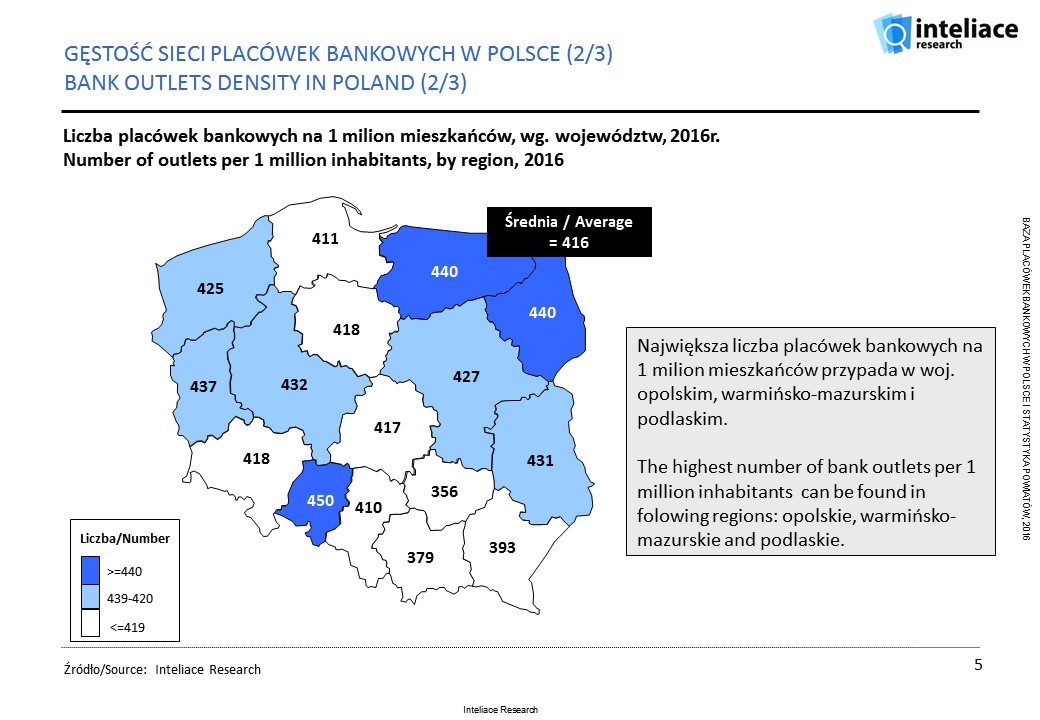
Bank outlets in Poland, 2016
The number of bank outlets in Poland keeps falling. As of Q1 2016, there were 16010 bank and credit union outlets, which corresponds to 416 outlets per million capita. The total number of outlets fell in 2015/2016 by 1210 outlets or by 7% YoY. Looking forward, more bank outlet closures should be expected. The increasing use of remote channels by customers is reducing time clients spend in physical bank outlets. For more information on recent developments in the Polish banking sector, please refer to the full publication/database.
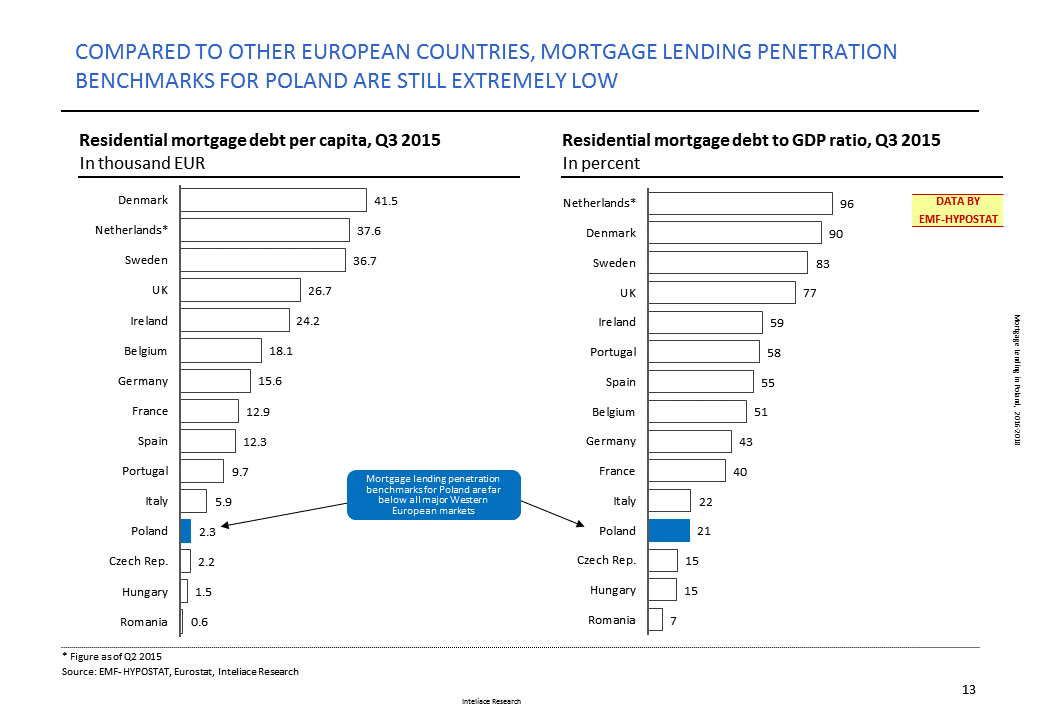
Mortgage lending in Poland, 2016-2018
An accelerating recovery in Poland`s residential construction could be observed since 2014. The number of new permits and starts jumped to 189k and 168k respectively in 2015 recording a double digit growth, compared to 2014. Key driving forces of improving new home construction have been rising income of individuals - average wages and salaries increased by +3.5% in 2015, and growing employment - the unemployment rate fell to 9.8% in Dec. 2015, compared with 11.4% a year before. Also the recent trend in real estate prices has indicated a gradual recovery. For more information on recent developments in the Polish banking sector, please refer to the full publication.
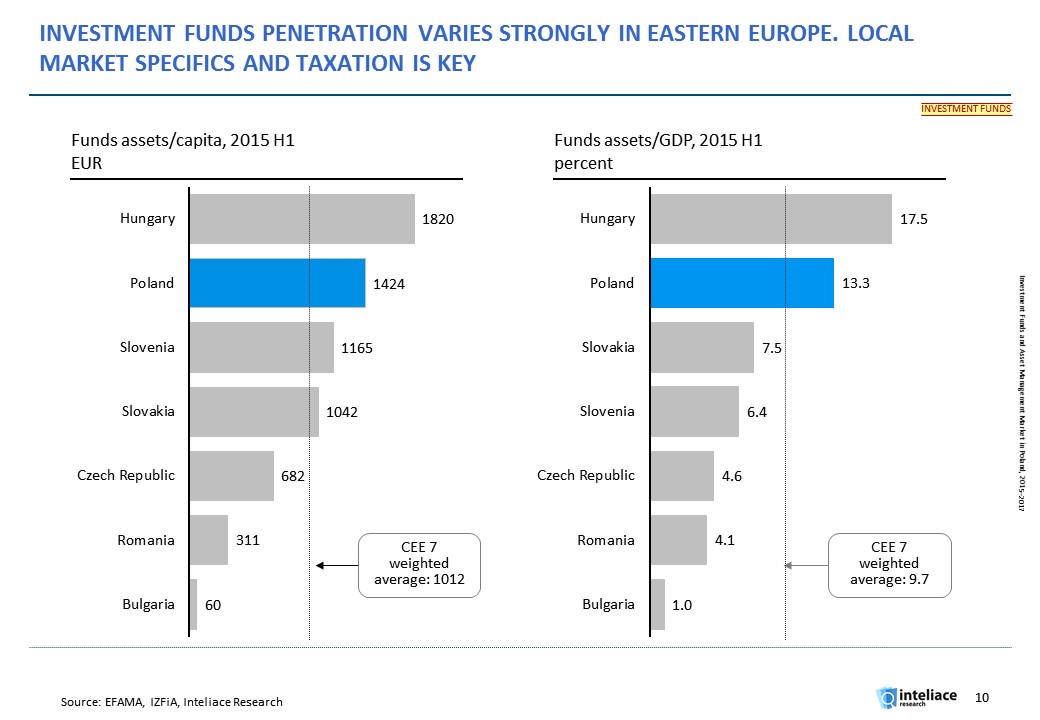
Investment funds and asset management market in Poland, 2015
The asset management industry in Poland remains in a fast-growing trend. The total value of assets under management (AuM) exceeded PLN 536 billion (EUR 128 billion) as of June 2015. While all key market segments have demonstrated positive developments, the growth in assets of investment funds has beaten other product groups. Assets of regulated investment funds topped PLN 230 billion, which corresponds to a 9% growth in the first half of 2015 alone. Outlook The asset management industry in Poland is expected to sustain a moderate growth at ~7% p.a. by 2017. In-line with historical trends it is investment fund assets, where the fastest growth is expected to occur. Nevertheless also insurance and pension assets are likely to demonstrate solid performance. A key growth factor will be increasing wealth of individuals thanks to the accelerating economy which supports private wealth formation and emergence of new clients. Today, the asset management industry in Poland is serving directly over 2 million clients which is a fraction of the population. However, growing disposable income and personal wealth could easily double this figure within the next decade.
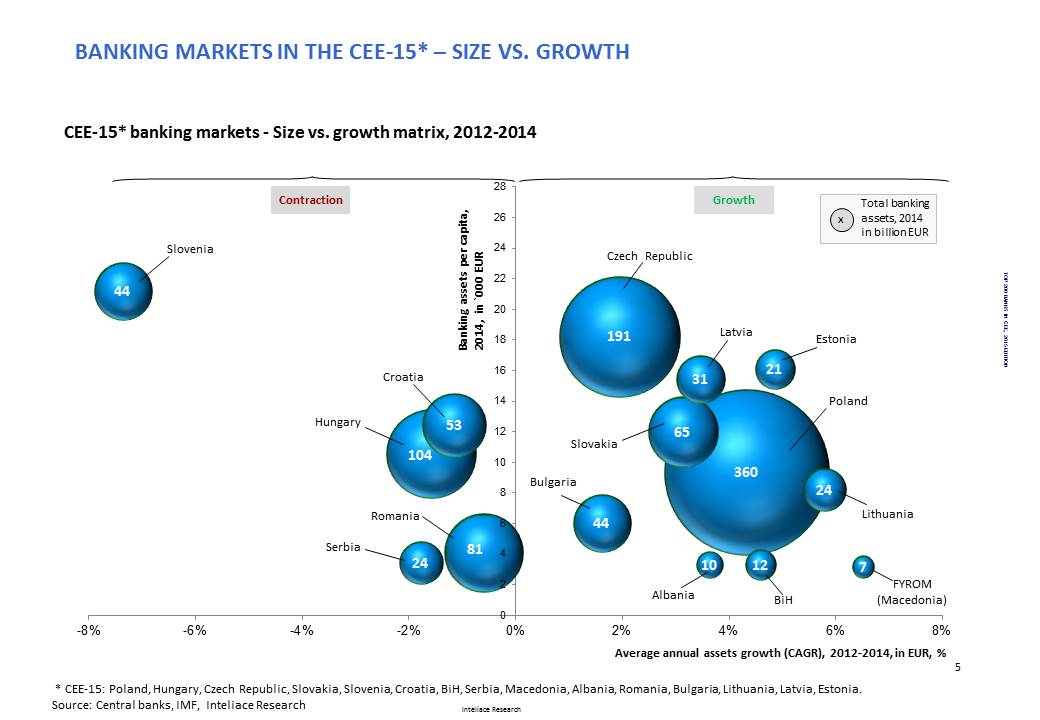
List of Top 200 banks in Central and Eastern Europe
Total banking assets in CEE15* topped 1.07 trillion EUR in December 2014. Despite recently observed convergence trends, there are still significant differences among CEE countries in terms of banking intermediation levels. While banking assets per capita exceed EUR 21k in Slovenia, the benchmark is nearly 7 times lower for Albania, Bosnia-Herzegovina or FYRO Macedonia. The level of financial intermediation for most of CEE is still extremely low if compared to Western Europe and the gap is expected to narrow gradually. Nevertheless, factors like hostile fiscal policy (case Hungary), economic rebalancing (case Slovenia) or poor supervision (case Bulgaria) may temporarily weigh on banking sectors in selected countries. -------------------------------------------------------------------------------------------------------------------------------------- *CEE15 includes Poland, Czech Republic, Hungary, Slovak Republic, Romania, Bulgaria, Estonia, Latvia, Lithuania, Croatia, Slovenia, Serbia, Bosnia and Herzegovina, Albania, and Macedonia.
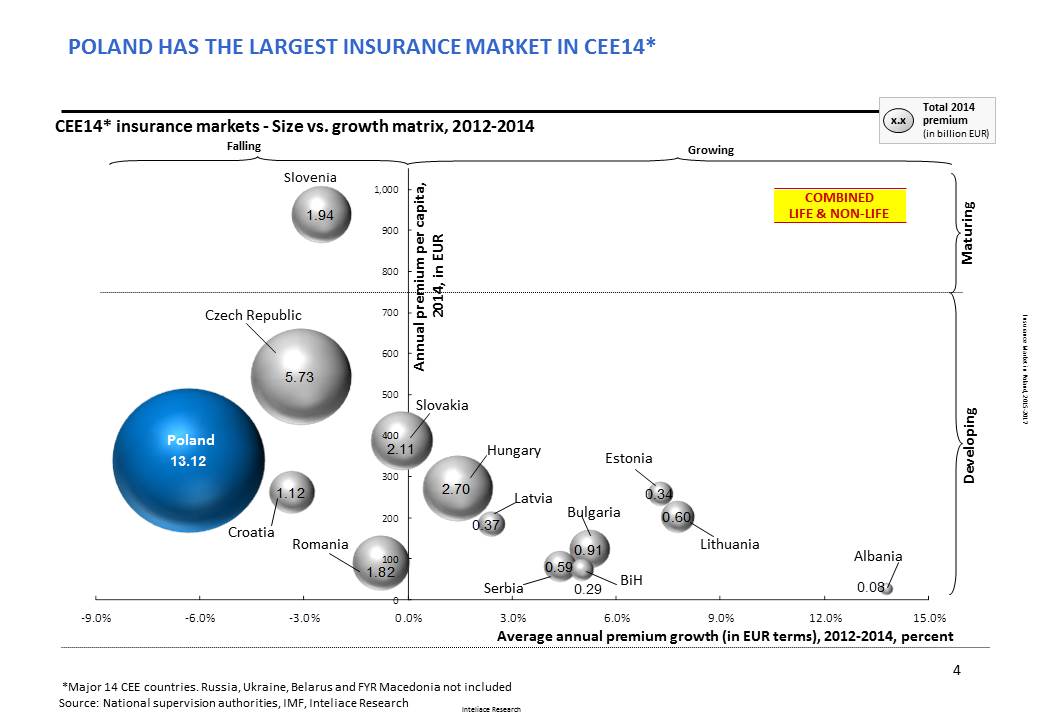
Insurance market in Poland, 2015-2017
Insurers operating in Poland are expected to take advantage from the ongoing economic recovery. The premium in non-life insurance segment is likely to rebound in 2015 as insurers will both increase sales of property insurance and slowly raise tariffs in car insurance. Also the improving situation of enterprises is expected to drive demand for specialized insurance products in the corporate sector including credit and liability insurance. At the same time, a better economic situation and improved sentiment in households sector, resulting from lower unemployment and increasing real wages, will boost the demand for unit-linked and plain risk life insurance. For more information on recent developments in the Polish insurance sector, please refer to the full publication.
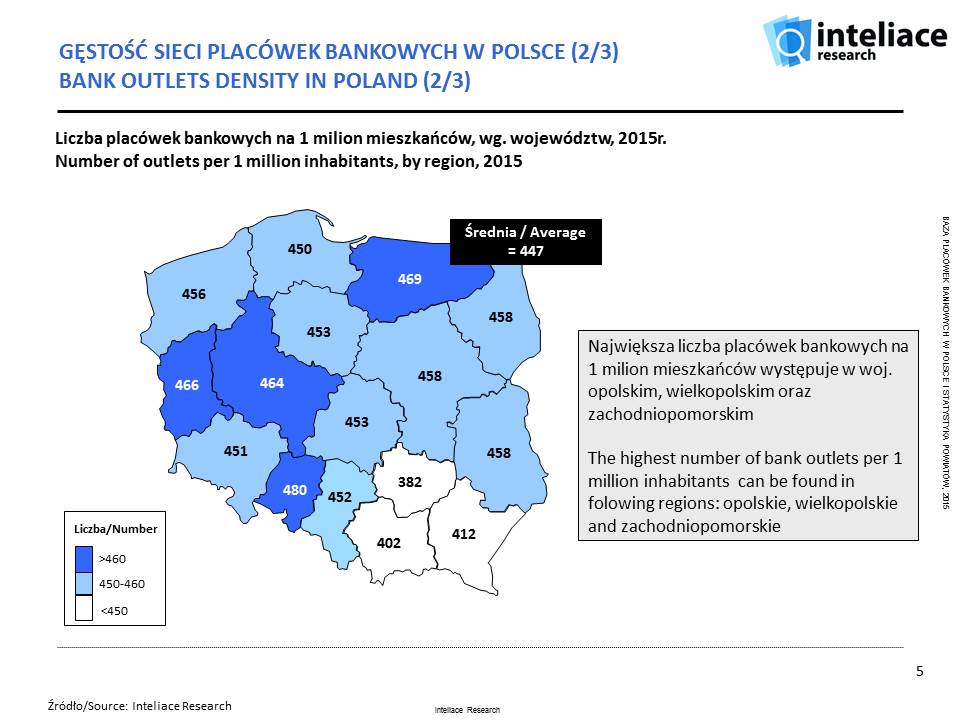
Bank outlets in Poland, 2015
The number of bank outlets in Poland has been falling recently. As of Q1 2015, there have been 447 bank and credit union outlets per million capita, which corresponds to a 3.5% decrease YoY. Looking forward, more bank outlet closures could expected. The increasing use of remote channels by customers, including mobile, will reduce time spent in branches. On the other hand, intensifying pressure on cost reductions due to eroding interest margins , will encourage banks to further cut least efficient or redundant outlets. For more information on recent developments in the Polish banking sector, please refer to the full publication/database.
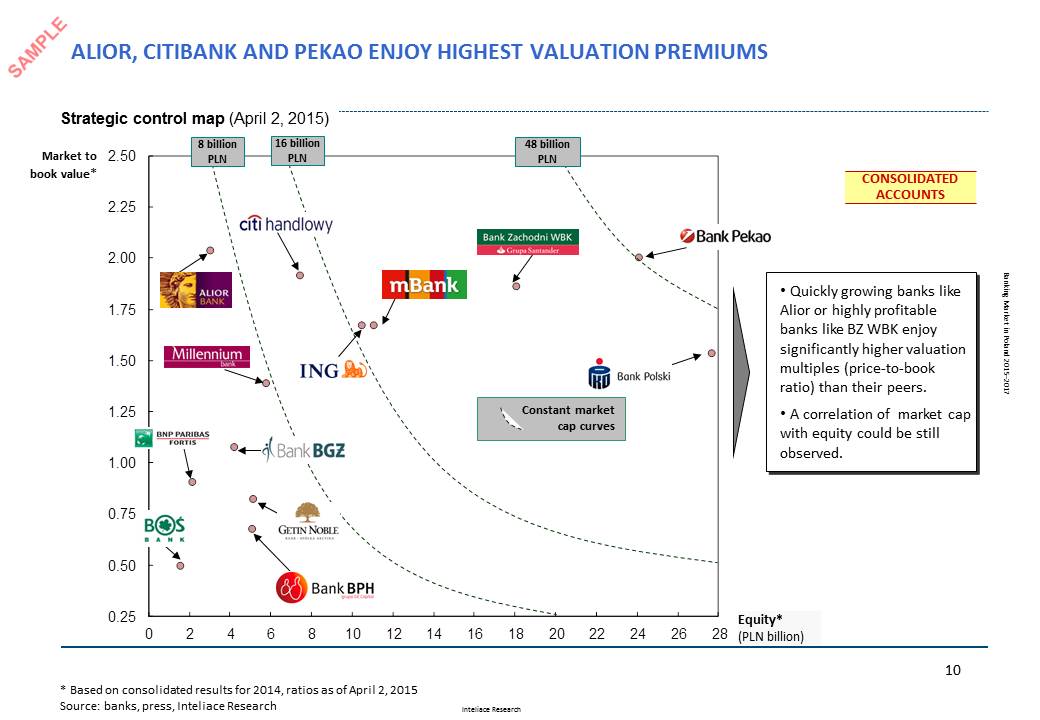
Banking market in Poland, 2015-2017
Most banks operating in Poland have benefited from the improving economy and higher consumer confidence, being able to expand their balance sheets considerably. Total banking assets hit a record PLN 1.53 trillion as of December 2014, which corresponds to a 9% YoY growth rate. Total client deposits at banks recorded a 9% YoY increase to PLN 956 billion and total client lending rose by 6% to PLN 910 billion. For more information on recent developments in the Polish banking sector, please refer to the full publication.
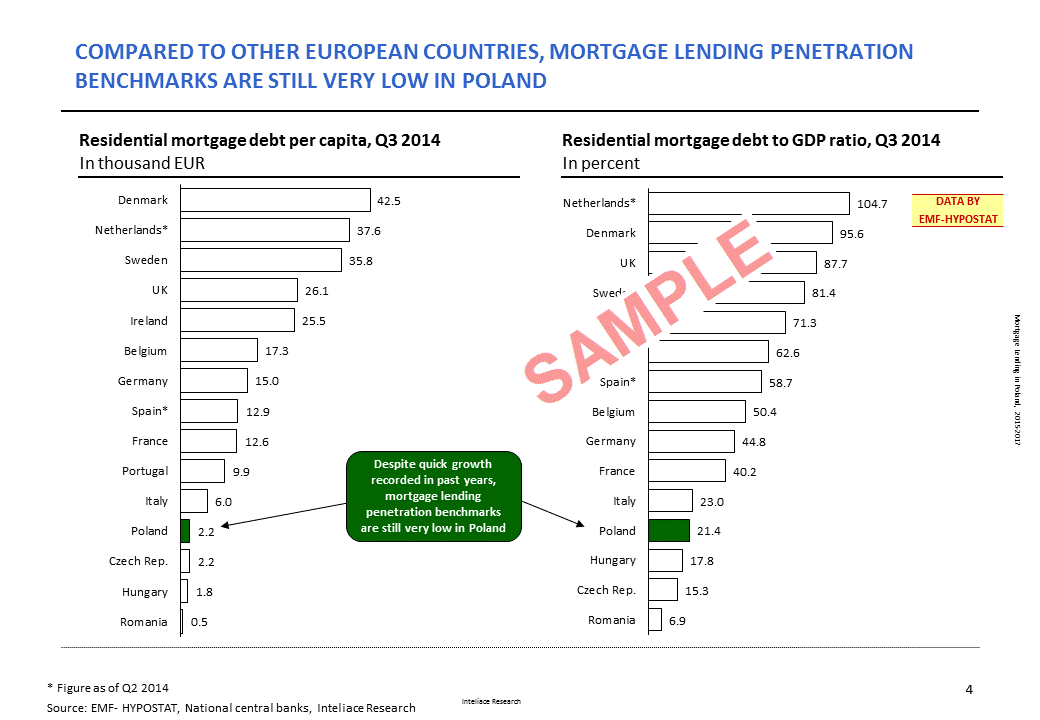
Mortgage lending in Poland, 2015-2017
The value of outstanding mortgage lending in Poland was up a 6% in 2014, reaching a total 351 billion PLN at year end. Building on favorable economic developments, positive customer sentiment and the cost of money at record low, new mortgage lending in Poland is expected to accelerate in 2015 -2017. For more information on recent developments in the Polish banking sector, please refer to the full publication.
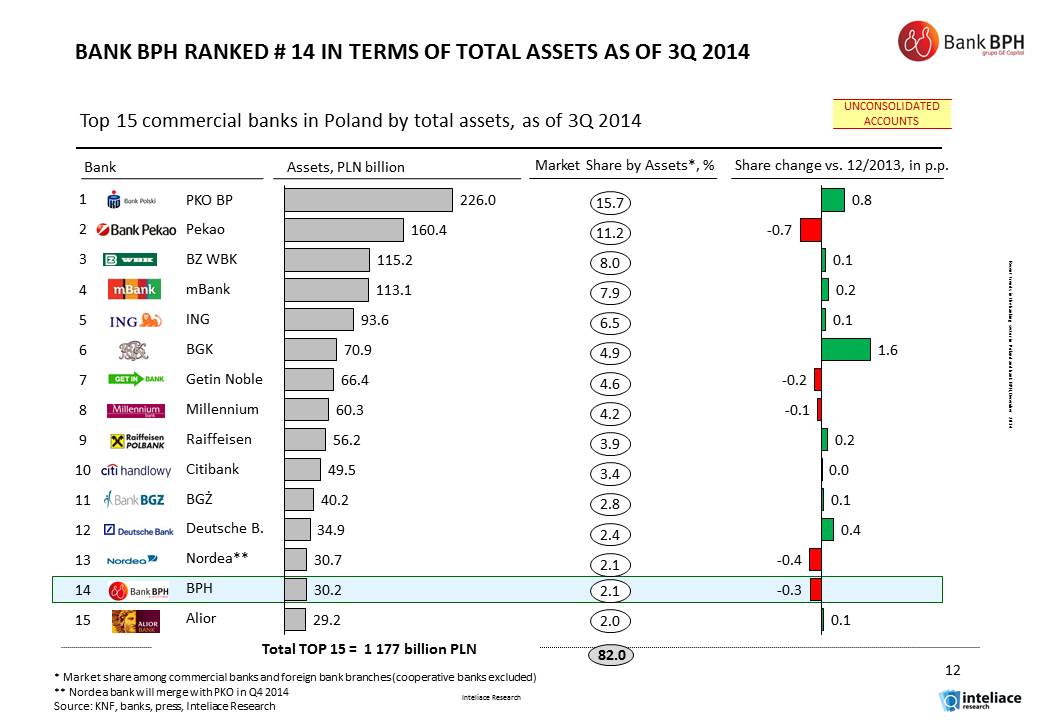
Bank BPH and Recent Trends In Poland's Banking Sector
Poland's banking sector keeps growing quickly following positive trends in the domestic economy and despite external headwinds. For more information on recent developments in Poland's banking sector, please refer to the full publication.
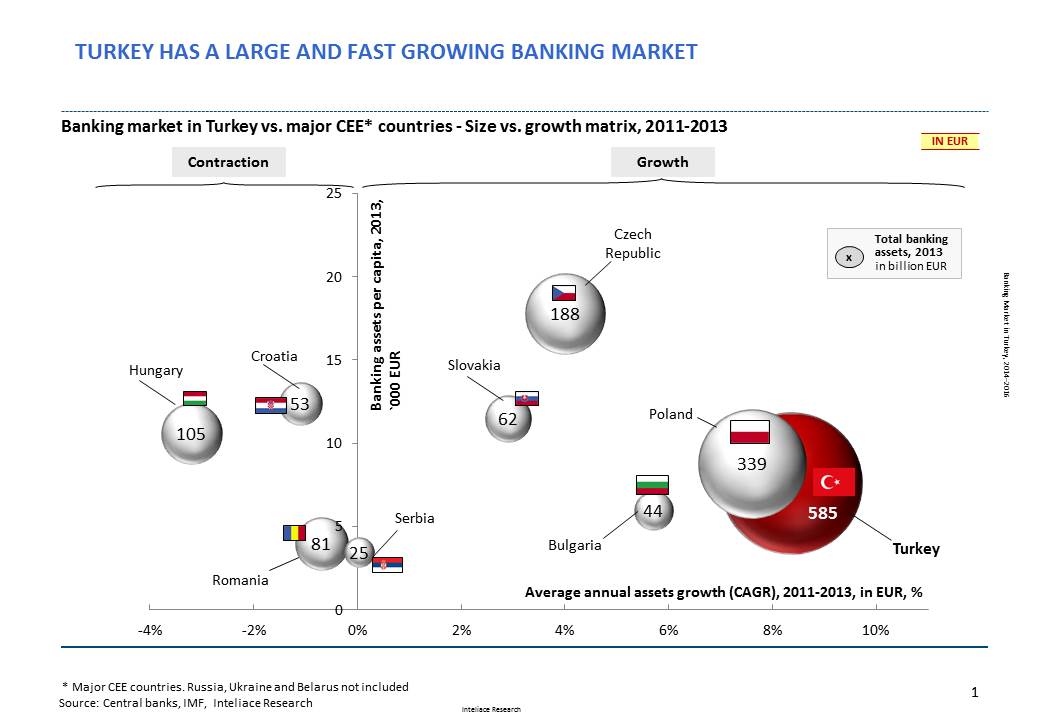
Banking market in Turkey, 2014-2016
Turkey's economy grew at a 3.3 percent annual rate in the first half of 2014 despite increasing global economic headwinds. Key banking volumes reflected the robust economy, however, growing at decelerating rates. Total assets increased to a record TRY 1.65 trillion (EUR 631 billion) as of June 2014. Lending remained relatively strong (+5% growth in value of outstanding loans during Jan.-Jun.2014), despite growing interest rates. The weakest segments were car and credit card lending hit by regulatory actions and by growing unemployment. Total deposits increased only by a fraction during H1 2014, driven up mostly by retail volumes. In terms of profits, banks were able to post solid results in H1 2014. Despite gradually falling (since 2012) interest margins and stagnating fee & commission income, banks managed to produce higher profits thanks to growing underlying volumes. A closer look at P&L statements of the banking sector in H1 2014 points to a good control of operating costs and a falling impact of bad-loan provisions (on a relative basis vs. total assets). The NPL* ratios for commercial loans and housing loans keep falling, however, credit card debt and other consumer lending showed first signs of deterioration, which could be attributed to higher interest rates and growing unemployment. For more information on recent developments in the Turkey's banking sector, please refer to the full publication.
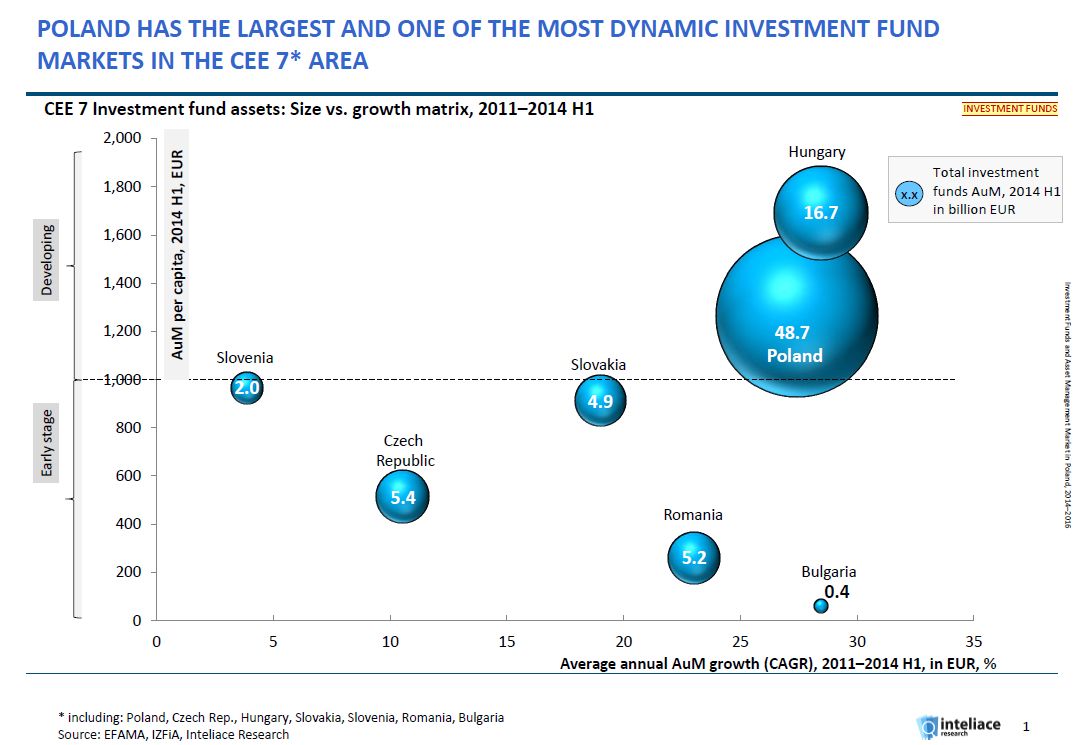
Investment funds and asset management market in Poland, 2014
Poland's asset management industry saw stable growth across all but one segment in H1 2014. Assets of regulated investment funds and assets in voluntary pension plans - pillar III kept growing quickly and reached PLN 203 billion and PLN 15 billion, respectively. Also managed funds* of insurance companies showed positive development climbing to PLN 152 billion, as of H1 2014. In contrast, Pillar II assets plunged by nearly 50% to PLN 152 billion as the overhaul of the second-pillar pension system, in early 2014, resulted in a forced transfer of roughly half of segment's assets to the state-run social security institution. As a consequence, despite positive developments in most segments, the total value of assets under management (AuM) in Poland contracted to PLN 522 billion (� 124 billion) in H1 2014. Three large firms: PZU, Aviva and ING remained the key asset managers in the country with a combined value of AuM of over PLN 200 billion. However, most of major asset managers continued to lose market share in favor of smaller and more flexible specialists, growing quickly in market niches. OutlookThe asset management industry in Poland is expected to sustain a moderate growth of ~7% p.a. by 2016. New inflows from individual clients will fuel investment fund assets, unit-linked insurance and Pillar III pension plans. One of factors supporting new investments will be exceptionally low market interest rates which are backing up the process of bank deposits conversion. However, the most important growth factor will be constantly increasing wealth of individuals, which has persisted for over 10 last years. The institutional part of asset management business is also likely to expand in the future although at slower rates than the retail segment. As far as the profitability of asset managers is concerned, Inteliace Research expects that the pressure on margins will intensify inline with the growing number of competing asset managers operating in the market, which eventually will lead to market consolidation around the most efficient players. * Technical reserves of non-life and life insurers, including unit-linked life funds.
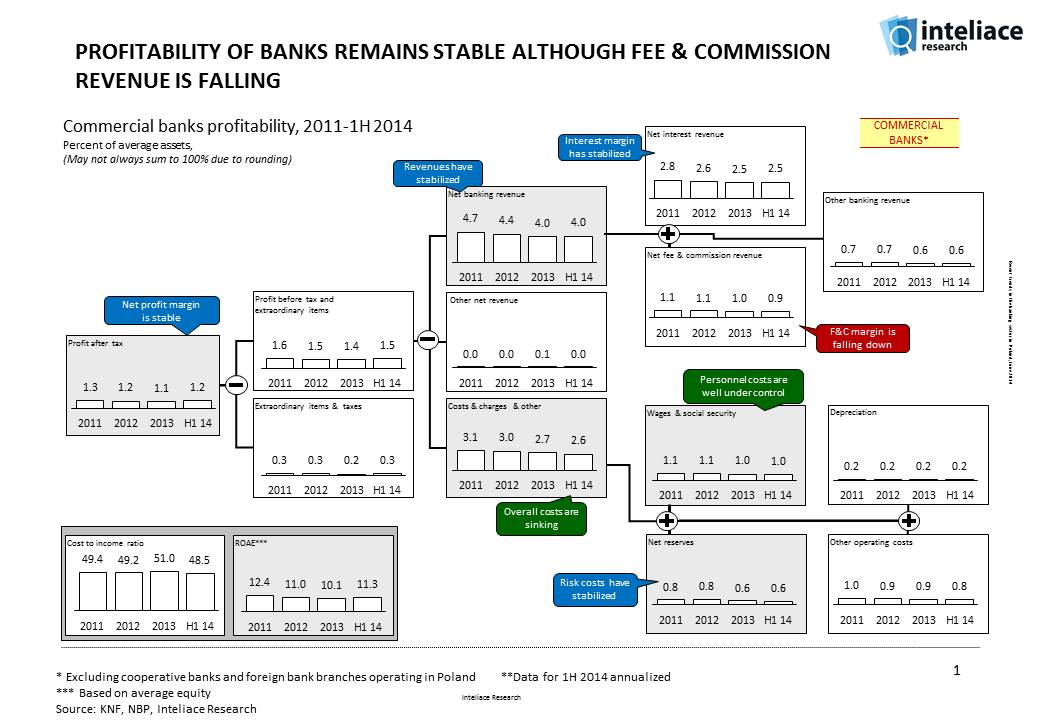
Recent trends in Poland's banking sector - H1 2014
In contrast to some troubled CEE banking markets as Bulgaria or Slovenia, Poland's banking sector consistently demonstrates strong performance. All key volumes (deposits and loans) kept growing at moderate rates in the first half of 2014. At the same time the level of non-performing loans has been decreasing for most of loan categories. The only exception with growing NPL rates has been mortgage lending, which could be attributed to ageing of contracts and low dilution due to weak new sales of mortgage loans. After a significant drop of market interest rates recorded in 2013 and a subsequent collapse of deposit margins, banks were able to stabilize margins again in H1 2014. As a result of higher margins and growing volumes, banks have recorded very good operating results, with net interest revenue advancing by 16% YoY in H1 2014. Strong interest revenues have more than compensated for stagnating fee & commission income, which has been affected by regulatory developments including bancassurance, card interchange and other.) The banking sector in Poland remains strong, it is well capitalized and finally, thanks to accelerating build-up of local deposit, it is less and less dependent on external headwinds. --------------------------------------------------------------------------------------------------------------------------------------
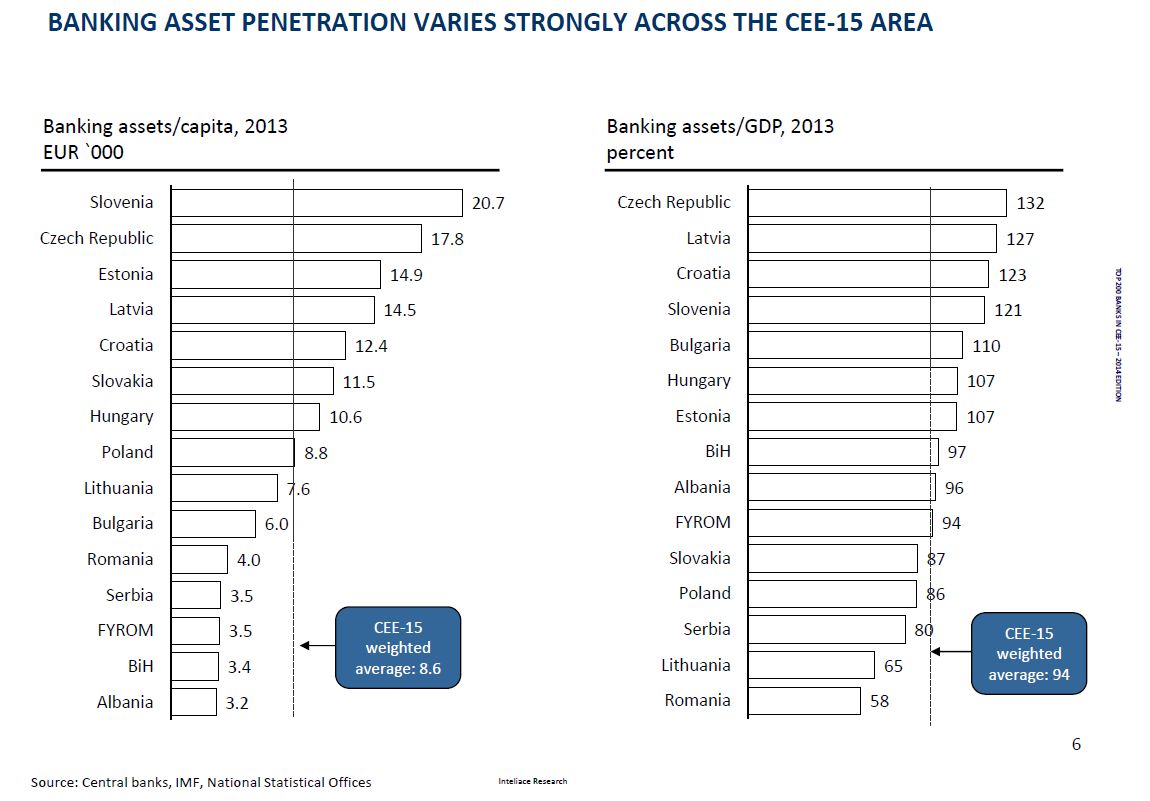
List of Top 200 banks in Central and Eastern Europe
Total banking assets in CEE15* topped 1.04 billon EUR, after increasing by ~1% in 2013. The recent growth in assets could be attributed mainly to positive developments in Poland, Czech Republic and few smaller peripheral countries including: Albania, BH and FYROM. In contrast, banking markets in Slovenia and Hungary continued to contract being affected by structural problems and unfavourable regulatory or fiscal environments. CEE15 banking markets continue to be dominated by foreign investors with: UniCredit, Erste, Raiffeisen and KBC controlling a combined 28% of total banking assets in the region. The fifth major banking group in CEE15 is Poland's PKO Bank Polski group with a regional market share of 5.3%. The TOP200 CEE league table is led by two Polish banks: PKO (assets of EUR 47.3 billion) and Bank Pekao (assets of EUR 37.4 billion), followed by the Czech major bank CSOB (assets of EUR 33.6 billion). Despite recently observed convergence trends, there are still significant differences among CEE countries in terms of banking intermediation levels. While banking assets per capita exceed 20k EUR in Slovenia, the benchmark is over 6 times lower for Albania or Bosnia-Herzegovina. The outlook for most CEE banking markets remains positive. The level of financial intermediation for most of CEE is still extremely low if compared to Western Europe and the gap is expected to narrow gradually. Nevertheless, factors like hostile fiscal policy (case Hungary), economic rebalancing (case Slovenia) or poor supervision (case Bulgaria) may temporarily weigh on banking sectors in selected countries. -------------------------------------------------------------------------------------------------------------------------------------- *CEE15 includes Poland, Czech Republic, Hungary, Slovak Republic, Romania, Bulgaria, Estonia, Latvia, Lithuania, Croatia, Slovenia, Serbia, Bosnia and Herzegovina, Albania, and Macedonia.
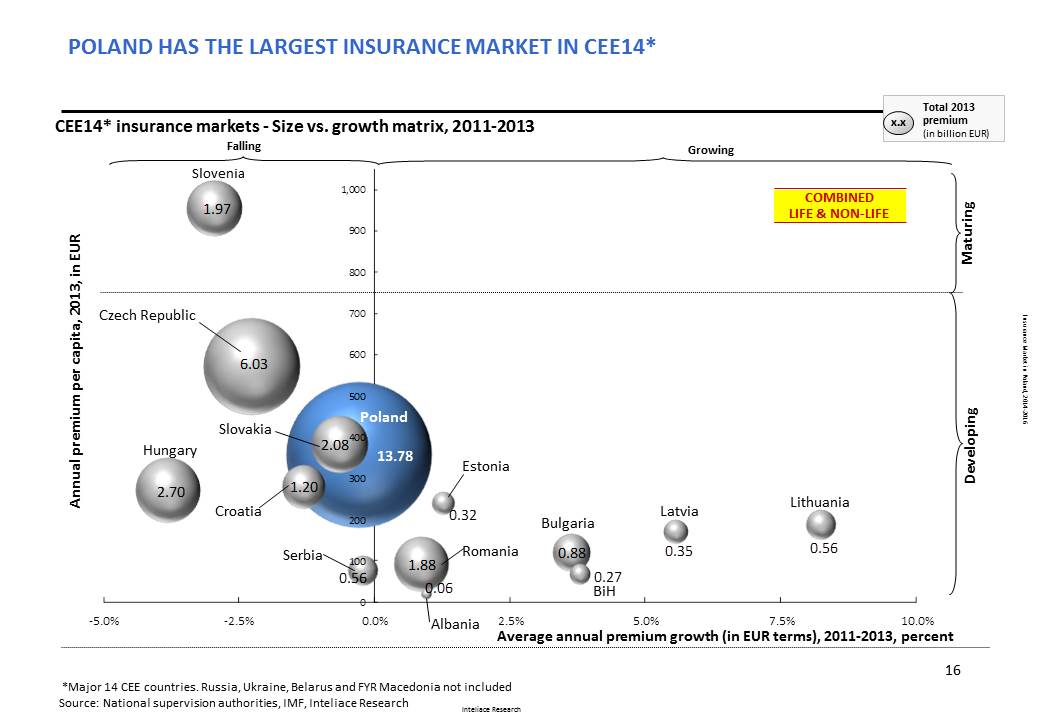
Insurance market in Poland, 2014-2016
In 2013, Poland's GDP growth rate dropped to 1.6% YoY, which was the lowest rate since 2009. Slowing consumer demand and depleting inventories were reducing the GDP growth rate while a healthy growth in exports and a positive balance in foreign trade had a positive contribution. In response to slowing economy, and in-line with global trends, the monetary policy of the Central Bank became looser in 2013 and interest rates were reduced to the lowest levels in modern history of the country. As a consequence of recent economic developments, the insurance sector slowed down with life premium sinking by 14% YoY and non-life premium increasing just by a fraction. The fall in life insurance premium could be attributed almost exclusively to plunging sales of single premium deposit-like products, which became less attractive due to lower interest rates. Other types of saving/investment products, especially unit-linked insurance were unaffected and continued to grow in 2013 reflecting relatively stable financial condition of households and high propensity to save for retirement. Within the non-life business, car insurance suffered from falling premiums (-5% YoY) due to persisting fierce competition among insurers while property, accident and corporate insurance recorded a moderate growth in premiums. For more information on recent developments in the Polish insurance sector, please refer to the full publication.
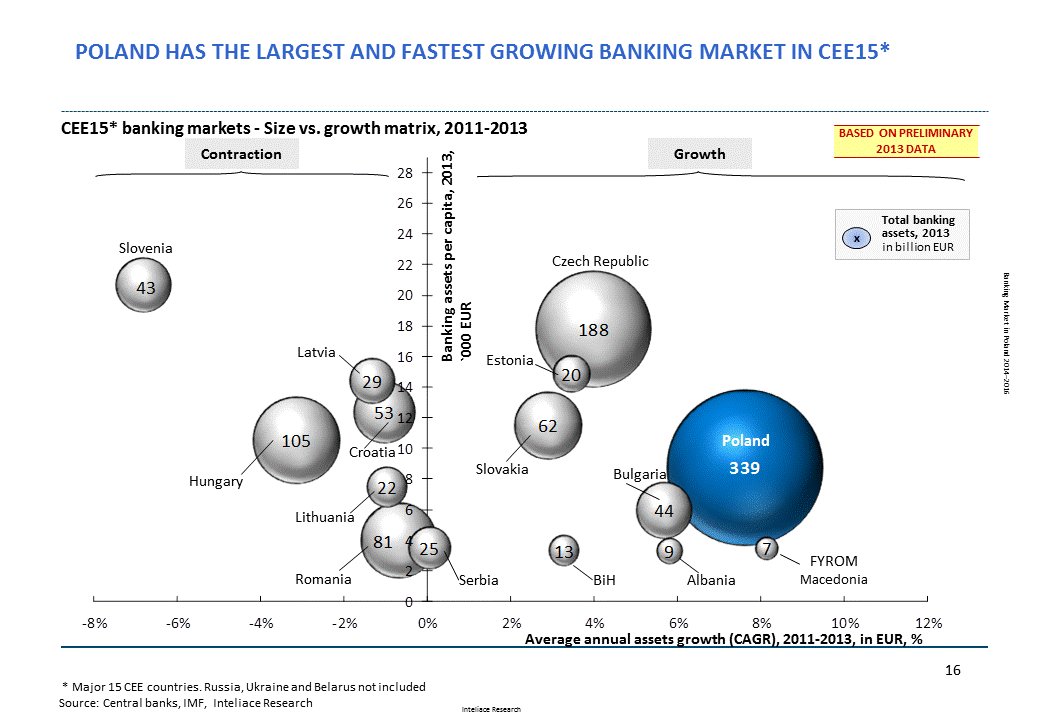
Banking market in Poland, 2014-2016
The future outlook for the banking sector in Poland is positive. Key banking volumes are expected to accelerate in 2014-2015. However, the growth in banks' revenues and profits might temporarily be held back by a number of factors including: unfavorable regulatory developments (e.g. card interchange), increasing risk costs and higher operating expenses. Poland's banking market continued to consolidate in 2013. Bank PKO took over most of businesses of Nordea Group in Poland, including Nordea Bank Polska, BNP Paribas agreed to buy BGZ bank and Getin Noble acquired retail operations of DZ Bank. However, the appetite for consolidation met growing resistance from the regulator: KNF (Polish Financial Supervision Authority). In recent statements, KNF described current level of concentration in the banking sector as "close to optimal" and warned that further mergers would be thoroughly examined (which means that further M&A is unwelcome). For more information on recent developments in the Polish banking sector, please refer to the full publication.