
Raporty i bazy danych
Ponad 82 publikacji obejmujących bankowość, ubezpieczenia, płatności, kredyty hipoteczne i zarządzanie aktywami w Polsce i Europie Środkowo-Wschodniej.
Zdecydowana większość naszych raportów jest dostępna wyłącznie w języku angielskim. Tytuły, opisy i spisy treści poniżej pozostają w oryginale.
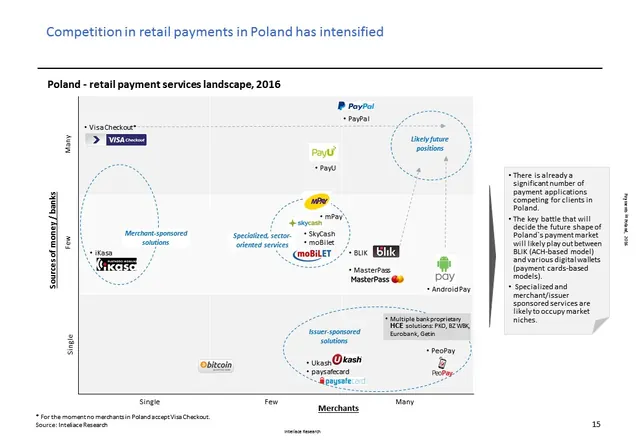
Payments in Poland, 2016
Poland's payment market has experienced an explosive growth during recent years. The number of card payments has more than doubled since 2013 and it has exceeded 3 billion by 2016. As consumers embraced card payments, Poland advanced to top six European markets by the number of transactions. The key factor of surging use of cards in Poland are contactless payments. Outlook The payment market will continue to expand in future as relatively high share of cash in Poland's economy offers a lot room for growth, in particular within: retail payments, P2P, public transport and public fees & duties. There is a clear opportunity in cash displacement and market participants are likely to address it. One can expect that over next five years a dominating mobile payment standard for mobile payments will evolve itself. It seems for the moment that the new standard will be based on payment cards rather than on ACH.
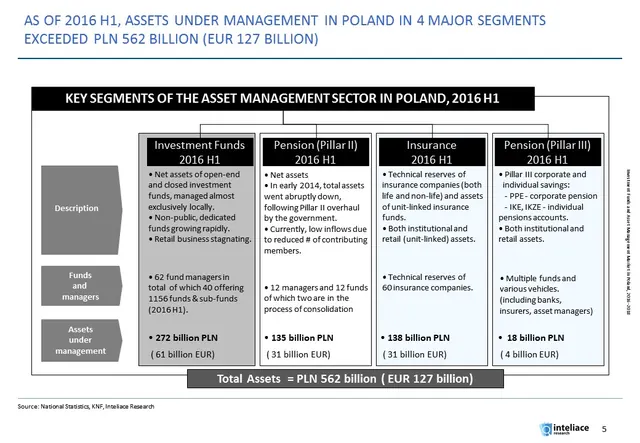
Investment funds and asset management market in Poland, 2016
Total assets under management in Poland topped PLN 562 billion or EUR 127 billion across all key categories in H1 2016. The largest part of AM market are investment funds with assets of PLN 272 billion. Outlook The asset management sector in Poland is likely to see a further growth in assets under management thanks to increasing households' wealth and corporate savings. Assets are expected to increase across all segments, whereas the highest growth rates could be anticipated in the third pillar pension sector. Although, until recently, most of newly created personal wealth has ended up in investments in productive assets, in banks as deposits or in real estate, future trends are likely to change. Based on historical evidence of more advanced economies, a gradual increase of fund component in savings, could be expected. This will, however, require asset managers to adjust the offer of vehicles and investment strategies to address key issues like: weak local equity market, low efficiency and regulatory developments. Moreover, the current fragmentation in fund management business is unlikely to persist, in view of ongoing consolidation in banking and insurance sectors. Therefore a new wave of consolidation of fund managers is likely to take place. Fund managers will need to increase the scale of operations or they will be forced to quit.
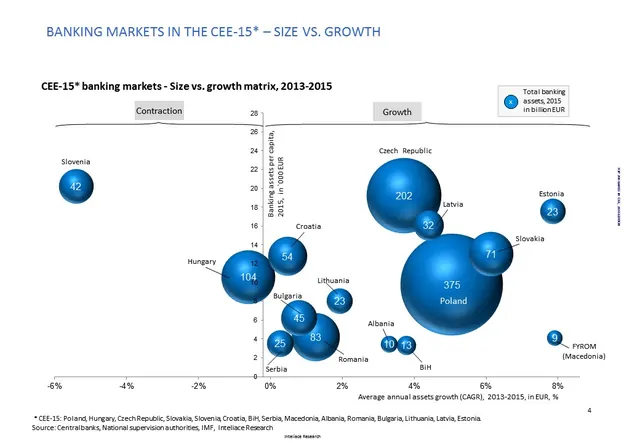
List of Top 200 banks in Central and Eastern Europe
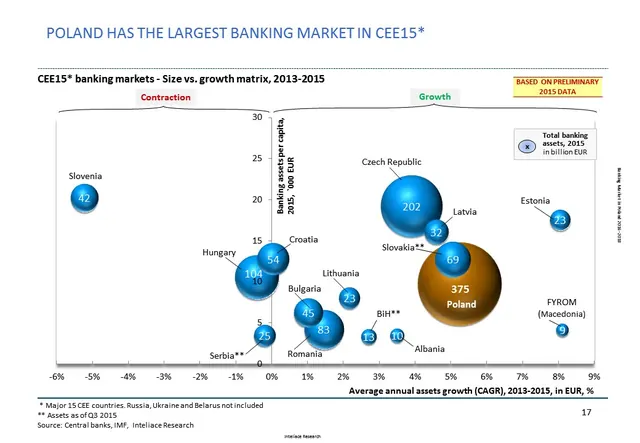
Total banking assets in CEE15* exceeded 1.11 trillion EUR as of December 2015, after adding ca.3% value within a year. The profitability of major CEE banks has improved significantly with weighted ROA and ROE growing to 0.79% and 6.81% respectively in 2015. Despite recently observed convergence trends, there are still significant differences among CEE countries in terms of banking intermediation levels. While banking assets per capita exceeded EUR 20k in Slovenia, the benchmark was nearly 6 times lower for Albania and Bosnia-Herzegovina.The level of financial intermediation for most of CEE is still extremely low if compared to Western Europe and the gap is expected to narrow gradually. -------------------------------------------------------------------------------------------------------------------------------------- *CEE15 includes Poland, Czech Republic, Hungary, Slovak Republic, Romania, Bulgaria, Estonia, Latvia, Lithuania, Croatia, Slovenia, Serbia, Bosnia and Herzegovina, Albania, and Macedonia.
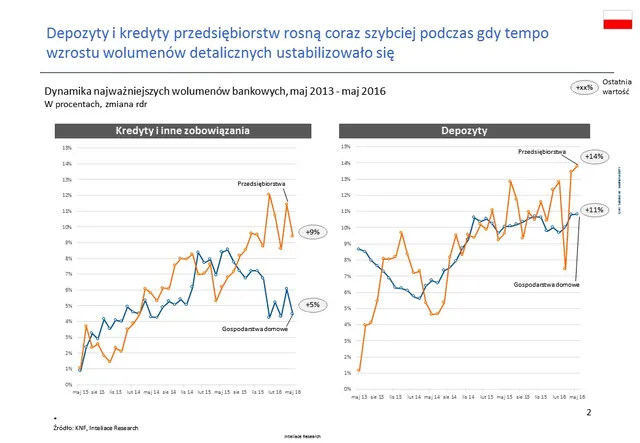
Sektor bankowy w Polsce
1. Depozyty i kredyty przedsiębiorstw rosną coraz szybciej podczas gdy tempo wzrostu wolumenów detalicznych ustabilizowało się. 2. W ciągu ostatnich 12 miesięcy gospodarstwa domowe zaoszczędziły w bankach 67 miliardów PLN, z czego około 40 miliardów PLN to wzrost zasobów netto (Wzrost salda depozytów - wzrost salda kredytów). 3. Banki podnoszą najniższe marże w wyniku podatku bankowego. Marże kredytów mieszkaniowych i kredytów dla przedsiębiorstw rosną. Jednocześnie marże kredytów konsumpcyjnych spadają. Z punktu widzenia gospodarki taki trend nie napawa optymizmem... For more information, please refer to the full publication or contact us at info@inteliace.com.
Swiss banks, 2016
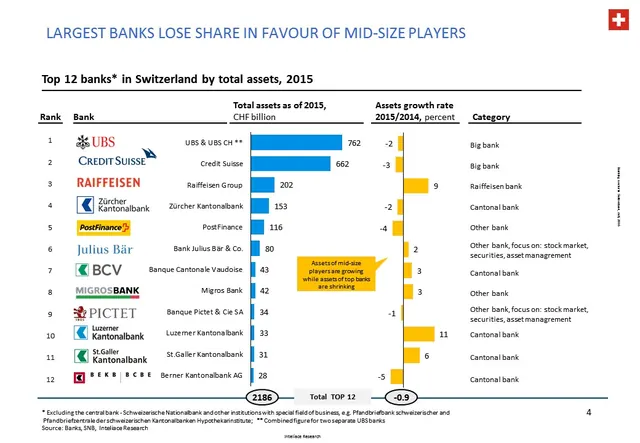
Banks operating in Switzerland continue to grow. However, there are structural changes taking place in the Swiss financial sector. As largest banks slowly lose market share, the position of regional and cantonal banks is improving. The share of domestic assets is growing while the share of foreign assets decreases, which could be attributed to increasing regulatory and compliance requirements. It could be also a warning sign that the role of Switzerland among global banking centers is eroding. The profitability of banks in Switzerland improved significantly in 2015. However, the key driver was extraordinary result and not the ordinary business. By contrast, the cost-to-income ratio, reflecting the core banking activity has deteriorated to above 70%. Banks look for solutions to improve productivity by a range of measures including higher automation and alternative distribution channels. In the same time the physical distribution network and the number of employees are being gradually reduced. Raiffeisen Group and cantonal banks from Luzern and St. Gallen were the fastest growing banks among TOP 12 institutions, in terms of assets in 2015. For more information, please refer to the full publication or contact us at info@inteliace.com.
Insurance market in Poland, 2016-2018
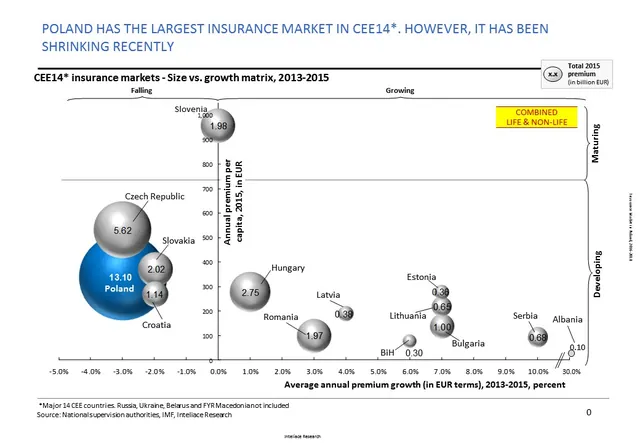
In contrast to the general economy, the insurance sector in Poland has hardly benefited from improving situation of households and corporate subjects. While the total gross premium written in non-life business advanced by 4%, the life insurance premium fell by 4% YoY in 2015. Key drivers of recent change in life premium have been changes to the regulatory and tax regime as well as external factors including ultra-low interest rates. The recent growth in non-life premium has been primarily a result of increasing tariffs in car insurance, which was an immediate effect of rapidly growing claims and substantial losses incurred on TPL policies. For more information on recent developments in the Polish insurance sector, please refer to the full publication.
Banking market in Poland, 2016-2018
Poland's economy accelerated in 2015 with Gross Domestic Product (GDP) advancing at 3.6% annual rate. Banking volumes have continued to grow fast in course of 2015, reflecting favorable developments in the economy and higher consumer confidence. Total banking assets hit a record PLN 1.6 trillion as of December 2015, which corresponds to a 4% YoY growth rate. In our base-case scenario, we see Poland's economy remaining strong in 2016 but decelerating in 2017 and 2018. We assume a continued growth in key banking volumes, in particular in retail deposits and in corporate lending. For more information on recent developments in the Polish banking sector, please refer to the full publication.
Bank outlets in Poland, 2016
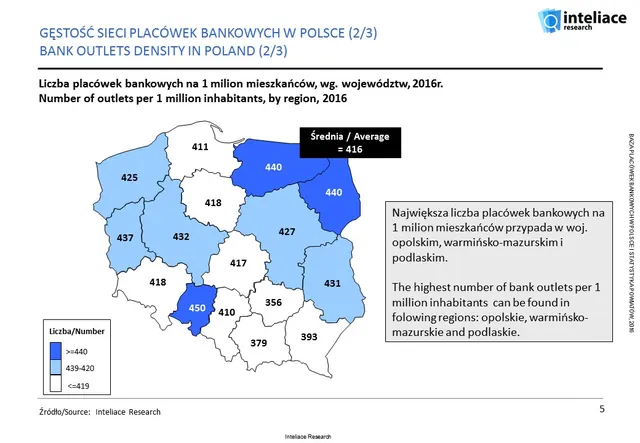
The number of bank outlets in Poland keeps falling. As of Q1 2016, there were 16010 bank and credit union outlets, which corresponds to 416 outlets per million capita. The total number of outlets fell in 2015/2016 by 1210 outlets or by 7% YoY. Looking forward, more bank outlet closures should be expected. The increasing use of remote channels by customers is reducing time clients spend in physical bank outlets. For more information on recent developments in the Polish banking sector, please refer to the full publication/database.
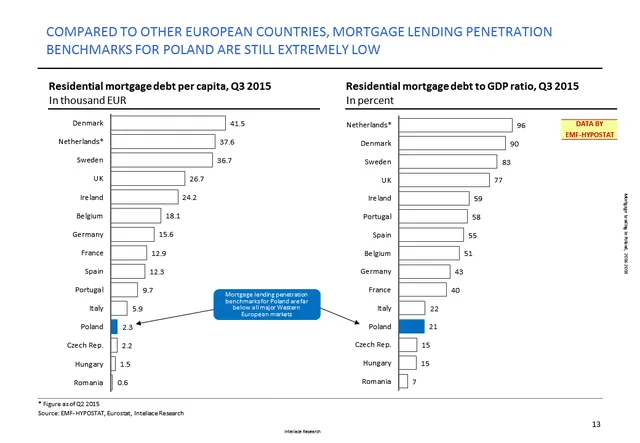
Mortgage lending in Poland, 2016-2018
An accelerating recovery in Poland`s residential construction could be observed since 2014. The number of new permits and starts jumped to 189k and 168k respectively in 2015 recording a double digit growth, compared to 2014. Key driving forces of improving new home construction have been rising income of individuals - average wages and salaries increased by +3.5% in 2015, and growing employment - the unemployment rate fell to 9.8% in Dec. 2015, compared with 11.4% a year before. Also the recent trend in real estate prices has indicated a gradual recovery. For more information on recent developments in the Polish banking sector, please refer to the full publication.