
Research reports & databases
80 publications covering banking, insurance, payments, mortgage lending and asset management across Poland and Central & Eastern Europe.
Payments in Poland, 2017
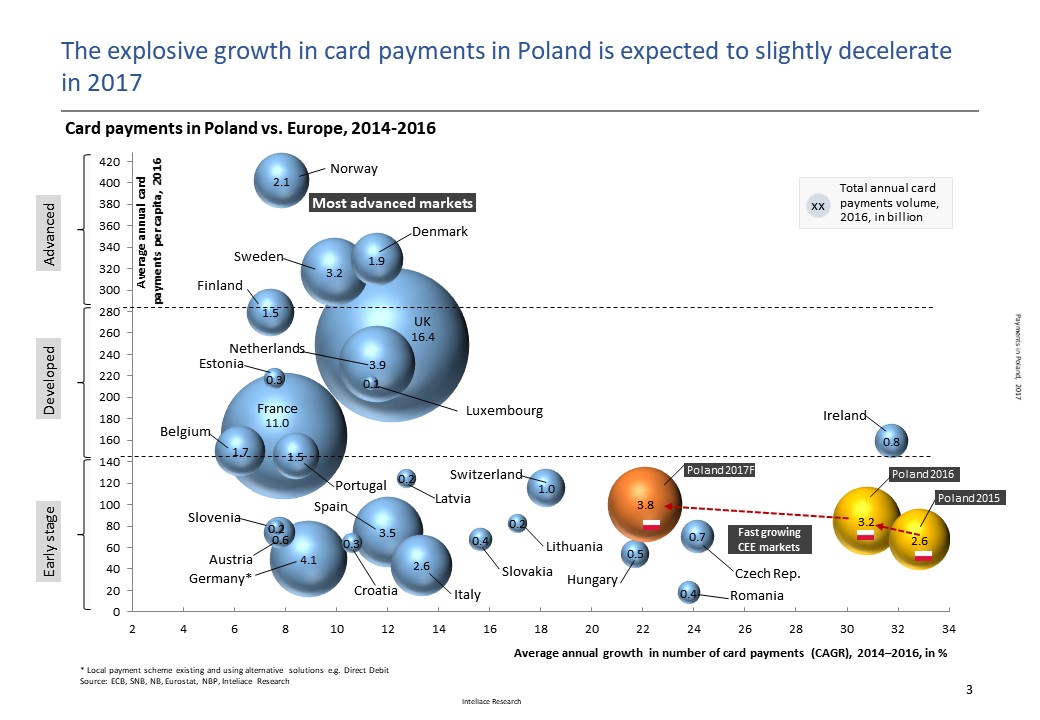
Poland's payment market is growing rapidly. The total number of payments exceeded 5.6 billion as of 2016 and it is estimated to top 6.4 billion in 2017. Most transactions executed in Poland involve payment cards and the share of cards in total payments exceeded 57%, corresponding to over 3.2 billion transactions in 2016. The fast growth in card transactions could be attributed to increasing frequency in card use and a gradual displacement of cash. Outlook The growth in payment volumes in Poland is likely to continue as will the role of cards in overall payments. Thanks to the proliferation of POS terminals and alternative payment solutions, in particular, in sectors where they have not been applied before, e.g. in public administration, the Post Office, local authorities and in smallest stores etc, cash will continue to be displaced. Assuming that no change in current trends will occur, the total volume of payments in Poland is likely to reach 10 billion transactions within next five years.
Investment funds and asset management market in Poland, 2017
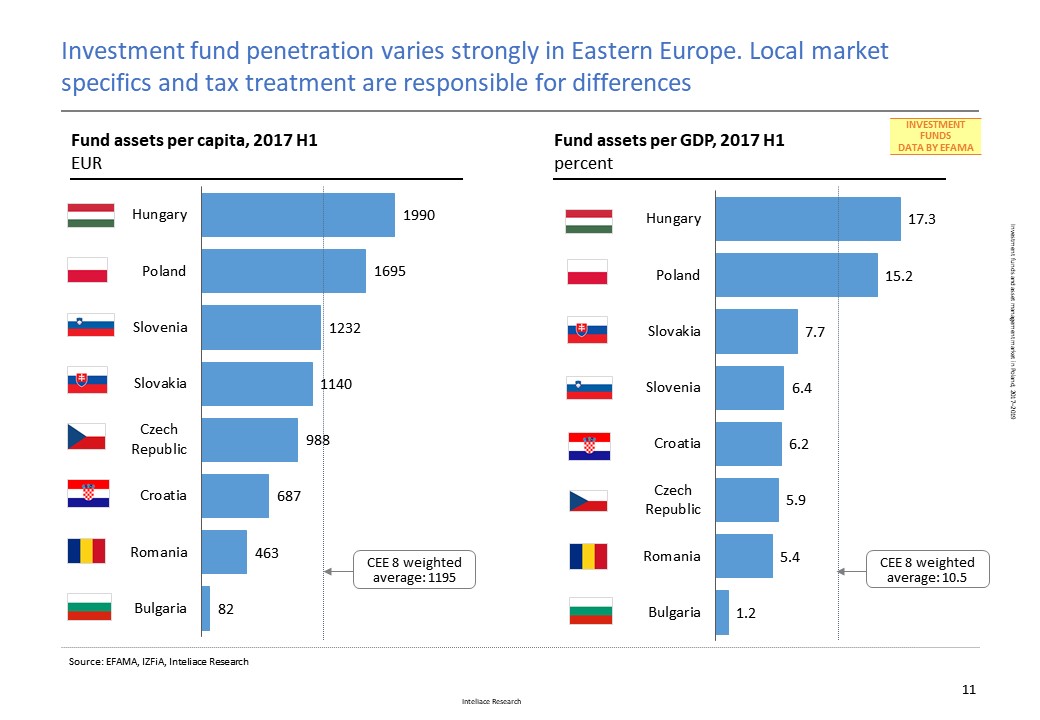
The growth in Poland's asset management sector has accelerated across all its segments, during 2016-2017H1. Assets of regulated investment funds reached PLN 272* billion, while reserves of insurance companies increased to PLN 148** billion, as of June 2017. At the same time, assets in the mandatory second pillar and in the voluntary third pillar III pension funds jumped to PLN 175 billion and PLN 21 billion respectively. As a consequence, the overall value of assets under management (AuM) in Poland topped PLN 632 billion or nearly EUR 150 billion in June 2017. Three largest firms: PZU, Aviva and NN managed AuM of over PLN 236 billion in total and their combined market share exceeded 40%. Outlook Assets under management in Poland are expected to experience solid growth in 2017 and to remain in an upward trend through 2019.
Banking market in Romania, 2017
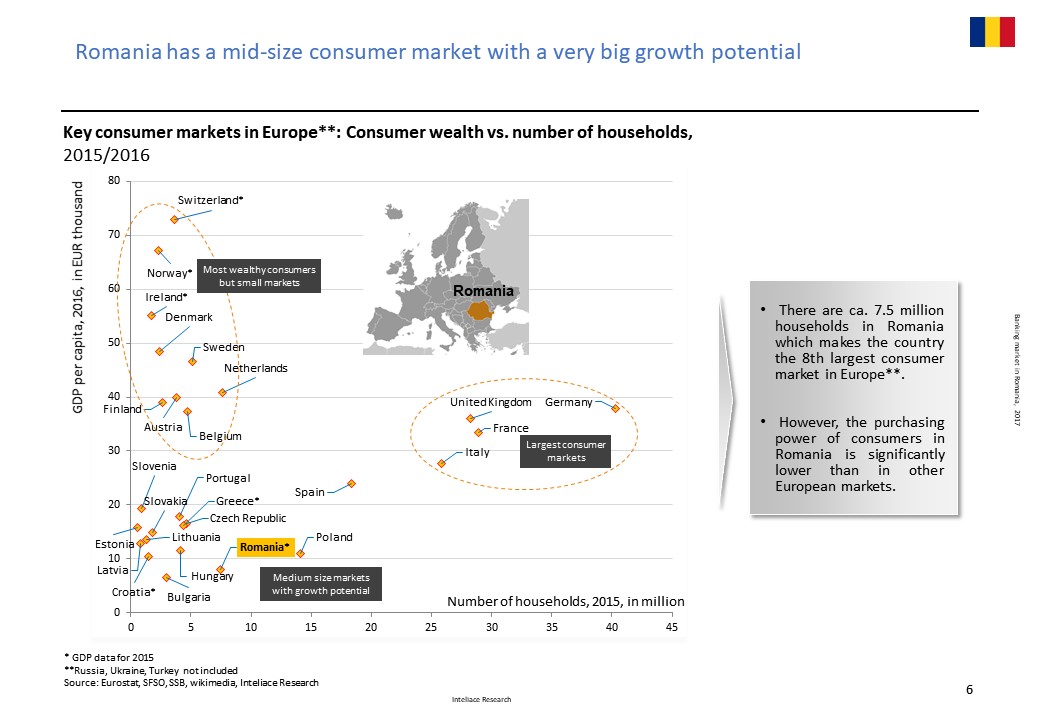
Total banking assets in Romania increased by 4.4% YoY to a record of RON 394 billion as of December 2016. Client deposits at banks recorded strong 12% YoY growth to nearly RON 333 billion with government and household deposits increasing most quickly. By contrast, outstanding client loans increased only by a fraction in 2016 and reached RON 231 billion. This was a consequence of a continued contraction in corporate lending and a still slow growth in retail loans. One of the most encouraging trends has been the falling ratio of non-performing loans which has halved since 2014. Banking sector in Romania has also made a significant progress in reducing currency risk as the share of outstanding loans denominated in foreign currency has fallen substantially, in particular in case of corporate and mortgage loans. For more information on recent developments in the banking sector in Romania, please refer to the full publication.
List of Top 200 banks in Central and Eastern Europe
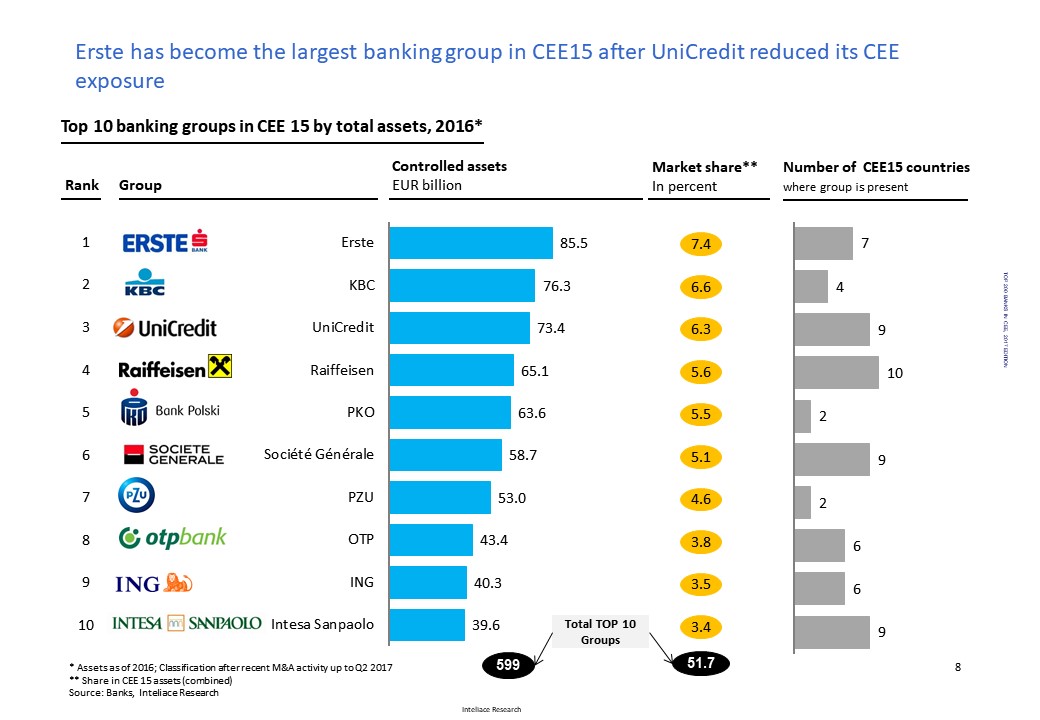
Total banking assets in CEE15* reached 1.16 trillion EUR as of December 2016, after adding ca.4% value within a year. The profitability of major CEE banks surged with weighted ROA and ROE jumping to 1.18% and 10.2% respectively in 2016. Despite recently observed convergence trends, there are still significant differences among CEE countries in terms of banking intermediation levels. While banking assets per capita exceeded EUR 20k in Czech Republic, the benchmark was nearly 6 times lower for Albania and Bosnia-Herzegovina.The level of financial intermediation for most of CEE is still extremely low if compared to Western Europe and the gap is expected to narrow gradually. -------------------------------------------------------------------------------------------------------------------------------------- *CEE15 includes Poland, Czech Republic, Hungary, Slovak Republic, Romania, Bulgaria, Estonia, Latvia, Lithuania, Croatia, Slovenia, Serbia, Bosnia and Herzegovina, Albania, and Macedonia.
Insurance market in Poland, 2017-2019
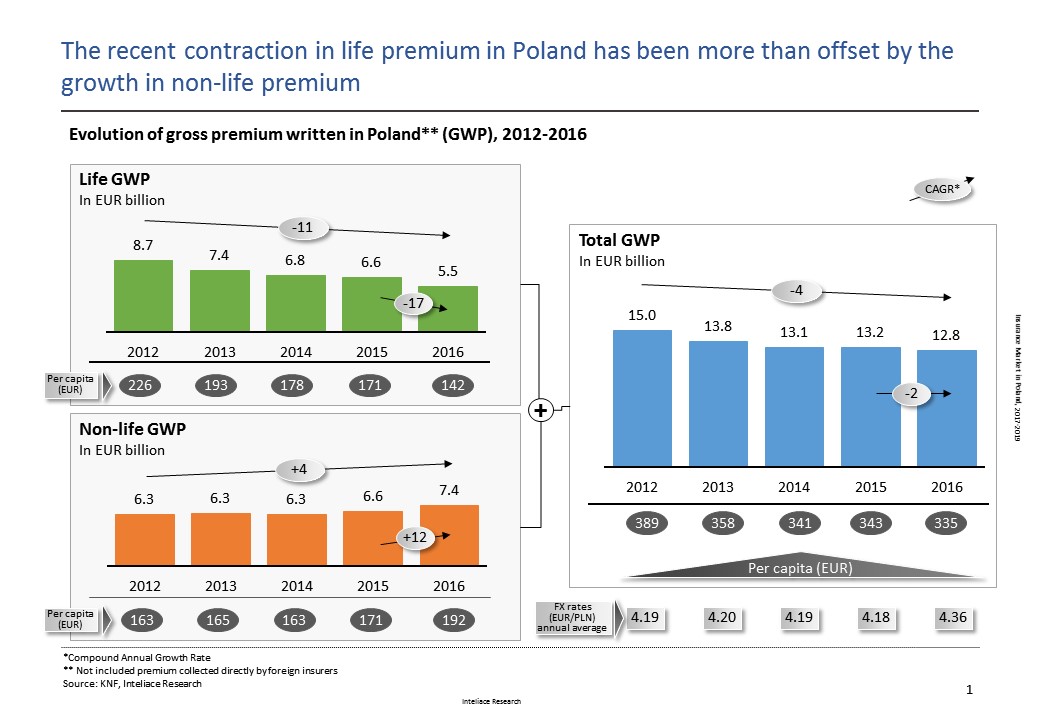
Poland has the largest insurance sector in the CEE with nearly € 13 billion in premium written p.a. and a 40 % regional GWP share. After overcoming the recent stagnation, total insurance premium in Poland is expected to increase at ~7% p.a. through 2019. The non-life insurance segment is likely to continue the fast growth driven by increasing tariffs and a higher number of contracts. Also the improving situation of enterprises is expected to fuel more demand for specialized insurance products in the corporate sector including property insurance. A rebound in new premium is expected to take place in the life business, after a tighter regulatory regime is fully implemented in 2017. Considering the extremely high competition among insurers and a persisting trend for higher claims, it is expected that profitability of insurers will improve only slightly in 2017-2018. For more information on recent developments in the Polish insurance sector, please refer to the full publication.
Bank outlets in Poland, 2017
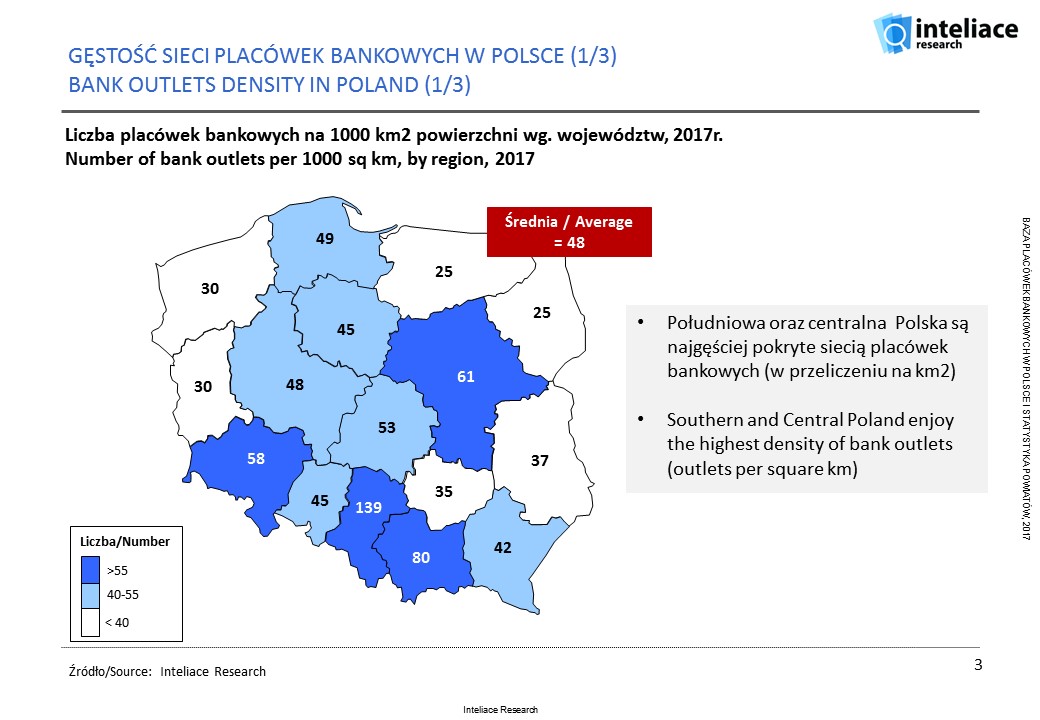
The number of bank outlets in Poland continues to fall. As of Q1 2017, there were 15093 bank and credit union outlets, which corresponds to 393 outlets per million capita. The total number of outlets fell in Q1 2017 vs. Q1 2016 by 917 outlets or by nearly 6% YoY. Looking forward, further bank outlet closures should be expected. An increasing use of remote channels, including mobile, and a growing personal service cost will put pressure on banks to close even more outlets. For more information please refer to the full publication/database.
Banking market in Poland, 2017-2019
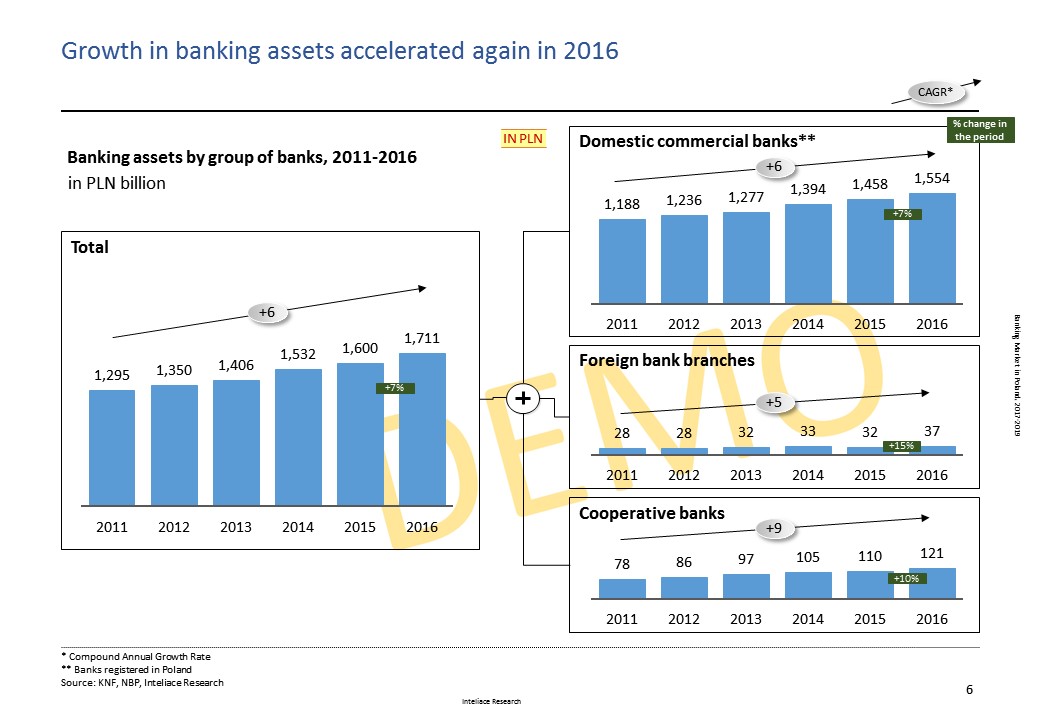
Banking sector. Banking volumes have continued to grow fast during 2016, despite relatively unfavourable regulatory environment. Deposits of non-financial clients at banks recorded a strong 11% YoY increase to nearly PLN 1.1 trillion while lending increased a bit slower, at 5% YoY to PLN 1.11 trillion. The growth of volumes was balanced across all client segments, however, retail deposits advanced particularly fast. As a consequence of growing key volumes, total banking assets increased by 7% YoY to a record of PLN 1.71 trillion as of December 2016. For more information on recent developments in the Polish banking sector, please refer to the full publication.
Mortgage lending in Poland, 2017-2019
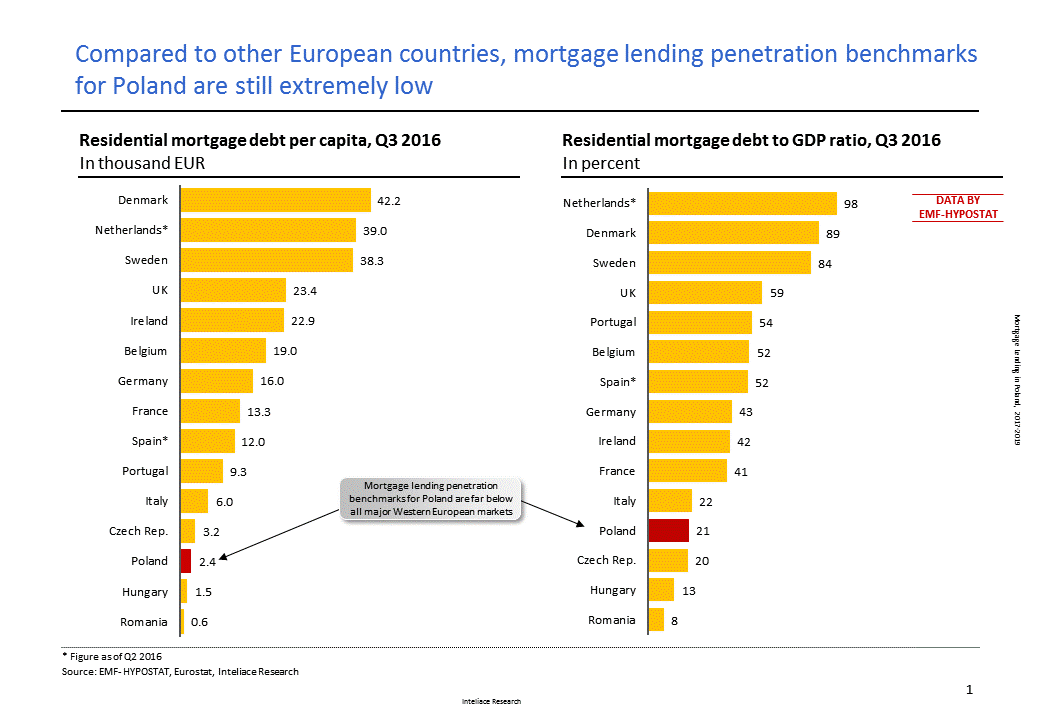
The growth in Poland's residential construction observed since early 2014 persisted throughout 2016. The number of new permits and starts increased to 212k and 174k respectively in 2016. Key driving forces of new residential construction have been record-low interest rates encouraging investment-type transactions and rising purchasing power of individuals. In 2016, average wages and salaries increased by +2.7% and the unemployment rate fell to 8.3% as of Dec. 2016 vs. 9.7% a year before. At the same time, residential real estate prices have been pretty stable with -3% to +5% YoY change as of Q3 2016, depending on location. Nevertheless, it is worth noting that housing prices are still lower by 2% to 10% if compared to 2010 levels. In contrast to strong residential construction sector, new mortgage lending by banks remained depressed in 2016. New sales of mortgage loans were almost unchanged in terms of value and they contracted by 2% if measured by volume. There are multiple reasons of weak sales of new mortgage loans by banks. One of them is higher share of buyers paying with cash, which is a consequence of increasing investment demand due to low interest rates (property for rent). Moreover, mortgage loans have been more expensive due to growing interest margins as banks have been passing increasing fees and taxes on clients. Finally, the range of mortgage lending offered by banks in Poland is still inadequate. While fixed interest rate contracts are very rare, variable rate loans, adjusted on a quarterly or half-yearly basis dominate in banks offer. For more information on recent developments in the Polish banking sector, please refer to the full publication.