
Research reports & databases
81 publications covering banking, insurance, payments, mortgage lending and asset management across Poland and Central & Eastern Europe.
Investment funds and asset management market in Poland, 2023
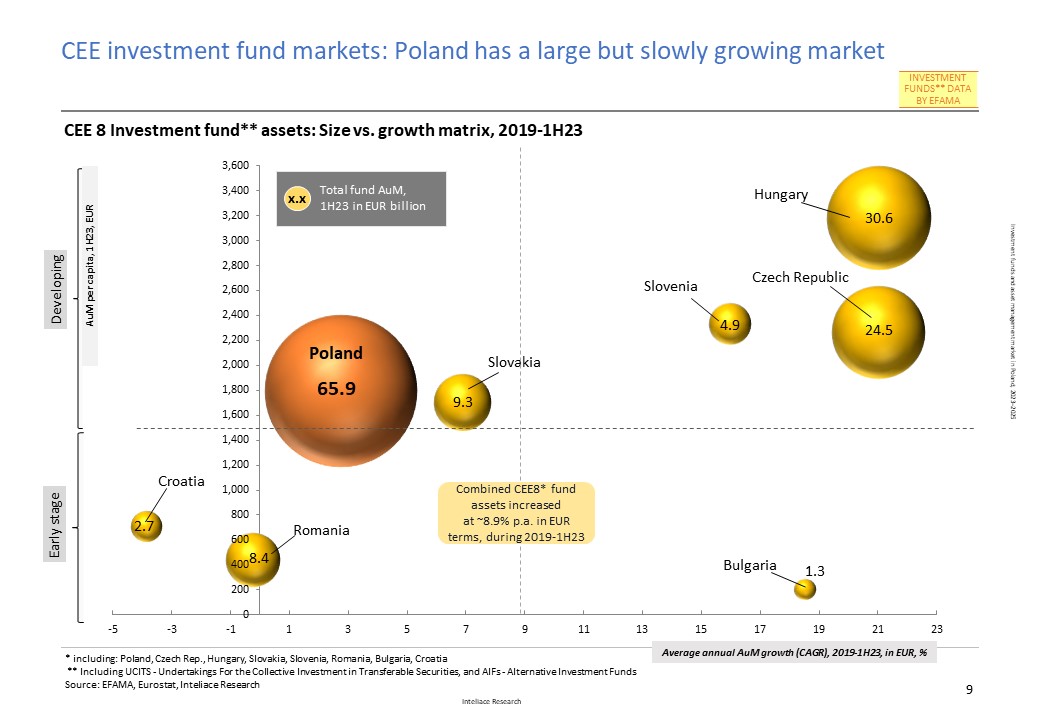
Over the last five years, the asset management sector in Poland has experienced stagnation, characterized by temporary fluctuations but lacking substantial growth in managed assets. However, 2023 brought some relief, with total assets under management in key segments* reaching over PLN 700 billion in the third quarter of the year, compared to PLN 636 billion at the end of 2022. Investment funds remained the key asset group, surpassing PLN 304 billion, followed by second-pillar pension funds with PLN 179 billion and insurance companies' reserves at PLN 162 billion. The smallest segment, third-pillar pension funds, saw a surge to PLN 60 billion in assets under management, exhibiting the fastest growth among all categories. If compared to the other markets in the region, Poland has clearly the largest investment funds sector within the CEE. However, the value of managed assets has been growing slower than in most other CEE markets recently.Consequently, despite having the largest fund market by value, Poland is still behind a few peers in terms of assets value per capita or assets per unit of GDP. The outlook The total value of assets under management in Poland is anticipated to grow by over 40% between 2022 and 2025, marking the end of multi-year stagnation. High growth is expected in pension assets, particularly within the "new" third pillar (PPK). *key categories included: Investment funds, Insurance assets, Pension assets (2nd and 3rd pillar); Excluded are bank and structured deposits, equities and bonds held directly --------------------------------------------------------------------------------------------------------------------------------------
List of Top 200 banks in Central and Eastern Europe /2023 edition/
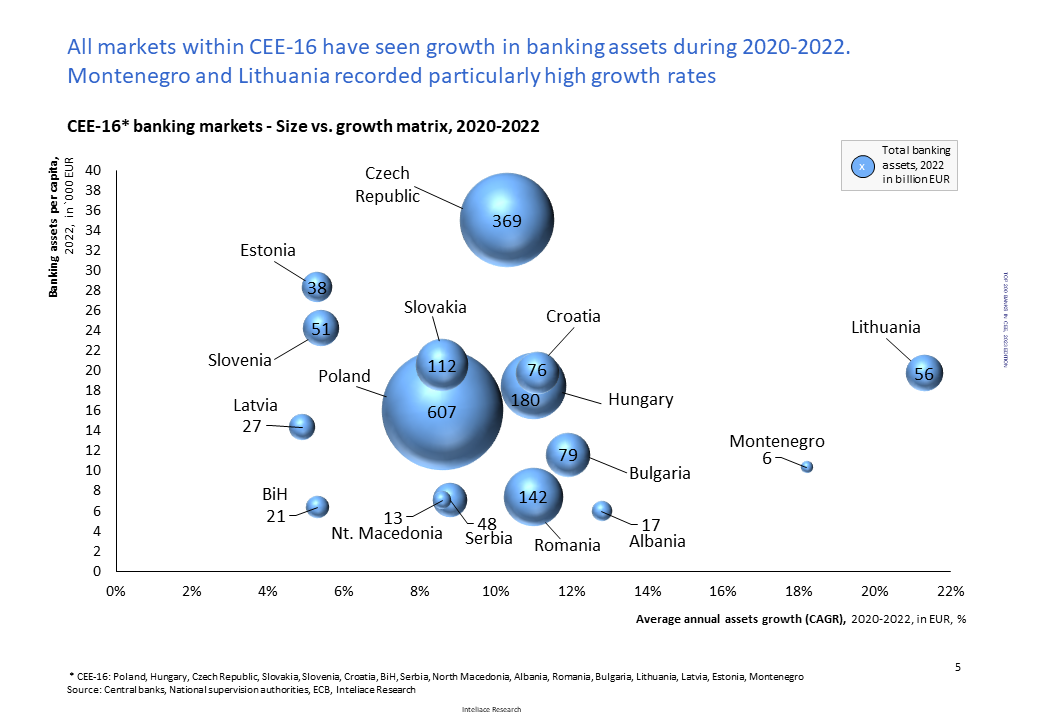
Total banking assets in CEE16* exceeded EUR 1.84 trillion as of December 2022 after growing by over 8% YoY. The year 2022 marked a robust performance for banks operating in Central and Eastern Europe (CEE16*), as the region experienced a remarkable asset growth of over 8% YoY, reaching a combined €1.84 trillion by December 2022, for 16 countries in the region. The expansion in the CEE financial sector was evident in nearly all countries within the region, with some markets like Croatia, Bulgaria, Romania, Albania, and Montenegro achieving double-digit growth rates. This recent surge in financial markets across CEE is a testament to the thriving economies, supported by healthy GDP growth and increasing individual incomes. Remembering the challenging year of 2020, when bank profits experienced a significant hit and key profitability benchmarks were more than halved, regional bankers have shown optimism with a gradual improvement in profitability since 2021. By 2022, the average Return on Assets (ROA) for the top 200 CEE banks reached 0.92%, while the average Return on Equity (ROE) was 9.9%. Although these figures are still below the levels recorded in the years 2016-2019, there is an expectation that regional banks will manage to return to their historical performance. For more info about developments in banking sectors in CEE please review the full publication. ------------------------------------------------------------------ *CEE16 include: Poland, Czech Republic, Hungary, Slovak Republic, Romania, Bulgaria, Estonia, Latvia, Lithuania, Croatia, Slovenia, Serbia, Bosnia and Herzegovina, Albania, Montenegro and North Macedonia.
Insurance market in Poland, 2023-2025
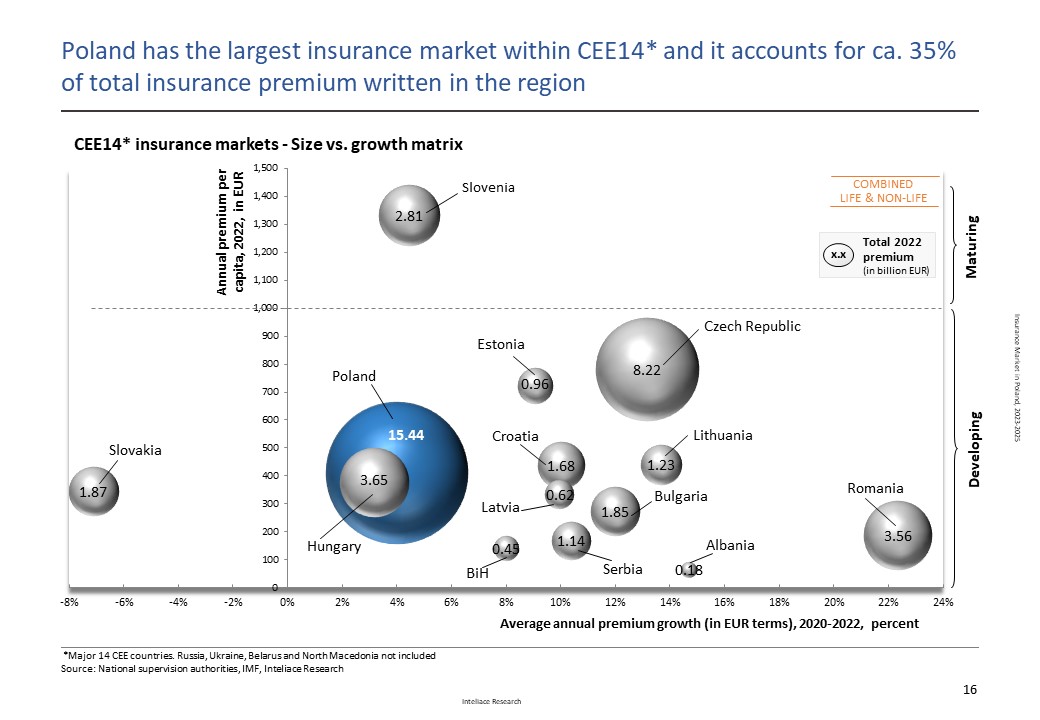
As of 2022, Poland had the largest insurance sector in CEE14 (Central and Eastern Europe*) with nearly € 15.4 billion in premium written p.a. and a 35 % share in the region. The insurance sector in Poland is undergoing a gradual evolution, with consolidation being one of key processes. Recently, a few players decided to leave the market and a number of M&A deals have been closed. Prominent transactions include the acquisition of Aegon by VIG, the acquisition of Aviva by Allianz, and the integration of MetLife by Nationale Nederlanden. Through consolidation, mid-sized insurers are able to scale up their operations and enhance profitability in the face of rising costs, required investments, and tariff pressures. Consolidation within the sector presents various benefits. It allows companies to achieve economies of scale, expand their customer base, enhance their product portfolios, and improve operational efficiency. Additionally, consolidation supports the development of stronger, more financially resilient players capable of meeting the evolving needs of policyholders. The outlook for insurers in terms of premium income is predominantly positive. By 2025, the combined premium written for life and non-life business in Poland is likely to top EUR 20 billion. However, while premium income is projected to accelerate in the mid-term, insurers' profitability is likely to stagnate. Insurers will need to make substantial investments to effectively defend their profitability. For more information on recent developments in the Polish insurance sector, please refer to the full publication.
Bank outlets in Poland, 2023
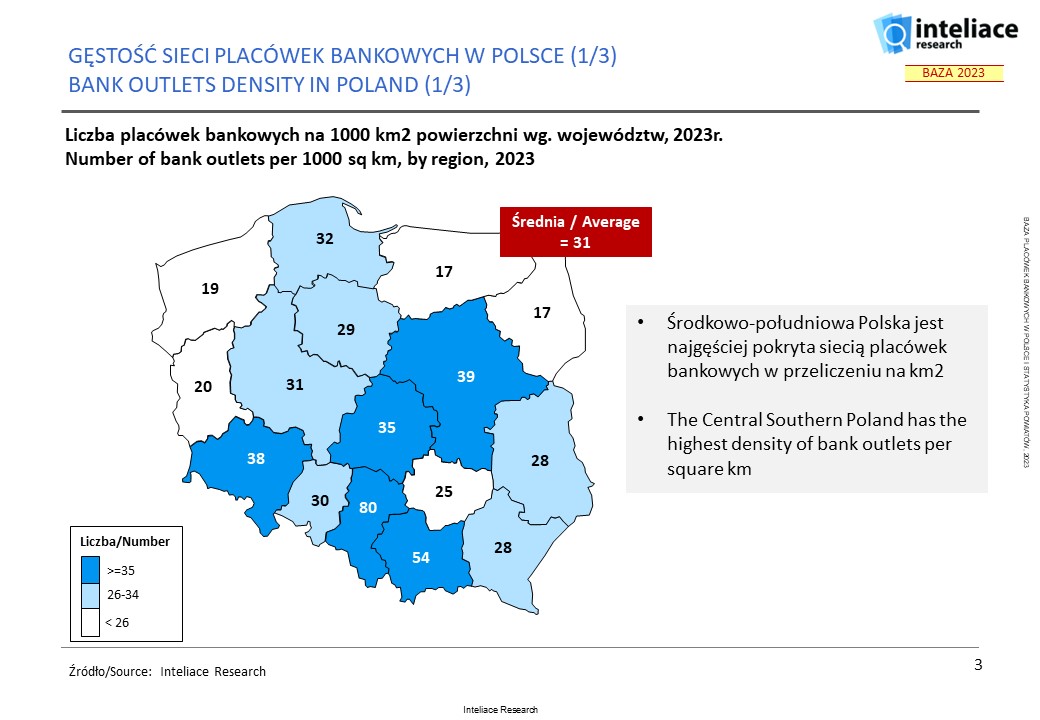
The year 2023 marked a significant milestone in the modern history of the banking sector in Poland. After more than 25 years, the number of bank outlets dropped below 10,000. According to data from the 2023 Bank Outlets Database, compiled by Inteliace Research, the number of bank outlets in Poland decreased by 425 units to 9,845 in April 2023 compared to 10,270 in April 2022. This represents a year-on-year drop of 4.1%. If calculated per capita, the ratio of individuals per single bank branch increased from 3.68 thousand to 3.84 thousand over the course of a year. Despite this decline, it is worth noting that the 4.1% annual loss in the number of bank outlets is the smallest decrease recorded in a decade. This could potentially indicate a deceleration in the rate at which banks are closing branches. While the number of branches in large and big cities remains relatively high—for example there are still 402 outlets in Warsaw, 175 outlets in Kraków, and 153 outlets in Wrocław—banking networks in smaller locations are already very limited. Banks may be hesitant to further close branches in mid-sized and small cities due to the risk of losing customers to competitors who still maintain a physical presence. Although the younger generation in Poland is embracing digital and remote banking, older people often reject electronic banking and prefer traditional services and cash payments. Therefore, catering to the needs of different customer segments might stop banks from more drastic moves, i.e. closing the last branches in smaller locations For more information on the current structure of the bank branch network in Poland please refer to the full publication/database.
Banking Market in Poland, 2023-2025
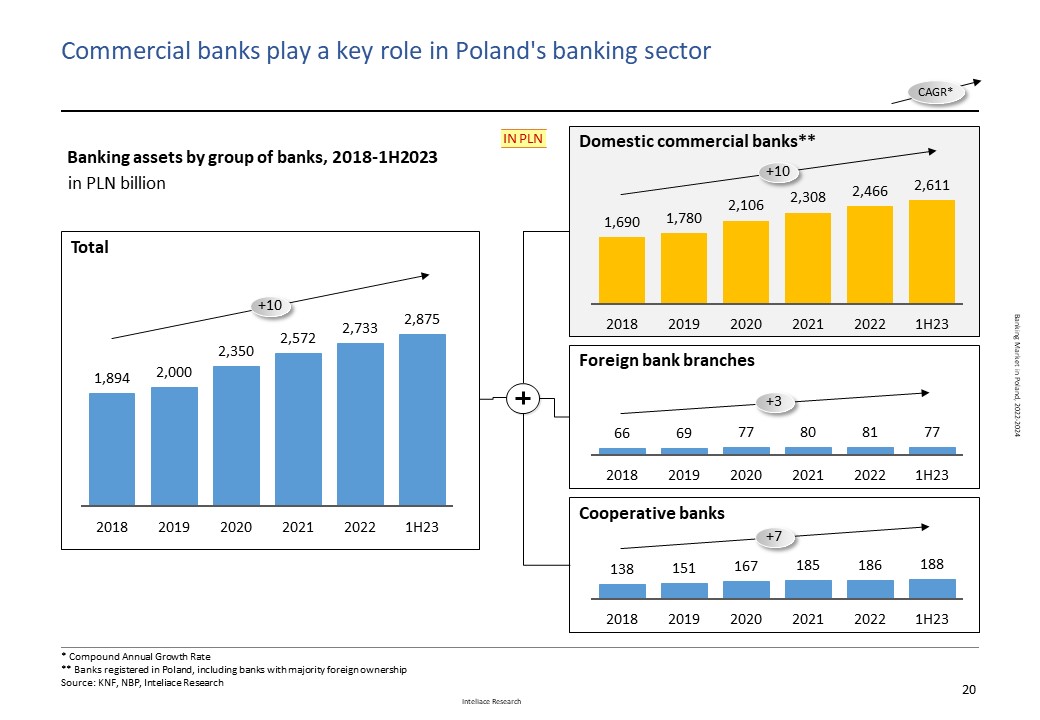
The competitive landscape within the Polish banking sector has not changed much over the past few years. The group of major commercial banks remained unchanged, concurrently increasing its market share slightly, indicating a trend toward growing concentration. Noteworthy in this context is the government-owned SPV Bank - BGK, which has ascended the top list of banks due to its exclusive rights in distributing support and lending funds from both the government and the EU. While there has been little M&A activity in the banking sector recently, an exception from this trend is Velo Bank. This institution is currently available for acquisition following a compelled restructuring and takeover by the government of the erstwhile Getin Noble Bank. The sales tender is presently open, with expectations for closure early in 2024. The surge in market interest rates, rising from zero to approximately 6.5% in 2022, had a profound impact on the banking sector. The escalating cost of money significantly influenced the new investment demand of corporations, while simultaneously limiting the capacity of individuals to secure new loans. Conversely, the notably higher interest rates, though still below inflation, spurred interest in depositing funds in banks. Consequently, overall client deposits at banks reached PLN 1.92 trillion in Q2 2023, reflecting an 11%+ change over 1½ years since the end of 2021. Concurrently, client loans experienced a contraction of over 2%, decreasing from PLN 1.29 trillion at the close of 2021 to PLN 1.26 trillion in Q2 2023. Despite many challenges, the future outlook for key banking volumes remains favorable. Total banking assets are projected to grow steadily, potentially reaching PLN 3.5 trillion by the end of 2025. For more information on recent developments in the Polish banking sector, please refer to the full publication.
Mortgage lending in Poland, 2023-2025
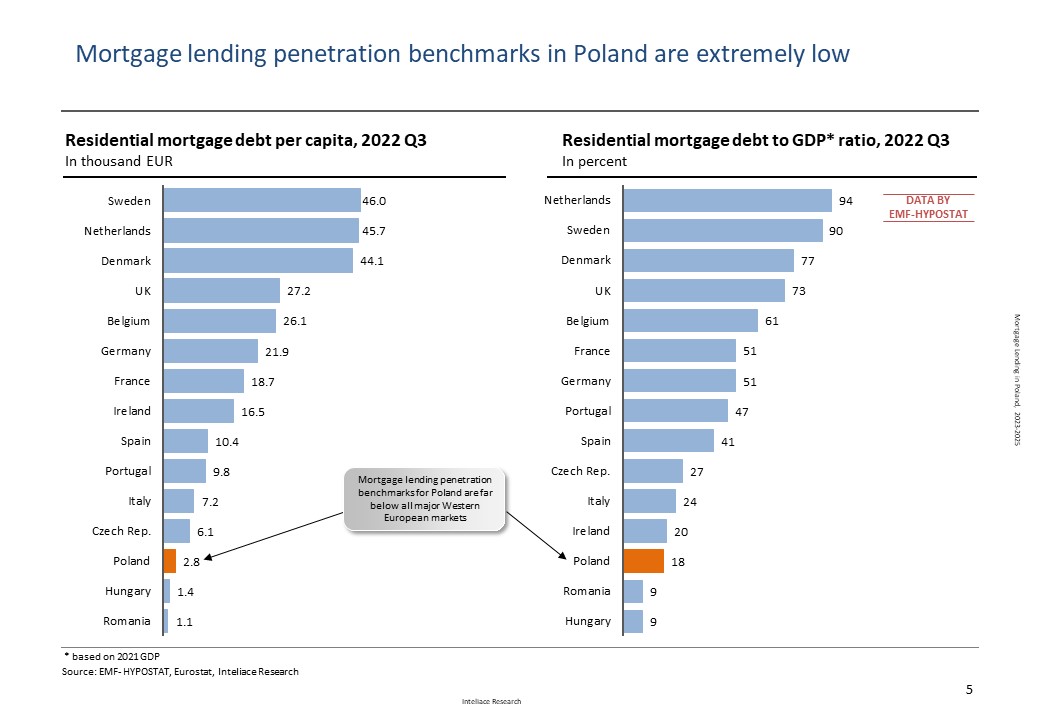
In Poland, in 2022, an abrupt decline in building starts (-28%) and new permits (-13%) was recorded. At the same time, the long-term trend of growing real estate prices slowed down visibly in the most expensive locations, such as Warsaw. An increasing number of existing homes being put on the market and more generous discounts offered by developers indicate that 2023 might see a stabilization or a slight correction in real estate prices. The rapid monetary tightening cycle of the Monetary Policy Council (RPP), which raised interest rates by nearly 7% within a year, has taken its toll on mortgage lending. Sales of new mortgage loans collapsed by nearly 75% year-over-year in late 2022. The negative momentum in the real estate market and in new mortgage lending is likely to persist through 2023. Assuming that there will be no further interest rate hikes, even the current level of rates is highly negative to new lending. The market is still far from equilibrium, and the growth in lending would require either significantly less expensive credit or lower real estate prices, both of which seem unlikely to materialize at least in 2023. For more information on recent developments in the Polish banking sector, please refer to the full publication.