
Research reports & databases
83 publications covering banking, insurance, payments, mortgage lending and asset management across Poland and Central & Eastern Europe.
Payments in Poland, 2020
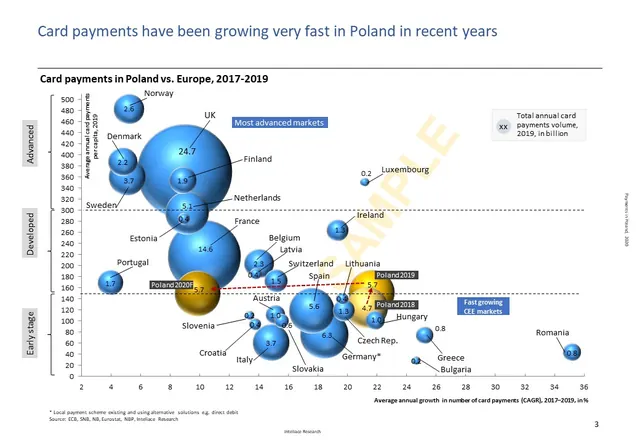
Poland's payment market had been growing fast until early 2020 when the trend came to an abrupt halt due to covid19 related business closures and highly reduced economic activity. While the total number of payments in Poland exceeded 8.8 billion in 2019, after increasing over 17% yoy, it is expected to stagnate and fall slightly in 2020. Outlook It can be expected that after the temporary stagnation in payment volumes, triggered by covid-19, the payment industry in Poland will gradually resume the growth. This will be, in particular, an effect of strong growth in eCommerce, replacing traditional, cash-intensive retail (B&M). Consequently, the very payment methods which are heavily used on the Internet are likely to benefit the most. --------------------------------------------------------------------------------------------------------------------------------------
Investment funds and asset management market in Poland, 2020
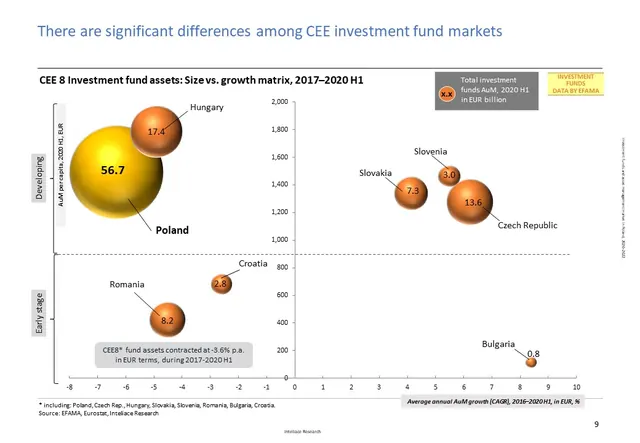
In line with trends observed in previous years, assets under management in Poland remained very volatile in 2019 and in the 1st half of 2020. Total assets* went down to PLN 588 billion in H1 2020 and this drop could be attributed to a very weak performance of equity markets impacted by accelerating Covid-19. The extraordinary situation has negatively affected all segments of the AM sector, although this was not equally visible across particular segments, in particular in the case of the 3rd pillar, where strong new inflows more than offset falling valuations. As of June 2020, assets of investment funds** contracted to PLN 281 billion, reserves of insurance companies remained almost unchanged at PLN 148*** billion, second-pillar pension funds plummeted to 132 billion, and third pillar pension assets increased slightly to PLN 27 billion. Overall, the asset management sector remained medium-concentrated with the top four groups: PZU, Aviva, NN, and Ipopema controlling over 52% of the entire market. the outlook Overall assets under management in Poland are expected to fall in 2020 but then rebound through 2022. Particularly promising will be the 3rd pillar pension segment where significant new flows will drive AuM regardless of their initial performance. The new legal framework, in force since mid-2019, has mandated employers to enrol their employees and to match employee contributions. A further boost to 3rd pillar assets will be supplied by the final dismantling of 2nd pillar pension funds, expected around 2021-2022, although this is going to be a zero-sum game for the AM sector as a whole. As far as the profitability of asset managers is concerned, the fund management fee cap is a negative element, however, fund managers will intensify their efforts to offset limited revenues by reducing operating costs, increasing the share of passive strategies, and consolidating operations (through M&A). * Across key categories: Investment funds, Insurance assets, Pension assets (2nd and 3rd pillar); Excluded are bank and structured deposits, equities and bonds held directly by private individuals ** Figures reported by the National Bank *** Technical reserves of non-life and life insurers, including unit-linked life funds as reported by KNF --------------------------------------------------------------------------------------------------------------------------------------
List of Top 200 banks in Central and Eastern Europe /2020 edition/
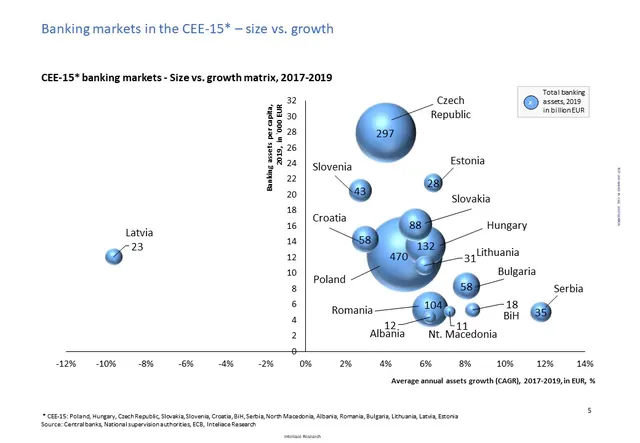
Total banking assets in CEE15* exceeded EUR 1.4 trillion in December 2019, after adding over 6% last year. Markets in the Southern part of the region including Serbia and North Macedonia have been growing most rapidly. In a few largest markets, e.g. in Poland and Czech Republic the nominal growth in assets has been boosted by appreciating currency. The profitability of major CEE banks remained almost unchanged in 2019 with ROA and ROE stabilizing at 1.15% and 10.4% respectively. The top banking groups in the region: Erste, KBC and UniCredit did not change. However, the consolidation processes continued with regional players getting stronger, e.g. OTP and PKO and a few foreign players reducing their presence in the region, e.g. Société Générale or Raiffeisen. ------------------------------------------------------------------ *CEE15 include: Poland, Czech Republic, Hungary, Slovak Republic, Romania, Bulgaria, Estonia, Latvia, Lithuania, Croatia, Slovenia, Serbia, Bosnia and Herzegovina, Albania, and North Macedonia.
Insurance market in Poland, 2020-2022
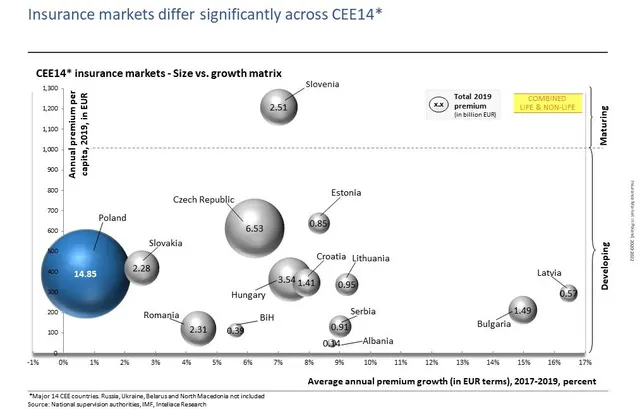
The impact of COVID-19 on the insurance sector in Poland has been noticeably across various product classes e.g. falling premium in car insurance or growing premium in property/accident insurance. However, the overall effect on the sector can be assessed as close to neutral. Premium in non-life segment remained flat in Q1-Q3 2020 if compared to the same period of the previous year. By contrast, within life insurance, premium contracted by ~3% YoY, however, the fall was not directly connected to COVID-19 but rather, it was a continuation of a long-term declining trend in life insurance-based investment products suffering from increasingly restrictive regulations. Tighter regulations are also quoted among triggers of recently observed consolidation. A few new M&A deals were announced in 2020, including withdrawal of AXA - to be acquired by Uniqa and Aegon to be purchased by VIG. Moreover, an even bigger transaction is in the cards for 2021 as Aviva considered disposing its Polish business For more information on recent developments in the Polish insurance sector, please refer to the full publication.
Bank outlets in Poland, 2020
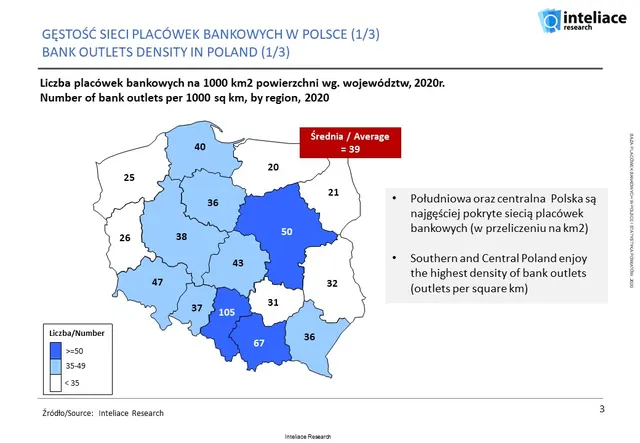
The reduction in bank outlet networks in Poland has accelerated in 2019. The total number of outlets fell by nearly 1,100 outlets (8%) last year and there were 12,315 operational bank and credit union outlets countrywide as of May 2020. The process of closing bank outlets in Poland is likely to continue in future. The contributing factors including cost optimization and change in behaviour of clients are likely to be reinforced by COVID-19 induced drop in frequency of branch visits. For more information on current and historical developments in bank branch networks in Poland please refer to the full publication/database.
Banking Market in Poland, 2020-2022
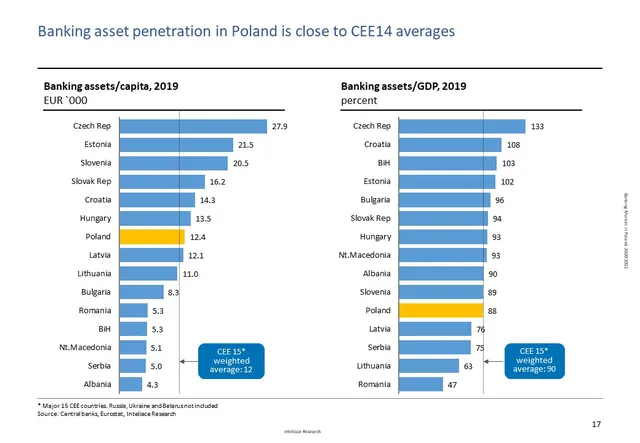
Banking volumes have continued to grow steadily during 2019 and Q1 2020. Deposits of non-financial clients at banks reached PLN 1.43 trillion after a 5% jump in Q1 2020 while client loans increased to PLN 1.26 trillion in Q1 2020, recording a 4% QoQ growth. The recent change in key volumes was balanced across all client segments. However, faster growth in deposits than in loans resulted in increasing liquidity within the sector. Total banking assets followed positive trends in client segments and they exceeded PLN 2.1 trillion as of March 2020. In terms of profitability, banks operating in Poland recorded a 9% jump in bottom line to PLN 14.2 billion in 2019 or a 9% YoY growth. The ROAA* and ROAE* benchmarks improved by a fraction to 0.73% and 6.88% respectively, in 2019. Nevertheless, this highly favourable outlook has been reversed in Q1 2020 when the Monetary Policy Council (RPP) started a new easing cycle. The dramatic shift in monetary policy in Q1 2020 combined with a weakening economy has created significant challenges to all banks operating in Poland. The series of interest rate cuts of 140 bp in Mar.-May 2020 alone is estimated to wipe ca. 33% of bank profits in 2020. Moreover, the predicted growth in regulatory charges, taxes and increased credit risk, will further cut into earnings. As a consequence, the bottom line of banks is likely to drop by over 50% in 2020 vs. the year before. This will be a major shock for banks as the over decade long period of stable profits has come to an end. Consequently missing profits will create a growth barrier for banks with thin equity buffers. For more information on recent developments in the Polish banking sector, please refer to the full publication.
Mortgage lending in Poland, 2020-2022
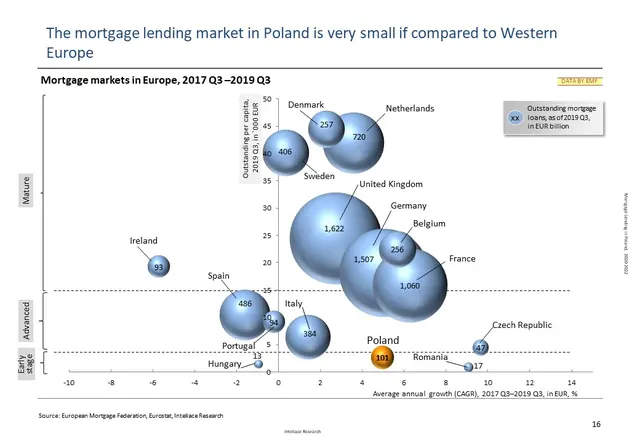
Residential construction in Poland sustained fast growth in 2019. The number of completions surged by nearly 12%, while the number of starts jumped by almost 7% in 2019. Recently, residential real estate has become increasingly popular among investots due to growing rents and a higher demand for rental properties. The boom is reflected in growing valuations, in particular, across large cities where prices are at multi-year highs. The growth in demand for real estate is also fuelled by negative real interest rates, which discourage individuals from holding bank deposits and which promote material investments, offering preservation of purchasing power. Mortgage lending accelerated in 2019. Sales of new contracts surged to over PLN 62 billon (EUR 14+ billion). Looking forward, in our base scenario, we expect new mortgage lending to cool-off slightly in 2020 but then to resume the solid growth in 2021 and 2022. For more information on recent developments in the Polish banking sector, please refer to the full publication.